

Analysis: The current wave of food price cuts should be viewed as a marketing move rather than the start of widespread reductions by all supermarkets
At first glance, recent price cuts by large retailers looks like the potential beginnings of a price war. SuperValu cut prices on 500 products, after which Aldi, Lidl and others quickly follow suit. Milk, bread and other staples are suddenly cheaper, while headlines talk of a grocery price war spreading across Ireland.
But if you take a closer look at the strategy, a different picture emerges. What we are witnessing is not a supermarket price war in the classic sense, but a carefully managed competitive adjustment designed to change perceptions rather than fundamentally reshape prices.
We need your consent to load this rte-player contentWe use rte-player to manage extra content that can set cookies on your device and collect data about your activity. Please review their details and accept them to load the content.Manage Preferences
From RTÉ Radio 1's Morning Ireland, is there a supermarket grocery price war coming? RTÉ Consumer Affairs Correspondent Aengus Cox looks at the rising number of supermarkets cutting the price of milk
SuperValu's announcement that it is cutting prices on more than 500 products is significant, but its motivation matters. As retail analysts have noted, the move is best understood as a market-share defence strategy by its owner, Musgrave Group. SuperValu’s market share has slipped below 20%, while Lidl Ireland has steadily closed the gap. Internal performance measures in the Musgrave Group will be bringing up red flags at this drop.
In this context, broad-based price cuts serve two purposes: they challenge the perception that SuperValu is more expensive than peers, and they attempt to stem customer drift to discounters. Rivals, operating on already thin margins, have little incentive to replicate a 500-product reset unless forced to do so by visible losses in market share. The timing is also opportune as retailers target cash strapped and cost-conscious consumers in the post-Christmas period.
Why the price of butter, milk and bread matter so much
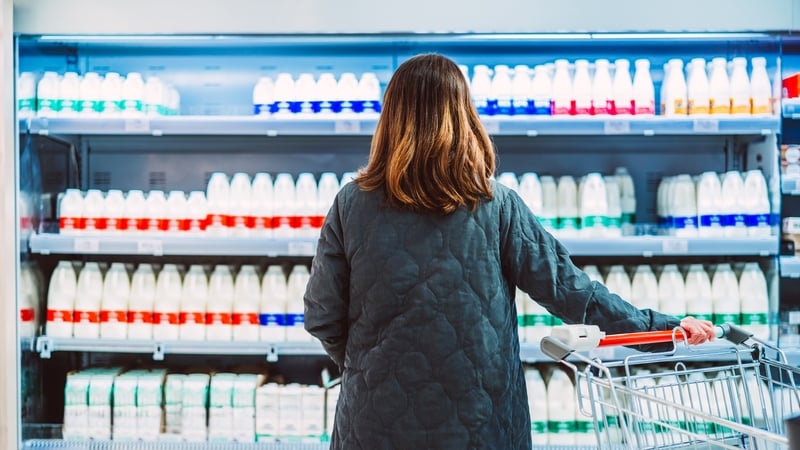
The flurry of activity around butter, milk and bread is not accidental. These are "known value items", products consumers buy frequently and remember prices for. This is similar to how we remember the price of fuel, and act as a price milestone for these items. Cutting them sends a powerful signal, even if the absolute savings are small. That is why we saw near-identical butter prices appear almost overnight across Aldi, Lidl, SuperValu and Centra.
We need your consent to load this rte-player contentWe use rte-player to manage extra content that can set cookies on your device and collect data about your activity. Please review their details and accept them to load the content.Manage Preferences
From RTÉ Radio 1's Drivetime, Irish Times consumer affairs reporter Conor Pope on why supermarkets are cutting the price of butter
This kind of price matching has long been a feature of the Irish grocery market as it reassures shoppers that no one retailer is out of line, while avoiding destructive undercutting. Crucially, all of these cuts are concentrated on own-brand goods, where retailers have maximum control over pricing and margins. Branded goods remain largely untouched. This approach will likely not encourage shoppers to switch retailers, but may encourage them to make in basket substitutions for own-branded goods.
Why this still doesn’t add up to a price war
True price wars are brutal and are typically signalled by a new entrant or a determined attempt to significantly increase market share. Firms sacrifice profits to gain a greater market share, hoping rivals blink first. However, that dynamic is largely absent here. Irish supermarkets operate on some of the lowest margins in Europe, a point repeatedly highlighted by the Competition and Consumer Protection Commission, and that reality acts as a powerful brake on escalation.
Even where prices have fallen, the impact on household budgets is limited. A family saving on milk, bread and butter might gain €60 or so over a year. This is welcome, but easily wiped out by ongoing grocery inflation, which remains elevated at around 6% according to Kantar Worldpanel. Context matters too: butter is still significantly more expensive than it was in 2021. Recent cuts are best seen as partial reversals, not a return to pre-inflation norms.
We need your consent to load this rte-player contentWe use rte-player to manage extra content that can set cookies on your device and collect data about your activity. Please review their details and accept them to load the content.Manage Preferences
From RTÉ Radio 1's Today with Claire Byrne in July 2025, should supermarkets operating in Ireland have to publish their profits?
The public responses from competitors are telling. Lidl points to earlier milk cuts. Aldi says it has already reduced prices across hundreds of products. Tesco stresses loyalty schemes and price matching rather than headline reductions. In other words, everyone is keen to be seen as competitive, but no one wants to light the fuse.
The real trigger for a genuine price war would be clear, sustained shifts in market share, rather than a burst of coordinated cuts on staples or a one-off 500-product announcement. Until that happens, restraint remains the dominant strategy. However, it will be interesting to watch the approach of incoming Musgraves CEO Niall Anderton from May.
So what are we really seeing?
What looks like a price war is better understood as competitive choreography. This consists primarily of visible cuts on headline items, rapid price matching, heavy emphasis on "investment" language and strict limits on how far reductions go. For consumers, that means some relief at the till, but no dramatic fall in grocery bills. For supermarkets, it reflects a delicate balancing act, responding to cost-of-living pressures without undermining already thin margins.
In short, this is not a war, but a controlled skirmish, and one where everyone is watching carefully to make sure it doesn’t turn into something more expensive. In the near-future, we are likely to see price cuts contained to own-brand goods and staples with no retailers having the appetite to engage in a full-scale price war.
Follow RTÉ Brainstorm on WhatsApp and Instagram for more stories and updates
The views expressed here are those of the author and do not represent or reflect the views of RTÉ