

Analysis: from frosty 1338, when Dubliners played football on the Liffey, to the epic snow of 2010, fierce weather conditions often hit Ireland over Christmas
It is Christmas time, and you are probably staying up to date with the latest weather forecast for the festive season. You may be busy running errands and organising the celebrations, travelling to meet friends and family, preparing to volunteer at a charity event to support vulnerable communities, or switching off and taking a well-deserved break elsewhere. Given the weather's changeability, people in Ireland are obsessed with keeping up with the weather forecast, and it dominates many conversations.
Especially in the Northern Hemisphere, Christmas cards and illustrations, fairy tales, ads, and overly familiar songs and films repeated year after year on the radio and television, depict Christmas as a nostalgic time when landscapes are painted with white snow, people are wrapped up in warm clothes, children build snowmen and engage in mischievous snowball fights, showcasing happiness and hope. The idea of a White Christmas has also been immortalised in literature, notably by Charles Dickens, whose A Christmas Carol was published in 1843.
Prolonged and severe cold waves occurred during the Little Ice Age, typically described as spanning from the early 14th to mid-19th century, as highlighted in palaeoclimate, instrumental and documentary records. The various Irish Annals contain the oldest descriptions of extreme weather events in Ireland.
We need your consent to load this rte-player contentWe use rte-player to manage extra content that can set cookies on your device and collect data about your activity. Please review their details and accept them to load the content.Manage Preferences
From RTÉ Archives, a blizzard hits Ireland in December 1962
Uncommon ice and great snow were reported from Christmas 815 to Shrovetide of the following year by the Annals of Four Masters. In the same century, from December 855 to the ides of January, an extraordinary snow and frost resulted in the main rivers and lakes of Ireland being crossed on foot by men and laden horses according to the Annals of Ulster. This source indicated great snow from December 1047 to the festival of Patrick the following year, with a grandeur unknown, resulting in the deaths of people, cattle, and wild animals.
In the years 1234 and 1235, a great snow followed by a pronounced frost enabled men and loaded horses to traverse the main rivers and lakes of Ireland as described by the Annals of Ulster, Annals of Connaught and Annals of Kilronan. A great snow also marked the Christmases of the years 1245 (Annals of Connaught), 1278 (Annals of Ulster), 1278 (Annals of Connaught), and 1285 (Annals of Clonmacnoise) - the latter was succeeded by scarcity.
An extraordinary frost prevailed from December 2nd 1338 to February 10 1339, denoted by the magnificent depth of snow and depth of ice in the river Liffey, enabling people to run, play football, dance and even set wood and turf fires to broil herrings as narrated by Camden's Annals. The Annals of Ulster stated that a great frost began five weeks before Christmas 1434 and persisted for seven weeks after, severe enough to allow people and horses to cross the main lakes of Ireland.
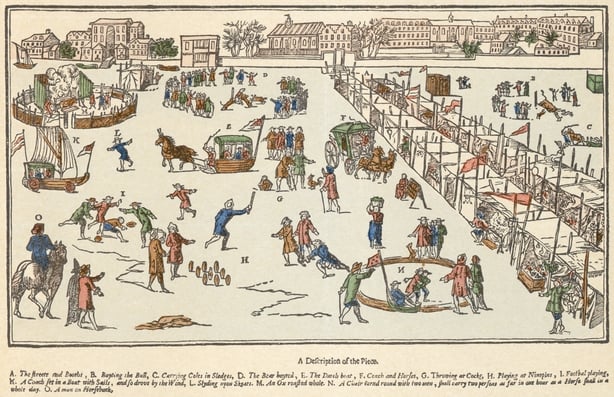
The Great Frost of 1683-84 was one of the most severe cold periods on record in Europe. Frost fairs on the frozen tideway of the River Thames during this period have been widely described in the literature and illustrated in paintings. The frost lasted from November to March and caused a "prodigious number of poor starved to death in Germany, France, Holland, Britain, and Ireland" as noted by the Saunders's News-Letter of January 7th 1784.
According to the Journal of the Chemico-Agricultural Society of Ulster, published on September 7 1863, the winter of 1683-84 is "recorded as being of great length and severity. The River Lee was frozen for many weeks at Cork, so hard that carriages passed on the ice from Ferry Slip to East Marsh. The frost on the Shannon, and generally throughout the island, was unprecedently intense." James Ferrar, in the History of Limerick, published in 1787, noted that the River Shannon had an ice thickness of seven or eight feet, with carriages and cattle frequently crossing the river from King’s Island to Parteen during the Great Frost of 1683-84.
The Great Frost of 1739-40, which started in late December and lasted until mid-February, was one of the most severe winters on record. Several anecdotal accounts described rivers and lakes frozen over, allowing festivities on ice. The Ulster Star of December 24 1997, mentioned that "carnivals, banquets and sheep-roasting on ice were held at many venues across Ireland. Even Lough Neagh is reputed to have completely frozen over and it is reported that people walked from the Tyrone shore side of the lough across ten miles of ice in order to get to Antrim market."
Read more: A short history of destructive Irish storms
In Dublin, "crowds walked on the Liffey, fires were made on it, and joints of meat roasted for the people" according to the Carlow Nationalist of April 23 1892. Nevertheless, a period of scarcity and distress followed due to crop failures, the loss of livestock, and the halt in the transport of goods and fuel. Due to the lack of available coal, many people sought out a fuel alternative by stripping gardens and parks, such as the Phoenix Park in Dublin, as described by the Evening Herald of December 6 2003. These conditions contributed to the famine in 1740-41, also known as Bliain an Áir, or the Year of Slaughter, characterised by mass deaths from starvation and fatal diseases.
The winter of 1813 – 1814 was severe, characterised by an intense frost and snow that began on Christmas 1813 and persisted until the end of March 1814. Samuel M'Skimin in the History and Antiquities of the County of the Town of Carrickfergus stated that "Lough Neagh and the sea between the counties of Down and Antrim were frozen over".
Adding to the non-exhaustive list of records of cold Christmas distinguished by a great frost or snow and remarked in weather diaries and newspapers, such as in the years 1728, 1740, 1784, 1787, 1829, 1830, 1859, 1860, 1864, 1869, 1870, 1878, 1886, 1891, 1906, 1914, 1935, 1938, 1939, 1961, 1962, 1995 or 2000.
We need your consent to load this rte-player contentWe use rte-player to manage extra content that can set cookies on your device and collect data about your activity. Please review their details and accept them to load the content.Manage Preferences
From RTÉ Archives, John Kilraine reports for RTÉ News on how people were dealing with the arctic conditions which made December 2010 the coldest month ever recorded in the country.
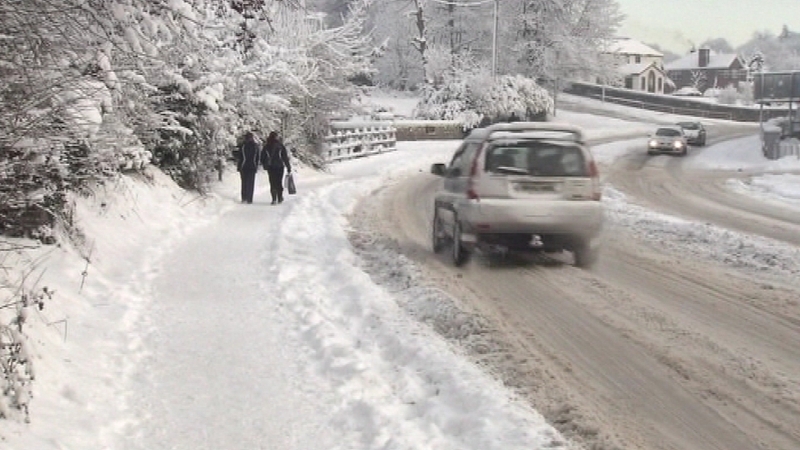
Regarding more recent events, a well-known White Christmas in the memories of many took place in December 2010, causing severe disruption. The lowest minimum air temperature of -17.5°C in December was recorded at Straide, Co. Mayo, on Christmas Day. On the same day, 27cm of snow depth was registered at Casement Aerodrome.
In Ireland, a cold period of several days can occur with the extension of a high-pressure system, associated with easterly polar continental airflow, thereby blocking the progression of low-pressure systems and weather fronts towards Ireland. Severe cold waves in Ireland, such as the winter of 2010, have been associated with strong and persistent negative phases of the North Atlantic Oscillation and Arctic Oscillation. Cold waves can follow shortly after a sudden stratospheric warming event, which is characterised by a rapid increase in air temperature in the polar stratosphere, disrupting the polar vortex and shifting winds from westerly to easterly, leading to cold air descending and impacting mid-latitude weather.
We need your consent to load this rte-player contentWe use rte-player to manage extra content that can set cookies on your device and collect data about your activity. Please review their details and accept them to load the content.Manage Preferences
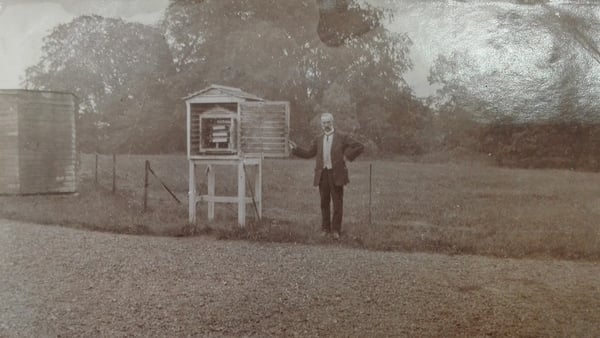
From RTÉ Brainstorm, where did all the historical Irish weather records go?
Examples of additional extreme events include the Christmas Eve storm in 1997, which caused significant damage and disruption, with Munster and South Leinster recording the highest wind speeds, although other parts of Ireland were also affected. According to Met Éireann, the highest sustained (10-minute mean) of 126km/h was registered at Roches Point in Co. Cork. In 1998, Ireland was battered by Ex-hurricane Stephen on Stephen’s Day with the highest gust of 178km/h registered at Malin Head in Co. Donegal. Impacts of these storms included structural damage, fatalities, power outages and trees blown out.
Storm force winds and flooding hit Ireland at Christmas 2013. In 2015, Storm Eva battered Ireland over Christmas, leaving many homes without electricity. On Christmas Day 2021, heavy rain and flooding affected the southeast, particularly Co. Wexford and South Wicklow. A bridge collapsed at Wilton, Bree, in Co. Wexford following the flooding event.
Will the Christmas illustrations and cards by the end of the century still evoke a cold and white Christmas, or will they reflect a warmer future climate?
Assessing documentary sources on the impacts of extreme weather events is essential to reducing vulnerabilities, enhancing emergency response, and increasing resilience to future extreme events. A project focused on assessing the impacts of extreme air temperature events derived from documentary sources is being carried out at Maynooth University.
The analysis of long-term winter air temperature trends highlights a statistically significant decrease in frost days, cold days, as well as a statistically significant increase in warm days and warm nights and warming of the coldest day and coldest night. In Ireland, snowfall is projected to decrease between 31% and 84%. How will the Christmas illustrations and cards look by the end of the century? Will they still evoke the nostalgia and storytelling of a cold and white Christmas, or will they reflect a warmer future climate?
Follow RTÉ Brainstorm on WhatsApp and Instagram for more stories and updates
The views expressed here are those of the author and do not represent or reflect the views of RTÉ