


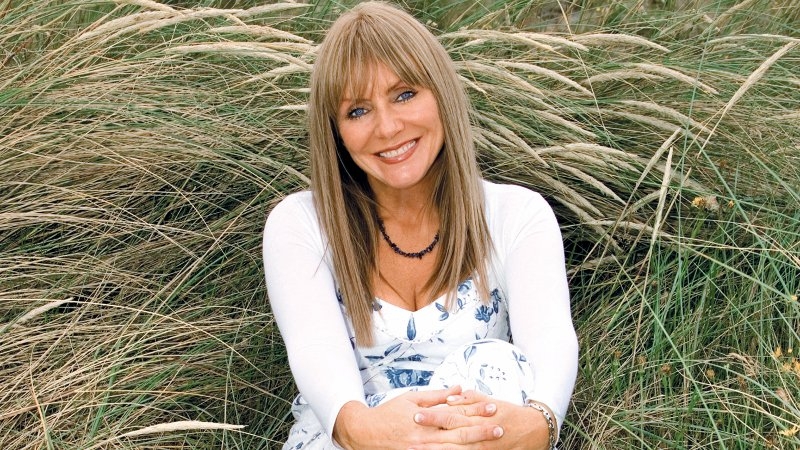
Three years ago, Frances Black founded an organisation that was to change people’s lives, not least her own. Donal O’Donoghue talks to the singer/songwriter about living with addiction
Frances Black is changing footwear when we meet – high heels for boots – the latest pitstop in a hectic week. The previous night her book, You Are Not Alone, was launched and now she’s getting ready for an appearance on The Daily Show. “Oh God”, she says, as she wrestles with zips and skinny heels and yet another deadline. She raises her eyes to heaven.
It’s Wednesday and she’s midway through an awareness week for the RISE Foundation, an organisation Black founded in 2008 to ‘support families with loved ones in addiction’. A key part of the campaign is the book in which she compiles the addiction stories of celebrities (Ben Dunne, Paul McGrath, Mary Coughlan) as well as regular folk. Frances Black stopped drinking in 1988 and overcame an addiction to sleeping tablets a dozen years later. Today, the 50-year-old singer burns with a new fire.
The story of RISE is Black’s story; her recovery, her work as an addiction therapist and her dedication to the families of addicts. “Everything that has happened to me has happened for a reason”, she says. “I have never been happier than I am at this moment in my life. My body sometimes is not able to keep up with my passion but I’ve never felt more focused. My kids are in good health, I have a strong relationship with my husband, Brian, and my recovery is strong. I’m very grateful each night when I put my head on the pillow that I have no substance in my body.”
Frances Black’s story is well known. A member of the famous traditional music troupe, the Black Family, she went on to become a singer and songwriter in her own right. But long before that, addiction was stalking her. She was just 13 when she took her first drink. “I can remember the warm feeling that you get that first time”, she says. “I remember thinking ‘that’s it, this is what I have been looking for.’ It was a nice feeling, relaxing. You think this is it, sorted, but the reality is the opposite. It’s false and it’s not the reality. My experience now of working in the field of addiction and seeing the devastation that it causes is so heartbreaking.”
By the age of 25, Black had two young children (Eoghan and Aoife), was living in a one-room flat and her marriage was over. She says that she was never at rock bottom, but the seeming normality of her life was itself a curse. Most evenings, she sat down with a bottle of wine. Most evenings she’d finish it. Drink was part of her life. It was only after she read an article by a journalist, describing her own booze-fuelled lifestyle, that Black recognised the signs. “I wanted to stop and I was very lucky that I saw that article”, she says. “But that wasn’t rock bottom for me. Rock bottom was the second time round when I started on the sleeping tablets and I didn’t know what was wrong with me. I was lost then.”
In 1988, she stopped drinking. She contacted The Sanctuary on Dublin’s Stanhope Street, told them she didn’t want to drink any more (“I didn’t like that feeling of powerlessness”) and took the first step on the road to recovery. “My life took off then”, she says. “I didn’t plan any of it. I was a Mammy with two kids trying to get through life and suddenly I was asked to join the band Arcady and then Kieran Goss and I started singing together. We were offered a record deal. Then some of our tracks were included on the album, A Woman’s Heart. Next thing, I released my first solo album. It all came knocking on my door. In our family, Mary was the singer. Sure I was with the Black Family but I had to fight to get in there.”
Frances, the youngest of five, grew up in Dublin’s south inner city. Spoilt? She shakes her head. “No, my eldest brother Shay did spoil me but the rest of them killed me”, She laughs. “But that was OK because I was a bit of a whinger.” When she left school at 15, she figured her cards were already marked. “I had a nun in fourth class who beat it into me that I was stupid”, she says. “It was beaten into me that I would never learn. I found it very hard to concentrate in school.” So she mitched from class. “I was a bit of a loner back then. I don’t remember much about the alcohol in my teenage years, I just remember the crippling shyness. I met my first partner when I was 16. We were too young. I had two babies by the time I was 21 and a broken marriage by the time I was 25. When I had my son, Eoghan, I grew up very quickly.”
In 2000, she was prescribed painkillers but became addicted to them. Within three months she was back on a slippery slope. “One day I took some sleeping tablets and during a blackout I took a drink – there was alcohol in the fridge. That was it. I knew then that something was not right. I asked my husband Brian for help. It’s very difficult for an addict to ask for help and also be ready to go into treatment.” She checked herself into a treatment centre in Co Kerry and kicked the habit. Other challenges lay ahead. In 2004, she went back to school. “One of the scariest things I ever did in my life”, she says. “I was petrified.”
But it was something Black had to do. Her mother, Patty, who had died the previous year, had left a small sum of money to each of her five children. Frances decided to do something with that legacy, “that would make my mam proud.” So she decided to go back to college, to study for a diploma in Addiction Studies at the Addiction Training Institute (ATI) at All Hallows in Dublin. “It was really challenging but I knew that she would be walking behind me as I walked in the gates of the college”, she says. She subsequently trained as a therapist at the Rutland Centre and then worked at the treatment unit. Black realised that a support network was needed for the families of addicts.
From there, the RISE Foundation emerged. “When you mention addiction, the first thing you think of is the person in addiction, whereas I wanted it to be just about the families and their recovery”, she says. “Yes, it causes the person in addiction devastation, but they are in a haze of oblivion, but the family are not, they are watching their child or their husband or their wife or whoever, going down this road. They know that they are losing them but they can’t stop it. That powerlessness can drive you insane.”
For the past few months, Black has worked like a demon on the book, on the album and on the publicity trail. “I have a fire in me belly”, she says. “I swear that if I drop down dead, at least I died trying and fighting to get this done for the families.” Her big ambition is to open a dedicated centre on Rathlin Island – her father Kevin’s birthplace and her childhood summer retreat. It will cost €1.5 million to complete, but she’s determined to see it through. The addictive personality that once took her to dark places, is now showing her another path. For Frances Black there’s no turning back. May the road rise with her.
