


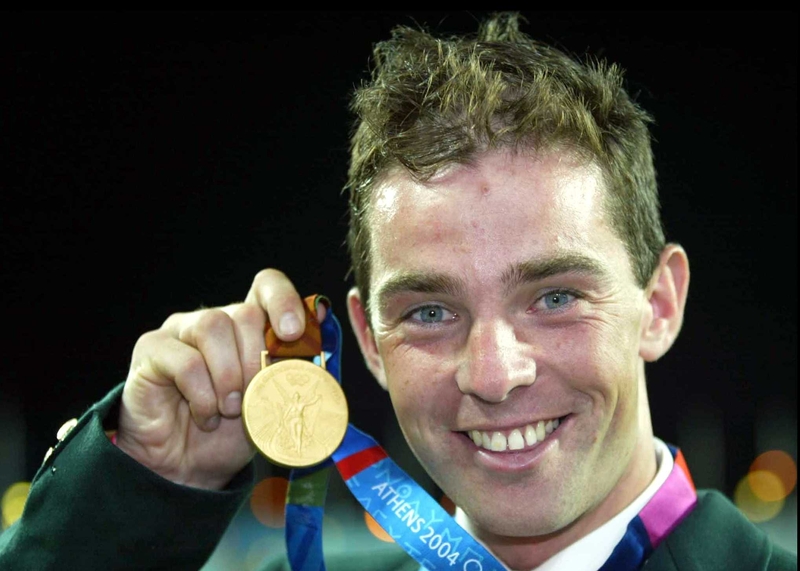
Ireland's Olympic gold medallist Cian O'Connor has again vehemently denied he is a cheat, after it was revealed that another of his horses, ABC Landliebe, had tested positive for a banned substance.
The sport's governing body, the Federation Equestre Internationale (FEI), last week informed O'Connor that Waterford Crystal, the horse the 24-year-old rode to Olympic glory at the individual show jumping event in Greece, had failed a doping test at the Games.
The County Kildare rider denied any wrongdoing when the story initially broke last Friday, claiming that the positive test had resulted from the administering of a sedative to the horse to treat a fetlock injury a month before the Olympics.
However, O'Connor's failure to mention the case of the other horse last week has again cast suspicion over his credibility.
Landliebe, the mare that provided O'Connor with a string of speed class wins this season, tested positive at the Italian Nations Cup show in Rome last May.
Asked on RTÉ's Morning Ireland radio programme if he had cheated, O'Connor replied: "Absolutely not." "I have nothing to hide, I have pushed for four years solid trying to get good publicity for the sport and for myself. I'm not going to run from anybody now and I'm willing to stand up and talk to the press," he added passionately.
O'Connor and his vet, James Sheeran, claimed that the Rome test failure also resulted from the administering of the same sedative given to Waterford Crystal, and not from treatment for colic, as he had initially told the FEI.
"Originally, I got the notification about Landliebe – and this has to be very clear – on the 30th of July," O'Connor said.
"Mistakenly, I thought it was colic. It was only last Thursday - when I went into the federation at 3 o'clock – that they gave me the information pertaining to my Olympic horse.
"They presented me with the final sanction from Rome and it was then that the penny dropped and I said 'it's the same thing', it's the same substance in both horses, I misunderstood it, it wasn't the colic.' It might sound confusing, but it's the truth."
O'Connor continued: "When I got the original result, it never registered with me that it could be something that the vet had given over a month in advance of competition.
"I mistook it to be the treatment (for colic) that the horse had got on the way to Rome, which obviously turned out wasn't testing positive. And it's only because I've had time to look at the whole situation in the last three days that I'm coming forward."
How a sedative could have showed up in the tests after being administered a month before competition is an issue that has, so far, baffled many experts in this case. Sedatives should clear out of a horse's system within 10 to 14 days.
However, Sheeran maintained that he believes that the tests have become increasingly sensitive.
"Why hasn't it showed up before? It is a first for me, it's a first for Cian. They have become so paranoid that they're scanning for particles, nanograms. Prior to this it was totally irrelevant. It's a question of sensitivity at the moment."
O'Connor again reiterated his disbelief that the sedative, which he and Sheeran are currently refusing to identify, had put his medal in jeopardy: "I would have never of thought that something that the vet had given over a month before competition was going to test. It wasn't a risk. James had used this on my horse, on other horses over the last seven years. It was never a hassle."
O'Connor also denied that the sedative may have been administered as part of the illegal practice of rapping. This cruel tactic, believed to be widely practised within the sport, involves sensitizing the horse's legs in the hope that the excessive pain it feels when it hits a fence will make it jump higher the next time it approaches a fence. Sedatives may then be given to the horse to calm it down, if it has become over-agitated by the treatment.
Sheeran claimed he did not know what the process of rapping involved. He added: "I can categorically state that Cian's horse management is second to none. He absolutely adores his horses and their welfare is not something that can ever be put in question."
O'Connor also insinuated that some members of the Irish equestrian community could be involved in a smear campaign against him. "Charlie Bird said earlier on in this interview that he got a tip-off and started to phone around. I've a lot of good pals in the sport but there are also a lot of nasty people out there."
O'Connor was part of the camp that opposed Eddie Macken's instalment as trainer of the Irish Olympic equestrian team prior to the Games. The Equestrian Federation of Ireland initially appointed Lieutenant Colonel Gerry Mullins as the team's trainer, however, after a protracted row, Macken ended up with the job.
If Waterford Crystal's B sample is positive, Ireland will lose its only medal of the 28th Olympiad. It's expected that the results of the B sample will be made public in about three weeks, after which O'Connor will be given 10 days to prepare a case to present to the judicial committee of the FEI.
If the FEI find him guilty, O'Connor then has the option of appealing to the Court of Arbitration for Sport (CAS).
