|
|
 |
|
 |
Irish Public Service Broadcasting - 1950s |
 |
 |
  |
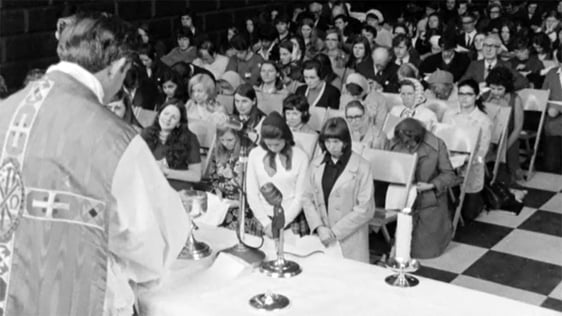
Pro-Cathedral, Dublin
Photograph taken: 1969
© RTÉ Stills Library |
 |
|
Angelus First Broadcast: 15 August 1950
Following a proposal by Archbishop McQuaid to mark Holy Year, the Angelus daily broadcast was inaugurated on 15 August 1950, the Feast of the Assumption.
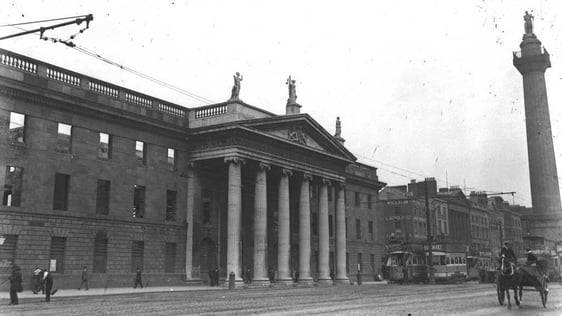
The broadcast required three underground lines connecting a 'programme clock' and time-switch in the GPO to a microphone, amplifier and striking gear in the Pro-Cathedral. To ensure accuracy in the timing, the programme clock, which activated the striking of the bell, took its time from the GPO's master clock, which was itself controlled by Dunsink Observatory. The equipment was designed by J.D. Ferguson, an engineer at the Department of Posts and Telegraphs.
Full story...
|
|
|
 |
  |
'The Pilgrim Road to Rome'
Script by P.P. O'Reilly
1950
© RTÉ |
 |
|
Mobile Recording Unit Travels to Rome: September 1950
The Mobile Recording Unit travelled to Rome for the Holy Year ceremonies. Using tape recording equipment, this was the first time the outside broadcast team had travelled to the continent. The team made their way through a city crowded with pilgrims and prelates, using a trolley with pram wheels to carry the recording equipment and batteries. A series of programmes called 'The Pilgrim Road to Rome', including commentaries on an audience with the Pope in the Vatican and the Pope's address to Irish pilgrims at Gandolfo, was produced out of the venture.
Other broadcasts from Rome for the Holy Year were transmitted courtesy of Vatican Radio (and Radiodiffusion Française), including the Pope's declaration of the dogma of the Assumption.
P.P. O'Reilly accompanied the Irish National Pilgrimage to Rome. Listen here to his description of the scene in St. Peter's and to Pope Pius XII addressing the Irish pilgrims.
|
Programme Title:
Irish National Pilgrimage to Rome
1st Broadcast: 1950
Reporter: P.P. O'Reilly
Clip Duration: 03'09"
|
Listen...
|
|
|
 |
  |
Continuity Studio, GPO: official opening
Jim Power,
Michael Keyes, Minister of Posts and Telegraphs, and Síle Ní Bhriain
19 April 1956
© RTÉ Stills Library |
 |
|
Additional Studios at GPO: November 1953
In 1953, two additional studios were added to the three existing radio studios in the GPO. The old Radio Éireann studios at the GPO were, by the 1950s, very outdated. They had been in use since 1928 and over the years had been re-arranged on an ad-hoc basis, so that the old orchestra studio served as a passage to the news room. An additional six new studios were built to accompany the three existing studios. These were on the third floor of the GPO, on the O'Connell Street side. They had the drawbacks which were inevitable for studios fitted into an office building: the ceilings were too low, and it was very difficult to get efficient sound-insulation and combine it with ventilation and air-conditioning. However, compared with the old fourth floor studios in use since the 1920s, they were a marvel of modernity. The new studios were also equipped for the production of round table discussions and plays.
|
|
|
 |
  |
Maurice Gorham
At the launch of '40 Years of Broadcasting'
(Also in image, Kevin McCourt and Todd Andrews)
Photographer: Roy Bedell
Photograph taken: 1967
© RTÉ Stills Library |
 |
|
Maurice Gorham Becomes Director of Broadcasting: 1 January 1953
Maurice Gorham was appointed Director of Broadcasting by Minister for Posts and Telegraphs, Erskine Childers, and took up his position in January 1953. Gorham, born in London, educated in Oxford and with extensive experience in broadcasting with the BBC, was the first Director of Broadcasting from outside the civil service. In 1967, Gorham published '40 Years of Irish Broadcasting'.
When Maurice Gorham was appointed in 1953, the Irish economy was depressed and the Department of Finance imposed strict financial limitations on Radio Éireann. Listen here to an interview with Maurice Gorham recalling conditions at the GPO in 1953. |
Programme Title: It's in the Air- 50 Years Of Irish Radio
1st Broadcast: 4 January 1976
Clip Duration: 01'07"
Presenter: John Bowman
Producer: John Shehan |
Listen...
|
|
|
 |
  |
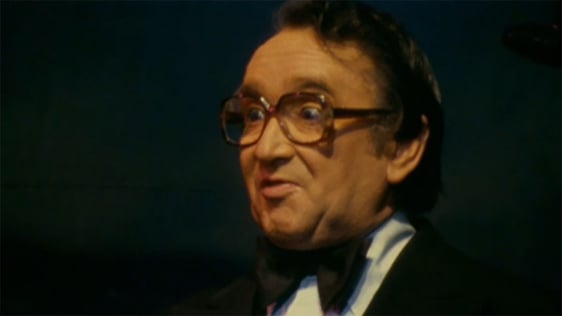
Gaiety Theatre
[Freeze-frame from 'Late Extra']
23 September 1966
© RTÉ |
 |
|
Series of Promenade Concerts at the Gaiety Theatre: 11 January 1953
The first concert in the Promenade Concert series took place at the Gaiety Theatre on 11 January 1953. Two more concerts followed at weekly intervals, with another group of three in March. The conductors were Pierre Michel Le Comte, Lieutenant-Colonel J.M. Doyle, and Winifrid Zillig who conducted the latter four concerts. Soloists were Charles Lynch, James Johnson, Francois d'Albert, Gwen Catley, Jaroslav Janacek and France Ellegaard. The title Promenade was a little misleading, as the Gaiety had no promenade, but the name proved popular nonetheless.
|
|
|
 |
  |
National Radio Club letter
from RTÉ Written Archives Collection |
 |
|
Broadcasts to Irish Missionaries in Africa: Autumn 1953
Irish missionaries in Africa were able to hear Radio Éireann relayed from Brazzaville, a short wave station in French Congo from autumn 1953. These broadcasts, Gaelic Games reports and a selection of programmes, were sent to Paris from where RTF, the French national broadcaster, transmitted and re-broadcast them from Brazzaville. This initiative was proposed by Gus Ingoldsby, Staff Administration Officer who unofficially managed sports broadcasts.
|
|
|
 |
  |
Audience Research Inquiry
Table 9 of results
19 March 1953
© RTÉ |
 |
|
Listener Research Introduced: March & September 1953
Two listener research studies were carried out in March and September 1953. 3,500 families were interviewed over a fortnight for both surveys, with a cross-check done by a postal survey. The Central Statistics Office designed the survey and analysed the results, while staff of the Department of Post and Telegraphs carried out the interviews.
The survey found that 85% listened to Radio Éireann as opposed to 53% to Radio Luxembourg and 49% to BBC Light. It came as a suprise to find that the number of sets in use between 1.00 p.m. and 2.30 p.m. exceeded those in use in the evening, though interference in the evening may have been a reason for this. As Irish dance music proved popular, a new programme, 'Take the Floor', was launched.
Further surveys were carried out in 1954 and 1955 which generated similar results. |
|
|
 |
  |
Francis MacManus
Photograph taken: c1960s
© RTÉ Stills Library |
 |
|
The 'Thomas Davis Lectures' series: September 1953
The 'Thomas Davis Lectures' series was launched in September 1953 with the aim of introducing the listening public to the best in Irish scholarship. As General Features Officer, Francis MacManus produced the series from 1953 to 1965.
Since then, the lectures, singly or in series, have been broadcast each autumn or winter, and have covered a broad range of subjects from the arts and sciences. These lectures quickly became one of Radio Éireann's most important programme features and have been published in book form.
Listen here to an extract from Frank O'Connor talking about the art of short story writing from the 'Thomas Davis Lectures' series in 1964.
Full story... |
Programme Title: Thomas Davis Lectures - The Art of the Short Story
1st Broadcast: 26 June 1964
Clip Duration: 01'56"
Presenter: Frank O'Connor
|
Listen...
|
|
|
 |
  |
'Din Joe'
RTÉ Television studios
Photographer: Roy Bedell
Photograph taken: c1960s
© RTÉ Stills Library |
 |
|
'Take the Floor' Begins: 1953
Following the results of the first Listener Research Survey, which showed an exceptional popularity of dance music on the radio in urban as much as rural areas, programming for dance music, which had been limited to 15 or 30 minutes, was greatly expanded. The flagship of this new policy was 'Take the Floor'. This programme featured an hour of Irish dance music with the Garda Céilí Band, singers, dancers and instrumentalists, all in the traditional mould. It probably owed a great deal of its success to the popularity of its compere, 'Din Joe'.
'Take the Floor' was broadcast on Radio Éireann until 14 May 1972. |
|
|
 |
  |
Joe Lynch
Photographer: Roy Bedell
Photograph taken: 1964
© RTÉ Stills Library |
 |
|
'Living with Lynch' Radio Comedy Series Begins: 1954
'Living with Lynch' which began in 1954, featuring Joe Lynch, a well-known member of the Radio Éireann Players, was one of the first new-style radio sketch comedies. The show was an early example of the 'packaged productions', where an independent production company would present an idea for a show to Radio Éireann and propose cast, budget and sample scripts.
Joe Lynch later starred in the RTÉ Television drama serials 'Bracken' and 'Glenroe' as the popular character, 'Dinny Byrne'.
A mixture of comedy and music, 'Living With Lynch' was recorded in front of an audience. Listen here to an extract from 'Living With Lynch' where schoolboys Fursey and Ernie ponder the advantages of having measles.
|
Programme Title:
Living with Lynch
1st Broadcast: Date not known
Clip Duration: 2'40"
Credits: - Joe Lynch - Charlie Byrne - Pamela Duncan - Jack Gregory
- RTÉ Orchestra |
Listen...
|
|
|
 |
  |
'The Kennedys of Castleross'
RTÉ Studios
Photograph taken: 1965
© RTÉ Stills Library |
 |
|
'The Kennedys of Castleross' Radio Drama Begins: 14 April 1955
On 14 April 1955, Radio Éireann's first soap 'The Kennedys of Castleross' began. The popular lunchtime series ran until 1975. Among the large cast were the actors Marie Kean, Pat Laffan and Philip O'Flynn. Mark Grantham was the main writer at the start of the series. Hugh Leonard, David Hanly and Kevin Fuller also wrote scripts for the series.
Listen here to the opening of the first episode featuring Marie Kean who played the leading role, Mrs Kennedy. |
Programme Title: The Kennedys of Castleross
1st Broadcast: 14 April 1955
Credits:
Marie Kean - Mrs Kennedy
Clip Duration: 01'10"
|
Listen...
|
|
|
 |
  |
Din Joe, Al Thomas and Jack Cruise
17 May 1953
© RTÉ Stills Library |
 |
|
A Short Survey of Irish Radio Variety, Radio Éireann Handbook: 1955
For the 1955 Radio Éireann Handbook, Mícheál Ó hAodha, Director of Productions, contributed an overview of Irish radio variety:
"...
there can be no exact definition of what radio variety should be, although there is a popular misconception that it consists solely of a fast-moving, high-pressured stage show, done into terms of sound..."
A Short Survey of Irish Radio Variety... |
|
|
 |
  |
Marion King and Sean Bunny
Radio Éireann studio
c1950s
© RTÉ |
 |
|
Children's Programmes: 1940s-50s
Marion King presented a popular children's series on painting, along with imaginary characters, 'Art Adventures with Sean Bunny and Marion King'. This series instigated an annual exhibition of children's art, the first of which was opened by Minister for Posts and Telegraphs, Erskine Childers. The exhibitions were shown in Dublin and in other centres around the country. Sean Bunny proved so popular a character that he got his own newspaper cartoon strip. |
|
|
 |
  |
Irish Radio and Television Show
Poster advertising exhibition
1958
|
 |
|
Preparation for television: 1950s
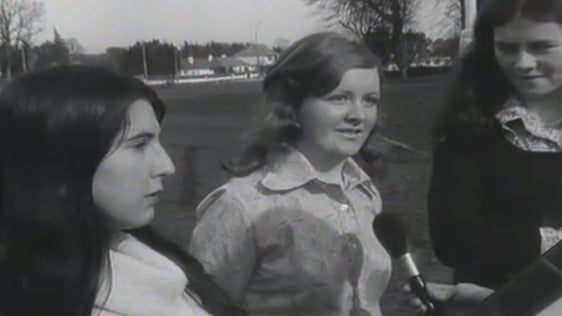
Television viewing in 1950s Ireland was mainly confined to the north and east coast of the country, where signals could be picked up from U.K. stations such as the BBC and ITV (after 1955). In the rest of the country it was practically unknown. The Department of Posts and Telegraphs under Secretary Leon Ó Broin had tried to provoke debate at political level as early as 1951, but was faced with a reluctance to commit public money to the new medium – to the extent that Leon Ó Broin was even denied an application to buy a television set for his own Department.
However, in the second half of the decade, interest in television gathered pace following demonstrations of the new device at trade shows and electrical goods retailers. In 1957, the Government appointed a commission to report into establishing an Irish television service. After visits to the U.S.A. and Great Britain, the commission recommended that Irish television should develop along purely commercial lines. However, after extensive debate around the Cabinet table, much of it informed by the Department of Posts and Telegraphs who were determined that television should be available for the whole country and should promote Irish culture, it was decided to adopt the dual-funded approach still in existence today. |
|
|
 |
RTÉ Broadcasting: | 1
| 2
| 3
| 4
| 5
| 6
| 7
| 8
| 9
|
1960s... |
 |
|
|
|
 |
Archive Products
See RTÉ CDs, DVDs, books, etc., including releases from RTÉ Libraries and Archives. RTÉ Shop...
|
|
|