


The list of injuries is so extensive that it's hard to believe that Derek Daly is still walking among us more than 40 years on.
A severely dislocated right foot and ankle, a severed toe, his left ankle crushed, a double compound fracture of the left leg, a broken hip joint, broken pelvis, broken ribs, third degree burns and a lacerated liver.
That's not all. It later transpired that the blood transfusion that he subsequently received left him infected with Hepatitis C and having to undergo HIV/AIDS testing for seven years thereafter.
And yet, on an early summers day in 2026, a 73-year-old Daly is bounding up the steps towards the RTÉ Sport podcast studio in a more sprightly fashion than yours truly who is just a little more than half his age.
The Dubliner does admittedly have to wear special footwear but without prior knowledge of his backstory, one would not even notice the fact.
The litany of injuries were all sustained in one horrific high-speed crash in September 1984 at the Michigan International Speedway, two years into Daly's stint in IndyCars.
It's one of many staging points in his upcoming autobiography Serial Survivor, an apt title that goes beyond that one accident and into both his personal and professional life.
Daly also swam in the shark infested waters of Formula One for five seasons from 1978 to 1982. In all, his tally of 15 world championship points makes up all but one of the points total that the five drivers who have represented the Republic of Ireland in the 76-year history of F1 have collectively amassed.
That period forms the backbone to a wide-ranging chat as he reflects on an unlikely journey from south Dublin to dicing it on the streets of Monte Carlo against some of motorsport's greatest names.
And then there is the post-racing broadcast career that led to him seeing a different side to ruthless legends like Ayrton Senna and Michael Schumacher in one-on-one situations, as well as rubbing shoulders with Muhammad Ali and Sylvester Stallone, and his late, long-time friend Eddie Jordan.
Watch the full interview above including a bonus blow-by-blow account of Daly's F1 point-scoring seasons in 1980 and '82, or listen in on Apple Podcasts or Spotify.
But amid the glitz and glamour of the high points, it's the deeply personal matters like parental support that stand out among the anecdotes.
For example the way Daly's mother - who is 97 and still going strong - reacted after the aforementioned Michigan catastrophe has stayed with him all these years on and highlights how drivers and their families cope with the real spectre of death.
"I mean, there's a piece in the book that flabbergasts me today," he says.
"I was all but killed in America... but during my recovery, although I never discussed it with my mother, in a phone call one day, she said to me, 'Do you have another drive lined up yet?'
"Can you imagine your mother almost sees you die in a crash, she comes over to help you recover, and then her question would be, 'Do you have another drive yet?'
"Because she knew I was still immersed deeply in the sport and I didn't want to walk away."
She also appeared to him as his life flashed before his eyes years earlier during a spectacular crash in a Formula One race at Zandvoort in 1980.
"At Zandvoort, I was so afraid," Daly recalls.

"I was doing 190-plus miles an hour. I had a left front suspension break because the brakes malfunctioned and I believed before I hit the guardrail, this is the crash I hoped I'd never have.
"People have heard in times of severe stress or when you're scared and you're frightened, your life goes before you. I've experienced that.
"And so I could see a video of my life going before me in slow motion as I'm heading for impact to the guardrail.
"I actually saw my mother sitting by the fire in Dublin. I heard the phone ring to tell her that I was dead.
"I experienced that before I ever even had an impact. And then right before the impact, I could feel the pain of my broken legs that I was about to get. That all in a millisecond."
Fortunately, on that occasion, there were no injuries and no devastating phonecall to be made to his parents.
Daly's late father, who passed away in 2008, also played a supportive role in his rise towards F1.
That's something very fitting within a sport that often has a strong father-son dynamic when it comes to drivers, including many of the contemporary greats like Max Verstappen and Lewis Hamilton, and a host of racing families.
Daly experienced both sides of it as a son and then as a father when his eldest Conor was making his way within the echelons of motorsport.
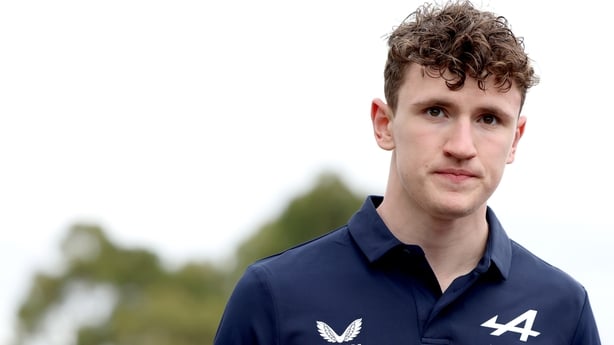
And the way in which Ireland's latest prospect Alex Dunne has his father Noel by his side is an aspect that will stand the Offaly man in good stead as he looks to make the final step from F2 to the F1 paddock, according to Daly, who has known him since he was 12.
But the key for Alpine junior Dunne will be to cross the chequered line first as often as possible across 2026.
"I want to see him get a fair chance, a fair good chance," Daly says.
"I think he has to win races. He has to win races in Formula 2 this year, which he can. He has to be a genuine front-runner and a potential for the championship (but) doesn't have to win it.
"He had such a momentum run last year. On the pole in Monaco, winning in Spa and then the rules took away the points that were critical for him and so his career momentum lost its way a little bit.
"But I'm a true believer that world class talent eventually shines through."
Daly is one of the select few to have flown the flag for Ireland in the paddock, so he is in no doubt about the seismic impact Dunne could have back home should he make it.
"The greatest developer of national pride I know is success in sport," he says.
"And because right now motor racing is so big on television, it's so colourful and it still retains the danger element, I think Alex Dunne has the potential to unite the whole country behind him.
"Last year when I was at Mondello, Alex Dunne made an appearance down there and he was mobbed.
"Just about everybody at Mondello had a papaya shirt on because the support for him was so big.
"You're going to see that multiply in droves all because of the national pride we will have in our guy out on the world stage waving the Irish flag."
