


US Secretary of State Marco Rubio has said there was a chance Iran would accept a deal to end the Middle East war as soon as today.
His comments came as Pakistan's powerful army chief arrived in Tehran to bolster mediation and US President Donald Trump abruptly skipped his son's wedding to stay in Washington due to "circumstances pertaining to government", fuelling speculation that talks had entered a sensitive stage.
Mr Rubio said there had been progress in negotiations but did not rule out Mr Trump resuming attacks on Iran.
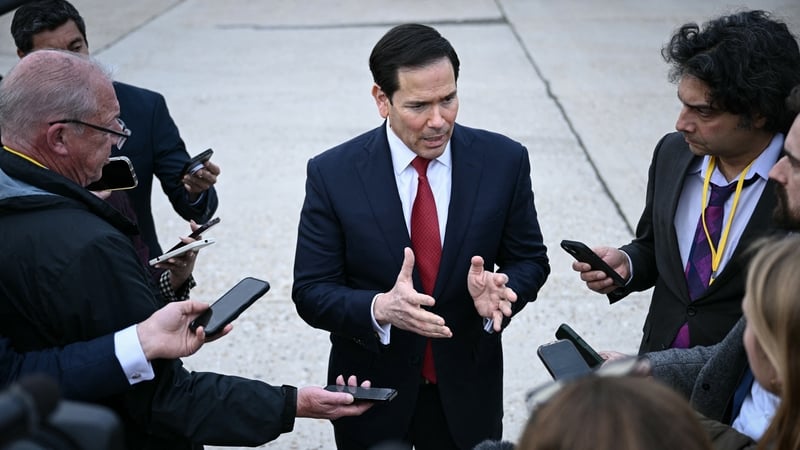
"There might be some news a little later today. There may not be. I hope there will be," Mr Rubio told reporters in New Delhi during his first visit to India.
"There's been some progress done, some progress made. Even as I speak to you now, there's some work being done," he said.
"There is a chance that, whether it's later today, tomorrow, in a couple days, we may have something to say."
Mr Rubio reiterated US demands that Iran fully open the Strait of Hormuz, on which it has exerted control in response to the US-Israeli attack, and that Iran hand over highly enriched uranium.
Mr Trump's "preference is always to solve problems such as these through a negotiated diplomatic solution. That's what we're working on right now," Mr Rubio said.
"But this problem will be solved, as the president's made... clear, one way or the other."
Meanwhile, Iran said it was finalising a 14-point framework for a deal with the United States, signalling a convergence of views while noting that gaps still remain.
"Our intention was first to draft a memorandum of understanding, a kind of framework agreement composed of 14 clauses," foreign ministry spokesman Esmaeil Baqaei said on state television.
He noted what he called "a trend towards rapprochement" with Washington but said "it does not necessarily mean that we and the United States will reach an agreement on the important issues".
Tehran said it has included the ending of a weeks-long US naval blockade and arrangements on the strategic Strait of Hormuz in the draft framework.
However, Esmaeil Baqaei said the nuclear issue was not part of an initial framework it was drafting to end the war.
"At this stage, we will not discuss the details of the nuclear issue... we have decided to prioritise an urgent issue for all of us: ending the war on all fronts including Lebanon," he said.
He added that the nuclear file will be "subject to separate discussions" at a later stage
Lebanon says soldier wounded in Israeli strike on barracks
Lebanon's military said an Israeli strike has targeted an army barracks in the south, wounding a soldier, despite a ceasefire in the war between Israel and militant group Hezbollah.
Israel kept up strikes on Lebanon today, hours after overnight raids on the south and east, including one that damaged a hospital. It also issued two evacuation warnings covering 15 south Lebanon villages ahead of further strikes there.
Israel's military has been pounding Lebanon despite the 17 April ceasefire, which was recently extended for several weeks.
The Iran-backed Hezbollah has kept up attacks on Israeli targets in south Lebanon and in northern Israel, including targeting Israeli air defence platforms across the border.
Lebanon's state-run National News Agency (NNA) reported no-warning Israeli airstrikes on around a dozen locations in the south.
The army said "a soldier was moderately wounded due to the hostile Israeli targeting of an army barracks in the city of Nabatieh".
A day earlier, Lebanon's military said its soldiers were loyal to the institution after the United States announced sanctions this week that included an officer accused of sharing information with Hezbollah.
The NNA said an overnight strike in the southern city of Tyre that targeted a site near a hospital caused "severe damage" to the facility.
An AFP correspondent saw shattered glass, ceiling panels blown out and damaged medical equipment at the multi-storey Hiram hospital.
Israel's military late on Friday had issued evacuation warnings ahead of strikes on two locations in Tyre.
Accompanying maps advised people to leave areas within 500 metres (yards) of the target buildings, with the Hiram hospital shown within the advised evacuation area.
The hospital's CEO, Dr Salman Aydibi, told AFP that around 40 patients were in the facility at the time, including seven in intensive care.
"We took the patients to a safer location" elsewhere inside the hospital, he said, adding that no patients were harmed but some 30 staff sustained minor injuries.
'Doomsday'
Dr Aydibi said the damage was being evaluated and the hospital remains operational, although the emergency department closed briefly.
He said it was the third strike near the hospital since the latest Israel-Hezbollah conflict erupted on 2 March.
Israel's army said it had targeted "Hezbollah infrastructure sites in Tyre" overnight, adding that "prior to the strike, steps were taken to mitigate harm to civilians".
Another AFP correspondent saw heavy damage at both targeted sites in Tyre.
"I don't know what happened, it felt like doomsday," said Wisam Baroud, who lives near one of the sites.
"We quickly got dressed, rushed outside, and started running," said Mr Baroud, showing damage to her home including rubble on beds and damaged cupboards.
Israel's army also targeted east Lebanon overnight, saying it attacked a "Hezbollah underground compound" used to manufacture weapons.
Lebanon's Hamas-aligned Islamist group Jamaa Islamiya and its armed wing the Al-Fajr Forces has said one of its members was killed in a strike in east Lebanon.
Hezbollah drew Lebanon into the Middle East war on 2 March with rocket fire at Israel in retaliation for the killing of Iran's supreme leader in US-Israeli strikes.
Under the terms of the ceasefire published by Washington, Israel reserves the right to act against "planned, imminent or ongoing attacks".
Israeli troops who invaded Lebanon are also operating inside an Israeli-announced "yellow line" running around 10 kilometres (six miles) deep along Lebanon's southern border.
