


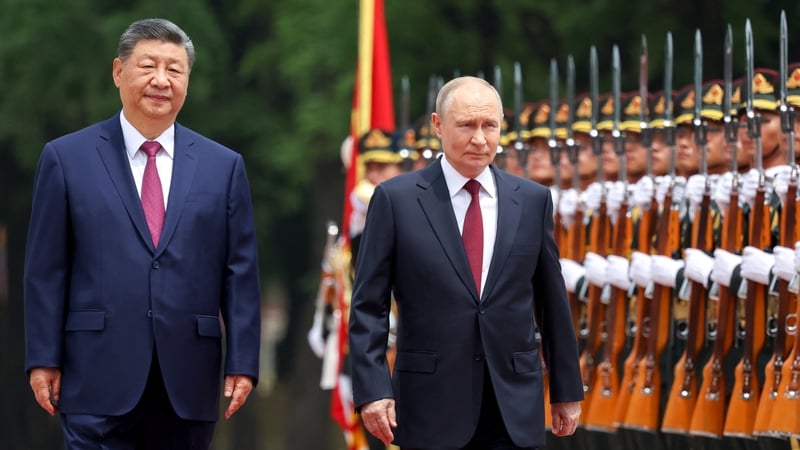
Russia and China said in a joint declaration that attempts by some countries to dominate global affairs in the spirit of the colonial era had failed but that the world was in danger of a return to the "law of the jungle".
"The global situation is becoming more complex," they said in a declaration released by the Kremlin in Russian.
"The global peace and development agenda is facing new risks and challenges, and there is a danger of fragmentation of the international community and a return to the 'law of the jungle'."
"Attempts by a number of states to unilaterally manage global affairs, impose their interests on the entire world, and limit the sovereign development of other countries, in the spirit of the colonial era, have failed."
China's President Xi Jinping welcomed Russian President Vladimir Putin in Beijing as they seek to underline their alliance in the wake of US President Donald Trump's visit last week.
Mr Putin said Russia was ready for cooperation with partners, including with the United States, and that he had discussed this with Mr Xi.
The Russian leader arrived in Beijing weakened by years of its war on Ukraine, as sanctions by Western powers put the squeeze on Russian energy revenues.
Moscow is already heavily dependent economically on Beijing, the main buyer of sanctioned Russian oil.
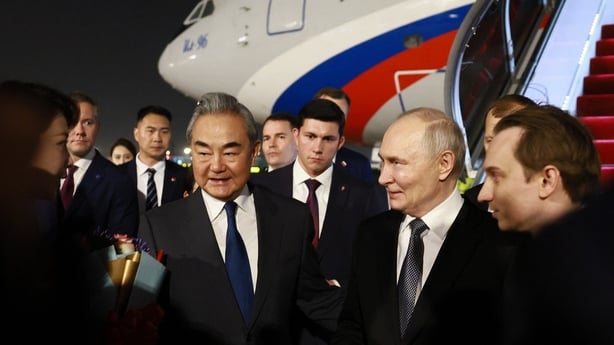
Russia and China did not reach an agreement on the new multi billion-dollar "Power of Siberia 2" gas pipeline in talks between Mr Putin and Mr Xi, the Kremlin told Russian state media.
Moscow, increasingly economically reliant on China since invading Ukraine in 2022, has pushed for the pipeline for years, but progress has been slow amid hesitation in Beijing.
Kremlin spokesman Dmitry Peskov told Russian media that while the two sides had reached a "basic understanding", including on "the route and how it will be built", there was no "clear timeline" and "there are still some details to be worked out".
The project was not mentioned in the Kremlin's long list of agreements published on its website after the Putin-Xi talks.
The pipeline would carry 50 billion cubic meters a year of gas a year and - crucially for Russia - the supplies would come from fields that used to serve Europe, to where exports have plunged since the war.
The route would run 2,600km from the Yamal Peninsula in northern Siberia through Mongolia into China.
China has shown less enthusiasm for the project, something Russia had hoped would change with the energy instability triggered by the Middle East war.
Mr Xi has played host to a series of world leaders as an increasingly unpredictable United States under Mr Trump pushed many to shore up alliances with Beijing, but the war in Iran has further accelerated the trend.
While Mr Trump enjoyed a show of ceremony last week, Mr Putin's visit is expected to be held in a more intimate setting.
His visit promises to display the close friendship enjoyed by the Russian and Chinese leaders, who will discuss strengthening their strategic partnership, according to the Kremlin.
"The Xi-Putin relationship does not require that kind of performative reassurance" like the pomp received by Mr Trump, said Patricia Kim from the Brookings Institution in Washington.
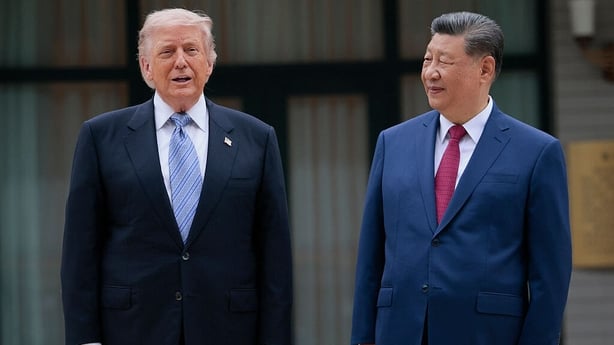
Mr Xi welcomed Mr Putin with open arms as an "old friend" when he last visited Beijing in September 2025 - language the Chinese leader did not extend to Mr Trump last week.
Both Mr Putin and Mr Xi view ties as "structurally stronger and more stable" than those between China and the United States, she told AFP before the Russian president departed Moscow.
Beijing has regularly called for talks to end the war in Ukraine but has never condemned Russia for sending in troops, presenting itself instead as a neutral party.
Mr Trump and Mr Xi discussed Ukraine last week, but the US president left China without a breakthrough.
"Xi will almost certainly brief Putin on his summit with Trump," Ms Kim said.
The lack of clear outcomes from the Xi-Trump meeting "likely reassures Moscow that Xi did not strike any understanding with Trump that would materially undercut Russian interests".
Mr Putin will be hoping for China to deepen its commitment to Moscow after Mr Trump told Fox News during his visit that Beijing had agreed to buy US oil to feed its "insatiable" appetite for energy.
With Russia reliant on sales to China to sustain its war effort, "Putin does not want to lose that support", Asia Society's Lyle Morris told AFP.
"Putin will likely be keen to hear from Xi about China's next step in the Middle East," Mr Morris said, after "Trump signalled clearly that he hopes Beijing will play a leading role".
When it comes to the US-Israeli war on Iran, China and Russia may have different priorities.
"(China) relies on the freedom of the world's major waterways to sustain its economic activities and would prefer that the standoff in the Strait of Hormuz end sooner rather than later," James Char of Singapore's Nanyang Technological University told AFP.
On the other hand, Moscow has "been benefitting economically from the fighting in Iran due to the relaxation of sanctions against Russian energy supplies, so may have a different view", he said.
