


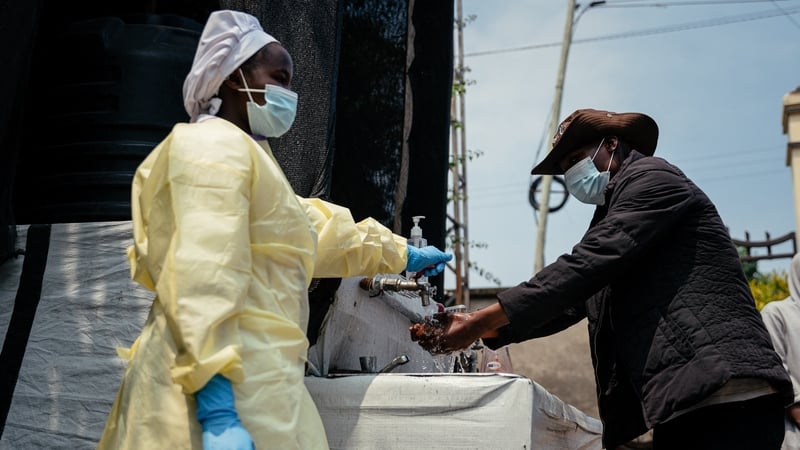
The head of the World Health Organization has said he is "deeply concerned" over the scale and spread of the Ebola outbreak in DR Congo.
"Early on Sunday, I declared a public health emergency of international concern over an epidemic of Ebola disease in the Democratic Republic of the Congo and Uganda," Tedros Adhanom Ghebreyesus told the World Health Assembly in Geneva.
"I did not do this lightly... I'm deeply concerned about the scale and speed of the epidemic," he said.
His comments come as a panel of experts led by the WHO will meet to discuss if there are any vaccine options to help tackle the outbreak.
There have been 131 suspected deaths and 500 cases linked to the outbreak of the Bundibugyo strain of Ebola in eastern Democratic Republic of Congo, according to the WHO.
The WHO and Africa Centres for Disease Control and Prevention have both declared it a public health emergency.
A WHO official warned that the duration of the outbreak could be lengthy.
"I don't think that in two months we will be done with this outbreak," Anne Ancia, WHO's DRC representative, told reporters in Geneva, speaking from Bunia in DRC's Ituri region, pointing to a recent Ebola outbreak that "took two years".
Watch: WHO chief concerned about scale and speed of Ebola epidemic
There are no approved vaccines or treatments for the Bundibugyo strain of Ebola, which has a fatality rate of up to 40%.
However, there is a vaccine named Ervebo, manufactured by Merck, that is used for the Ebola Zaire strain but has shown evidence of providing some protection against Bundibugyo in animal studies. The potential for testing this and other options will be on the agenda.
"When you have an outbreak with a strain that does not have countermeasures, we are going to advise on the best approach to take," said Dr Mosoka Fallah, acting director of the science department at Africa CDC.
"We will look at what evidence we have and make a decision."
The outbreak's epicentre is in the northeastern Ituri province on the border with Uganda and South Sudan, whose status as a gold-mining hub leads to people regularly crisscrossing the region.
The virus has already spread into neighbouring provinces, as well as beyond the DRC's borders.
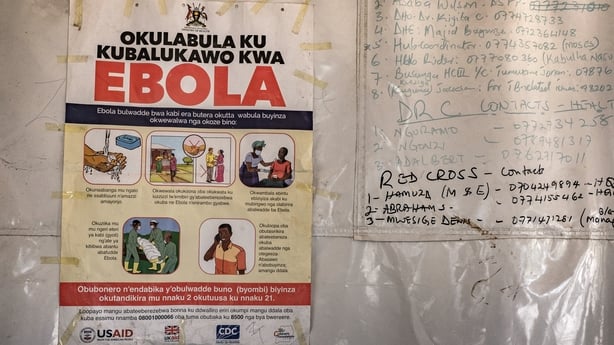
Suspected cases have been reported in the commercial hub of Butembo in neighbouring North Kivu province, some 200km away from the epidemic's ground zero, DR Congo health minister Samuel Kamba has said, without giving further details.
Another case has been recorded in Goma, a key provincial capital currently in the hands of the Rwanda-backed M23 militia.
Last night, the Africa Centres for Disease Control and Prevention declared the outbreak a Continental Public Health Emergency.
Declaring a continental emergency empowers the Africa CDC, based in Ethiopia, to mobilise extra resources including emergency response teams and surveillance operations.
"Africa CDC expresses deep concern about the high risk of regional spread due to intense cross-border population movements, mobility related to mining activities, insecurity in affected areas, weak infection prevention and control measures... and the proximity of affected areas to Rwanda and South Sudan," it said.
The agency said it was working closely with the World Health Organization to strengthen coordination, as developed in response to recent mpox and cholera outbreaks.
"This outbreak is occurring in one of the continent's most complex operational environments, marked by insecurity, population mobility, fragile health systems, and the limited availability of medical countermeasures for Bundibugyo strain Ebola virus disease," said Africa CDC head Jean Kaseya.
Germany to admit and treat US Ebola patient from DR Congo
Germany is preparing to admit and treat a US doctor who contracted Ebola in the Democratic Republic of Congo during the current deadly outbreak, the German health ministry has said.
The patient was named as medical missionary Dr Peter Stafford, who lives in DRC with his wife Rebekah, also a doctor, and their four young children, by the Christian missionary organisation Serge.
"US authorities have requested assistance from the German government in treating a US citizen who contracted Ebola in Congo," a German health ministry spokesperson said.
"Preparations are currently under way to admit and treat the patient in Germany," the spokesperson added, without saying where and when the patient would be treated.
"In Germany, there is a nationwide network of experts for the management and care of patients with diseases caused by highly pathogenic agents."
The US Centers for Disease Control and Prevention had said that the US doctor had contracted the virus following exposure related "to their work" in DRC and had tested positive late on Sunday.
Missions group Serge said Dr Stafford was exposed while treating patients at Nyankunde hospital, where he had worked since 2023.
The group said it was "grateful for international cooperation to safely care for" the family of six and another doctor who had been treating Ebola patients, Patrick LaRochelle.
It said the doctors and the family would be treated "in a location where they can undergo continued risk monitoring and receive specialised medical care".
The German ministry did not say whether Dr LaRochelle and Dr Stafford's wife and family, who had shown no symptoms, would also be flown to Germany.
