


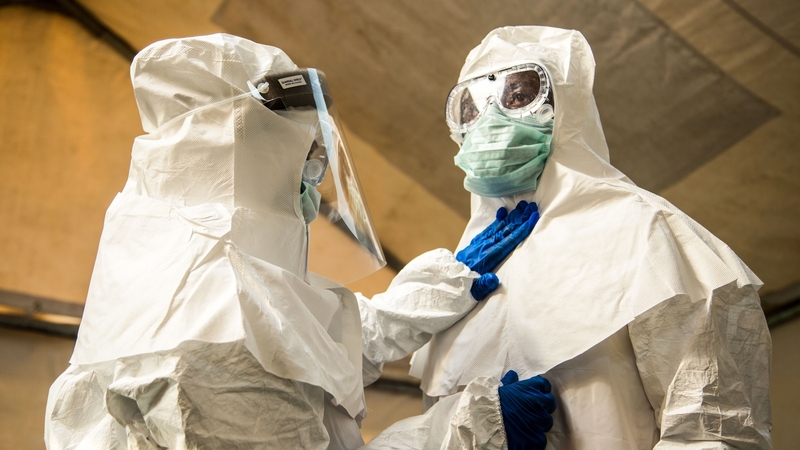
A new outbreak of the deadly Ebola virus has been declared in the eastern Democratic Republic of Congo, African health officials said, with neighbouring Uganda also confirming one related death.
Until now, the outbreak had been confined to Ituri province in northeastern DRC, bordering Uganda and South Sudan, according to the Africa Centres for Disease Control and Prevention (CDC Africa).
It warned of a high risk of spread, with 246 suspected cases and 65 deaths reported in the DRC.
Uganda's health ministry said a 59-year-old man from the DRC had died in Kampala after being admitted earlier in the week. His body was repatriated the same day.
"This is an imported case from DRC. The country has not yet confirmed a local case," the ministry said.
Tests showed the man was infected with the Bundibugyo strain of Ebola, for which no vaccine exists. Vaccines are only available for the Zaire strain, which is the deadliest variant.
"It is a large outbreak," said Jay Bhattacharya, acting director of the US Centers for Disease Control and Prevention (CDC).
The DRC government has not yet commented on the outbreak in the vast central African nation of more than 100 million people.
"The region where it is happening is highly volatile with the humanitarian situation" and cross-border population movements, said WHO emergency alert and response director Abdi Rahman Mahamud.
But he noted the country has extensive experience managing Ebola outbreaks.
"With the insecurity, people are crowded together in the city, and since there are so many people in the city, an epidemic like this would be very serious," Anne-Marie Dive, a resident of Bunia, the main city in Ituri, said by telephone.
