


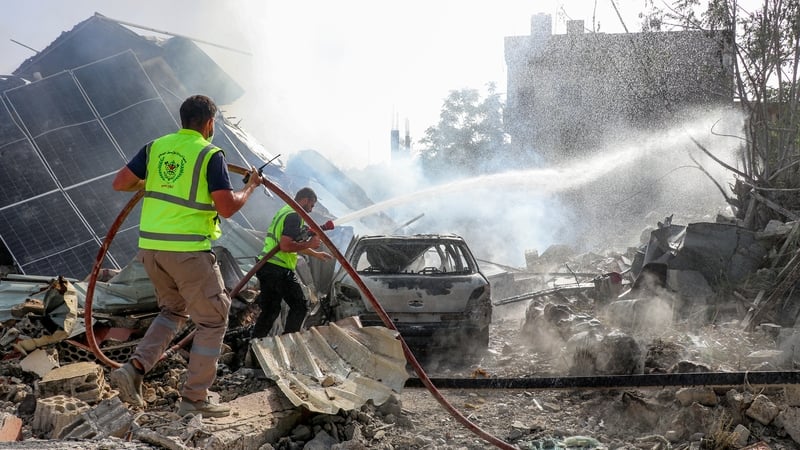
Israeli strikes on Lebanon have killed 380 people since a ceasefire in the Israel-Hezbollah war began on 17 April, Lebanon's Health Minister Rakan Nassereddine told a press conference.
The overall toll in Israeli strikes since the war erupted between Israel and Hezbollah on 2 March has reached 2,882 people, including 279 women and 200 children, he added.
Since the ceasefire, "380 people have been killed and 1,122 wounded," Mr Nassereddine said.
A ministry official told AFP that the toll includes 39 women and 22 children.
Under the terms of the truce released by Washington, Israel reserves the right to act against "planned, imminent or ongoing attacks".
In addition to carrying out ongoing airstrikes, Israeli troops have been operating behind a so-called "yellow line" that runs around 10 kilometres north of the border between the two countries.
Some 108 emergency and health workers are among the overall death toll, while 249 others have been wounded, and "16 hospitals have been damaged" since the start of the conflict, Mr Nassereddine said.
"It's a massacre... there are no armed men or fighters in these (ambulance) vehicles, just medical equipment and wounded, contrary to what Israel says," he added.
Israel has accused Hezbollah of using ambulances and medical facilities for military purposes, an accusation the group denies.
Hezbollah drew Lebanon into the Middle East conflict on 2 March when it launched rockets at Israel to avenge the killing of Iran's supreme leader in US-Israeli strikes.
Israel responded with massive strikes and a ground invasion in the country's south.
The Iran-backed Hezbollah said its fighters are included in the government tolls.
Lebanese leaders urged the United States to pressure Israel to halt its attacks, which have intensified in recent days.
The appeal came as Lebanese and Israeli representatives are set to meet later this week in Washington for a third round of direct talks.
Israeli troops conduct raid along south Lebanon's Litani River
The Israeli military said its troops had conducted a days-long raid in the area of the Litani River in south Lebanon, where exchanges of fire with Hezbollah persist despite a ceasefire.
In a statement, the military said that over the past week, troops had conducted a "special operation to clear terrorist infrastructure from the Litani area and establish operational control in the area".
It said soldiers had been operating south of the Israeli-declared "yellow line" that runs around 10 kilometres north of the border, and where Israeli forces continue to be stationed.
Israeli media reported that troops had gone beyond the Litani river and operated on the outskirts of the town of Zawtar al-Sharqiyah.
When asked by AFP, the Israeli military said it was unable to confirm whether troops had crossed the Litani, but it published photos from the operation showing soldiers walking along a bridge traversing a river.
Other photos published by the military showed tanks and soldiers operating along the riverbank.
"During the operation, the troops located compounds used by Hezbollah terrorists, underground tunnel routes containing large quantities of weapons, weapons storage facilities, and missile launchers," the military said, adding that it had struck more than 100 targets.
It also said troops had "struck and eliminated dozens of terrorists in close-quarters combat, alongside aerial support".
In a separate statement today, the Israeli military said it had identified an "unsuccessful attempt to launch a surface-to-air missile toward an Israeli Air Force aircraft," but that no damage or injuries were caused.
The military's Arabic-language spokesman, Avichay Adraee, issued fresh evacuation warnings for several villages in south Lebanon today.
Israel approves tribunal law for 7 October Hamas trials
Meanwhile, Israel's parliament has passed a law establishing a military tribunal to try hundreds of Palestinian militants who took part in the 7 October 2023 attack on Israel, a step politicians said would help heal national trauma.
The surprise attack, led by fighters from the Palestinian militant group Hamas, was Israel's deadliest single day and the worst attack on Jews since the Holocaust.
At least 1,200 people were killed in Israel, most of them civilians.
Israel responded by launching an assault on Gaza that killed more than 72,000 Palestinians, mostly civilians, and left much of territory in ruins.
Israel has been holding an estimated 200-300 fighters - the precise number is classified - captured in Israel during the attack, who have not yet been charged.
The special military court established by the law, to be presided over by a three-judge panel in Jerusalem, could also try others captured later in Gaza and suspected of participating in the attack, or of having held or abused Israeli hostages.
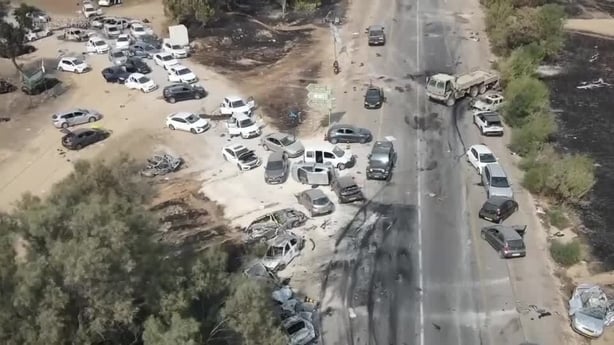
The new law was backed by a wide majority of 93 of the Knesset's 120 politicians, in a rare show of Israeli political unity.
The militants burst through the Gaza border and rampaged through southern Israeli villages, army bases, roads and a music festival.
Besides the killings, the fighters also took 251 hostages back to Gaza.
No trial date
Politicians from both the governing coalition and the opposition authored the bill, meant to ensure all assailants are brought to justice under existing Israeli criminal statutes for what it describes as crimes against the Jewish people, crimes against humanity and war crimes.
Proceedings will be public, with major hearings broadcast live.
While defendants will attend only key hearings in person and all others by video, surviving victims will be allowed in-person access, according to the new law.
Ya'ara Mordecai, an international law expert at Yale Law School, said the new law raised some concerns about due process, given the military court setting, as well as a risk of atrocity proceedings turning into politicised or symbolic "show trials".
Knesset member Yulia Malinovsky, one of the bill's authors, said that the legislation ensures a fair and lawful trial.
"They will be sentenced by Israel's judges, not by the street or by what we all feel," Ms Malinovsky said before the vote.
"At the end of the day, what makes us great is our spirit, our resilience, ability to cope and withstand this immense pain."
Option of capital punishment
Israel's penal code includes capital punishment for some of the charges which the militants are likely to face.
If handed down, a death sentence would trigger an automatic appeal on behalf of the defendant, according to the new law.
The last person executed in Israel was Adolf Eichmann, an architect of the Nazi Holocaust, hanged in 1962 after being captured in Argentina by Israeli agents.
Military courts in the occupied West Bank can sentence Palestinian convicts to death but have never done so.
A separate law passed by Israel in March making death by hanging a default sentence for Palestinians convicted in military courts of deadly attacks drew criticism at home and abroad and is expected to be struck down by the Supreme Court.
Hamas condemns new law
Hamas Gaza spokesperson Hazem Qassem said the new law "serves as a cover for the war crimes committed by Israel in Gaza."
The International Criminal Court is probing Israel's conduct of the Gaza war and has issued arrest warrants for Prime Minister Benjamin Netanyahu and former defence minister Yoav Gallant, as well as three Hamas leaders who have all since been killed by Israel.
Israel is also fighting a genocide case at the International Court of Justice.
It rejects the allegations as politically motivated and has argued that its war is against Hamas, not the Palestinian people.
