


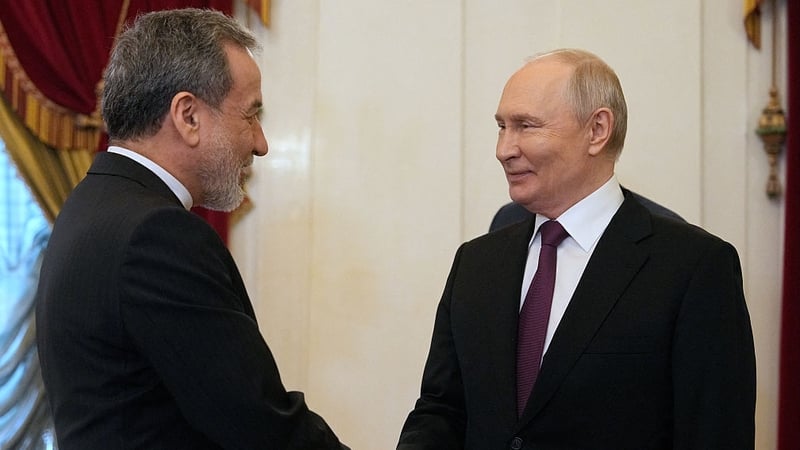
Iran's Foreign Minister Abbas Aragchi has said that Iran is looking into US President Donald Trump's request for negotiations, according to a post on the minister's Telegram account.
He told reporters in Russia that President Trump requested negotiations because the US has not achieved any of its objectives.
Mr Trump scrapped a visit to Islamabad by his envoys Steve Witkoff and Jared Kushner for talks on ending the conflict, and said Iran could telephone if it wanted to negotiate.
Earlier, Russian President Vladimir Putin told Mr Aragchi that he hoped the Iranian people would weather what he described as a "difficult period" and that peace would soon prevail.
President Putin held talks with Mr Aragchi in St Petersburg earlier.
Russia has offered to mediate to try to help restore calm to the Middle East following US and Israeli strikes on Iran, which Moscow has condemned.
It has also repeatedly offered to store Iran's enriched uranium as a way of defusing tensions, an offer the United States has not taken up.
"For our part, we will do everything that serves your interests and the interests of all the peoples of the region to ensure that peace is achieved as quickly as possible," Mr Putin told Mr Aragchi, according to Russian state media.
"Last week I received a message from Iran's Supreme Leader. I would like to ask you to convey my most sincere thanks for this and to confirm that Russia, like Iran, intends to continue our strategic relationship," Mr Putin added.
We need your consent to load this rte-player contentWe use rte-player to manage extra content that can set cookies on your device and collect data about your activity. Please review their details and accept them to load the content.Manage Preferences
Iran last year sealed a 20-year strategic partnership agreement with Moscow. Russia is building two new nuclear units at Bushehr, the site of Iran's only nuclear power plant, and Iran supplied Russia with Shahed drones for use against Ukraine.
Mr Aragchi said relations between Russia and Iran would continue to strengthen and thanked Mr Putin for Moscow's support, the state RIA news agency reported.
Mediators still seek to bridge US, Iran gaps
Work has not halted to bridge gaps between the United States and Iran, sources from mediator Pakistan said, despite the failure of face-to-face diplomacy after US President Donald Trump called off a trip by his envoys over the weekend.
Iranian sources disclosed Tehran's latest proposal, which would set aside discussion of Iran's nuclear programme until the war is ended and disputes over shipping from the Gulf are resolved.
That is unlikely to satisfy Washington, which says nuclear issues must be dealt with from the outset.
Hopes of reviving peace efforts have receded since the US President scrapped a visit on Saturday by his envoy Steve Witkoff and son-in-law Jared Kushner to Islamabad, the Pakistani capital, where Mr Aragchi shuttled in and out twice over the weekend.
With the warring sides still seemingly far apart on issues including Iran's nuclear ambitions and access through the crucial Strait of Hormuz, oil prices resumed their upward march when trade reopened.
Brent crude was up around 2.5% to around $108 a barrel.
"If they want to talk, they can come to us, or they can call us. You know, there is a telephone. We have nice, secure lines," Mr Trump told "The Sunday Briefing" on Fox News.
"They know what has to be in the agreement. It's very simple: They cannot have a nuclear weapon; otherwise, there's no reason to meet," Mr Trump said.
Islamabad reopens after lockdown to host talks
Senior Iranian sources, speaking on condition of anonymity, said the proposal carried by Mr Aragchi to Islamabad overt he weekend envisioned talks in stages, with the nuclear issue to be set aside at the start.
A first step would require ending the US-Israeli war on Iran and providing guarantees that Washington cannot start it up again. Then negotiators would resolve the US blockade and the fate of the Strait of Hormuz, which Iran aims to reopen under its control.
Only then would talks look at other issues, including the longstanding dispute over Iran's nuclear programme, with Iran still seeking some kind of US acknowledgment of its right to enrich uranium for what it says are peaceful purposes.
Asked about any new Iranian proposals, White House spokesperson Olivia Wales said: "These are sensitive diplomatic discussions and the US will not negotiate through the press.
"As the president has said, the United States holds the cards and will only make a deal that puts the American people first, never allowing Iran to have a nuclear weapon."
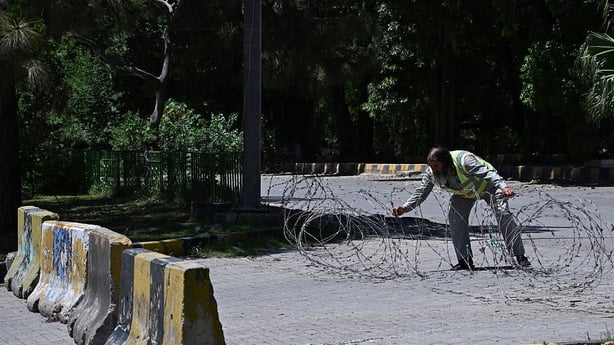
In a sign that no face-to-face meetings are planned any time soon, streets reopened in Pakistan's capital Islamabad, which had been locked down for a week in anticipation of talks that never took place.
The luxury hotel that had been cleared out to serve as a venue was again taking reservations from the public.
Pakistani officials said negotiations were still taking place remotely, but there were no plans to convene a meeting in person until the sides were close enough to sign a memorandum.
"The draft will be negotiated remotely till they reach some consensus," said a Pakistani source familiar with the negotiations.
Global growth outlook
Washington, which says its main war aim has always been preventing Iran from obtaining a nuclear weapon, wants Iran to give up a stockpile of highly enriched uranium and forgo further enrichment of material that could be used to make a bomb.
Although a ceasefire has paused the US-Israeli strikes on Iran that began on 28 February, no agreement has been reached on terms to end a war that has killed thousands, driven up oil prices, fuelled inflation and darkened the outlook for global growth.
Both sides could be settling in for a test of wills, to see who can endure the economic pain before making concessions.
Iran has largely blocked all shipping apart from its own from the Gulf through the Strait of Hormuz since the war began. This month, the United States began blockading Iranian ships.
Trump faces domestic pressure to end Iran war
With his approval ratings falling, Mr Trump faces domestic pressure to end the unpopular war.
Iran's leaders, though weakened militarily, have found leverage in negotiations with their ability to stop shipping in the strait, which normally carries a fifth of global oil shipments.
While Mr Aragchi met Pakistani officials, Mr Trump, speaking in Florida on Saturday, said he cancelled his envoys' visit due to too much travel and expense for what he considered an inadequate Iranian offer.
Iran "offered a lot, but not enough," he said. Iranian officials had already played down any suggestion that Mr Aragchi might meet the Americans while in Islamabad.
Read our latest Middle East stories here
