


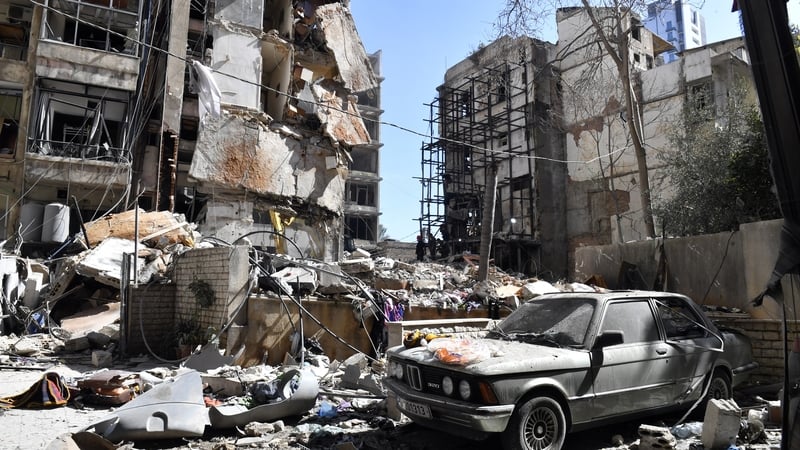
Israel has bombed more targets in Lebanon, putting the Middle East ceasefire in further jeopardy after its biggest attacks of the war yesterday killed more than 250 people.
The EU's foreign policy chief Kaja Kallas said that the ceasefire agreement should cover Lebanon and that Israel's heavy-handed actions does not fall within self-defence.
Ms Kallas also said that Hezbollah should disarm and that the organisation had dragged Lebanon into the war.
Iranian President Masoud Pezeshkian said Israel's strikes on Lebanon render negotiations 'meaningless'.
Spain strongly condemned Israeli strikes on Lebanon as well as the broader war on Iran, cementing Madrid's role as an outspoken critic of the US and Israeli military campaigns.
Foreign Minister Jose Manuel Albares described the conflict as an attack on civilization.
"The prophets of war and violence seek to return to the values and practices of history's darkest moments," he said, accusing Israel of violating international law and the newly brokered two-week ceasefire after a massive wave of airstrikes across Lebanon killed more than 250 people yesterday.
Yesterday, Prime Minister Pedro Sanchez reiterated his call for the European Union to scuttle its association agreement with Israel, urging an end to "impunity for (Israel's) criminal actions".
Iranian negotiators were expected to travel to Pakistan for the first peace talks of the war, where they are due to meet a delegation led by US Vice President JD Vance on Saturday.
But there was no sign Iran had lifted its blockade of the Strait of Hormuz, which has caused the worst disruption to global energy supplies in history, and Tehran said there would be no deal as long as Israel was striking Lebanon.
The supply shortage drove the price that European and Asian refineries were paying for a physical barrel of oil to record levels near $150 a barrel, with even higher prices for some products such as jet fuel.
Lebanon was pulled into the Middle East war when Hezbollah began firing rockets into Israel on 2 March to avenge the killing of Iran's supreme leader Ayatollah Ali Khamenei in Israeli-US attacks on 28 February.
The US has also said Lebanon is not covered by the truce, but Iran and Pakistan, which acted as mediator, say it was explicitly part of the deal.
A host of countries, including prominent US allies Britain and France, said the truce should extend to Lebanon and condemned Israel's attacks on the country.
French President Emmanuel Macron earlier said Lebanon "must be fully covered" by the ceasefire while British Foreign Minister Yvette Cooper said the UK "strongly" wanted to see Lebanon included in the ceasefire in the Middle East.
Lebanese govt bans non-state weapons in capital Beirut
Lebanon's cabinet has instructed security forces to restrict weapons in Beirut exclusively to state institutions.
"The army and security forces are requested to immediately begin reinforcing the full imposition of state authority over Beirut Governorate and to monopolise weapons in the hands of legitimate authorities alone," Prime Minister Nawaf Salam said at the end of a cabinet meeting.
Information Minister Paul Morcos said the decision prompted objections from Hezbollah's two ministers in the cabinet.
The Lebanese government banned Hezbollah's military activities at the beginning of March, shortly after the start of war with Israel, but the decision has not stopped the Iran-backed armed group and political party - represented in cabinet and parliament - from conducting military operations.
In the wake of yesterday's strikes across Lebanon, Mr Salam said the Lebanese government will submit "an urgent complaint" to the UN Security Council, and he denounced the "dangerous escalation in defiance of all regional and international efforts to stop the war in the region".
Israel says it kills Hezbollah chief's nephew
The Israeli military said it had killed the nephew of Hezbollah's Secretary-General Naim Qassem, who had served as his personal secretary, and had struck river crossings used by the group overnight.
Israel struck Beirut's southern suburbs just before midnight and at dawn, and hit towns across the south this morning, Lebanese state media said.
For its part, Hezbollah, which had initially said it would pause attacks on Israel in line with the ceasefire, said it was resuming them this morning and had fired once across the border into Israel and twice at Israeli forces in southern Lebanon.
Watch: US did not agree that ceasefire would cover Lebanon - Vance
Rescuers across Lebanon were working through the night to try to save wounded people trapped under rubble of destroyed buildings after the Israeli attacks, which hit heavily populated areas without customary warnings for civilians to flee.
"This is my place, this is my house, I've been living here like more than 51 years. So, everything destroyed. See?" said Naim Chebbo, sweeping shattered glass and debris from his home in Beirut after strikes destroyed the building next door.
Mourning for Khamenei
"What happened yesterday was grave violation," Iranian deputy foreign minister Saeed Khatibzadeh told BBC Radio of Israel's attacks on Lebanon.
"It was a catastrophe, could actually end in more catastrophe, and this is the nature of this rogue behaviour that we are seeing from Israel in the whole Middle East."
Inside Iran, where the halt to six weeks of US and Iranian airstrikes has been portrayed as victory for the clerical rulers, huge crowds turned out for a commemoration to mark 40 days of mourning for Supreme Leader Ayatollah Ali Khamenei, killed on the war's first day.
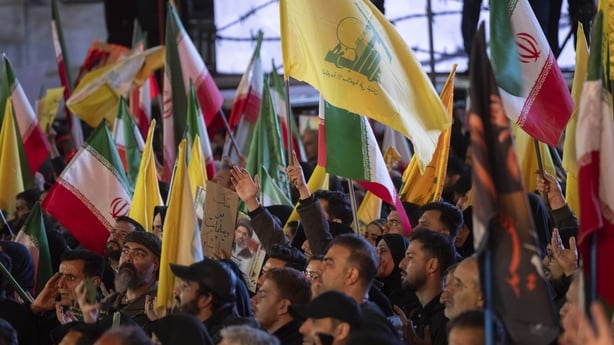
State TV showed crowds in Tehran, Kermanshah, Yazd and Zahedan, with mourners in black carrying Iranian flags and portraits of Khamenei and his son and successor Mojtaba.
In Tehran, officials including atomic chief Mohammad Eslami and roads minister Farzaneh Sadeq attended.
Large commemorative billboards were displayed, and a large Lebanese Hezbollah flag was visible on one building, while crowds moved toward the compound where the elder Khamenei was killed.
In Shiraz, a funeral procession was held for Revolutionary Guards' intelligence chief Majid Khademi, killed earlier this week in an Israeli strike in his home province of Fars.
Oil prices spike
The futures contracts for delivery of oil in May or June, typically used as benchmarks for global oil prices, have eased since Mr Trump announced the ceasefire this week on expectations that deliveries of blocked Gulf oil would quickly resume.
But the price of physical oil for delivery now has shot up to record levels as refiners struggle to meet demand with a fifth of the global supply knocked out for a month and a half.
Mr Trump, who announced the truce on Tuesday night just before a deadline he had set to destroy Iran's "whole civilisation" unless it unblocked the strait, threatened more attacks.
If Iran did not comply, then "the 'Shootin’ Starts,' bigger, and better, and stronger than anyone has ever seen before," he posted on social media. "In the meantime our great Military is Loading Up and Resting, looking forward, actually, to its next Conquest. AMERICA IS BACK!"
Though Mr Trump has declared victory, the US did not achieve the aims he had announced to justify the war at its outset: to eliminate Iran's ability to attack its neighbours, destroy its nuclear programme and create conditions that would make it easier for Iranians to topple their government.
Iran still possesses missiles and drones capable of targeting its neighbours and a stockpile of more than 400 kg of highly enriched uranium.
Its rulers, who had faced a mass uprising just months ago, survived the superpower onslaught with no sign of organised opposition.
And they have demonstrated their ability to exert control of the strait, despite a massive US military presence in the region built up over decades to protect Washington's allies and safeguard shipping.
The core disputes remain unresolved, with each side sticking to competing demands for a deal that could shape the Middle East for generations.
'Freedom of navigation means navigation must be free'
Oil prices climbed today with investors concerned about the fragility of the truce and elevated geopolitical risks over Middle East supply, with doubts that restrictions in the Strait of Hormuz would soon ease.
There was scant sign that the strait was open in any meaningful way since the agreement, with Iran still asserting its control over the vital artery, a conduit for a fifth of the world's oil and liquefied natural gas supply, and demanding tolls for safe passage.
Tehran's newly demonstrated ability to cut off Gulf energy supplies through its grip on the strait, despite decades of massive US military investment in the region, shows how the conflict has already altered power dynamics in the Gulf.
Iran's Revolutionary Guards navy posted a map today showing alternative shipping routes in the Strait of Hormuz to help ships avoid naval mines, the semi-official Iranian news agency ISNA said.
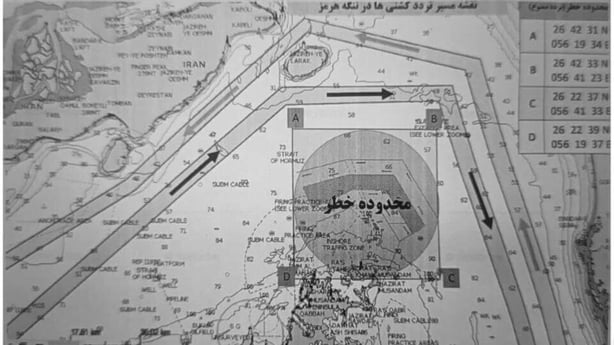
The map suggests Iran is preparing to reopen the Strait, however the presence of sea mines means that the waterway remains dangerous, and that reopening it fully may take days, or longer.
British Foreign Secretary Yvette Cooper is expected to say today that shipping through the Strait of Hormuz, must be toll-free, countering a push by Iran to control a channel long treated as an international waterway.
"The fundamental freedoms of the seas must not be unilaterally withdrawn or sold off to individual bidders. Nor can there be any place for tolls on an international waterway," Cooper will say in an annual foreign policy speech in London, according to advance extracts.
"Freedom of navigation means navigation must be free."
