


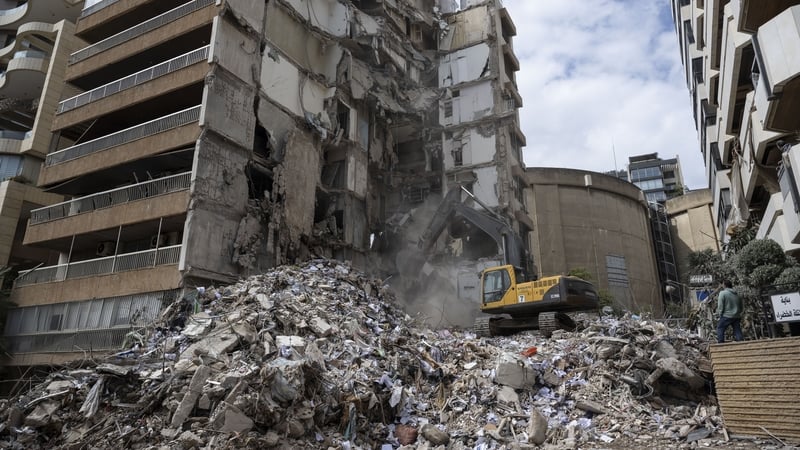
Israeli Prime Minister Benjamin Netanyahu has said he is seeking direct talks with Beirut, a day after the worst bombardment of the war killed more than 250 people in Lebanon and placed President Donald Trump's US-Iran ceasefire in jeopardy.
Mr Trump announced a ceasefire in the six-week-old Iran conflict on Tuesday, just hours before a deadline after which he threatened to destroy Iran's entire civilisation.
In Pakistan, authorities were preparing for the first round of US-Iran talks, locking down the capital Islamabad.
But there was no sign Iran was lifting its near-total blockade of the Strait of Hormuz, which has caused the worst disruption to global energy supplies in history, with Israel's ongoing attacks on Lebanon cited as a key sticking point.
In the first 24 hours of the ceasefire, just a single oil products tanker and five dry bulk carriers sailed through a strait that typically accommodated 140 ships a day before the war, accounting for around a fifth of the world's oil and liquefied natural gas flows.
Mr Netanyahu, whose government rebuffed a historic offer for direct talks with Lebanon last month, said in a statement that he had given instructions to start peace talks as soon as possible, which would also include disarming Iran-aligned militant group Hezbollah.
"In light of Lebanon's repeated requests to open direct negotiations with Israel, I instructed the cabinet yesterday to start direct negotiations with Lebanon as soon as possible," he said.
"The negotiations will focus on disarming Hezbollah and establishing peaceful relations between Israel and Lebanon."
An hour before Mr Netanyahu's statement, Lebanese President Joseph Aoun said he was working on a diplomatic track on this matter that was starting to be seen "positively" by international actors.
A senior Lebanese official said Lebanon had spent the last day pushing for a temporary ceasefire to allow for broader talks with Israel, describing the effort as a "separate track but the same model" as the US-Iran truce.
The official said no date or location had been set yet but that Lebanon needed the US as a mediator and guarantor of any agreement.
Israel says ceasefire does not cover Lebanon
Israel, which invaded Lebanon last month in parallel with the war on Iran to root out Hezbollah, says its actions there are not covered by Mr Trump's ceasefire.
Washington has also said Lebanon is not covered by the truce, but Iran and Pakistan, which acted as mediator, say it was explicitly part of the deal. A host of countries, including Britain and France, said the truce should extend to Lebanon.
Watch: US did not agree that ceasefire would cover Lebanon - Vance
Iran's Parliament Speaker Mohammad Baqer Qalibaf, expected to head the Iranian delegation opposite US Vice President JD Vance, tweeted that Lebanon and the rest of Iran's "axis" of regional allies were inseparable parts of any ceasefire.
A Pakistani source said Pakistan was working on ceasefires for Lebanon as well as Yemen, where Israel has also hitIran-aligned forces.
Israel says it kills Hezbollah chief's nephew
The Israeli military said it had killed the nephew of Hezbollah's Secretary-General Naim Qassem and struck river crossings in southern Lebanon overnight. Israel hit Beirut's southern suburbs just before midnight and at dawn, and hit towns across the south this morning, Lebanese state media said.
Israel expanded its evacuation orders for areas on Beirut's outskirts, telling residents in the Jnah district to leave immediately. Orders also covered areas near Beirut airport and the Camille Chamoun stadium, Lebanon's largest, now converted into a shelter for the displaced.
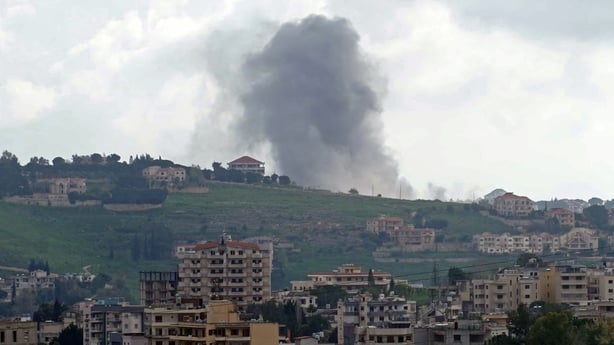
Hezbollah has announced at least 20 military operations, saying it had targeted Israeli vehicles on Lebanese territory as well as firing into northern Israel.
Following yesterday's attacks, which Lebanese officials described as a "massacre", Lebanon declared a day of mourning. Rescuers searched through the night for dead and wounded under rubble after the attacks, which hit heavily populated areas without warnings for civilians to flee.
Outside Beirut's Rafik Hariri University Hospital, a steady stream of ambulances arrived throughout this afternoon, driving past the emergency room entrance straight to the forensic department.
"We're picking up body parts for the most part. It's very rare that we find entire bodies intact," said a rescue worker on condition of anonymity because he was not authorised to speak to the press.
One woman, between tears, said she had lost her entire family in one of the strikes.
Zeev Elkin, a member of Prime Minister Benjamin Netanyahu's security cabinet, said Israel would keep hitting Lebanon, though he signalled it would scale back during the peace talks.
He described yesterday's huge attacks as a one-off, made possible because the ceasefire meant war planes that would be flying sorties over Iran were available to hit Lebanon: "As long as this fragile ceasefire in Iran exists, we can use the entire might of our air force to badly hurt Hezbollah."
After six weeks of war, Mr Trump has sought an off-ramp before the economic consequences derail his presidency.
The ceasefire has curbed a surge in benchmark oil prices, which are based on contracts to deliver oil a month in the future. But present-day spot prices are still rising, with some refineries in Europe and Asia paying record levels near $150 a barrel.
The US retail price for diesel has risen to $5.69 a gallon, just 13 cents below the all-time high.
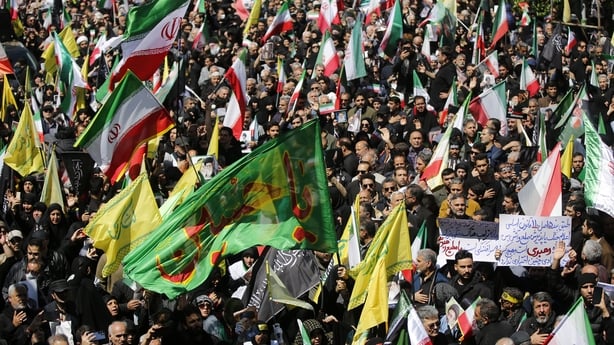
Inside Iran, where the halt to six weeks of US and Iranian airstrikes has been portrayed as total victory for the clerical rulers, huge crowds turned out to commemorate 40 days of mourning for Supreme Leader Ayatollah Ali Khamenei, killed on the war's first day.
State TV showed crowds in Tehran and other cities, with mourners in black carrying Iranian flags and portraits of Mr Khamenei and his son and successor Mojtaba. Commemorative billboards were displayed and a huge Hezbollah flag hung from one building.
US Republicans block bid to rein in Trump Iran war powers
US House of Representatives Republicans have blocked a Democratic effort to end US attacks on Iran, as President Trump's party continued to prevent efforts to rein in the Republican president's war powers.
Representative Chris Smith, a New Jersey Republican, presided over an abbreviated "pro forma" House session, ending it before a group of Democrats could seek to pass the resolution via unanimous consent.
Democrats in the Senate and House of Representatives have tried and repeatedly failed in recent months to pass war powers resolutions to force Mr Trump to obtain politicians' authorisation before launching military operations, in both Iran and Venezuela.
Mr Trump's threat early this week that "a whole civilisation will die" intensified concern from Democrats, dozens of whom called for Mr Trump's removal from office.
The 1949 Geneva Conventions on humanitarian conduct in war prohibit attacks on sites considered essential for civilians.
"Threatening genocide is not a negotiating tactic," Representative Sara Jacobs, a California Democrat, told a news conference outside the Capitol after the pro forma session, held because Congress is out of Washington for the two-week Easter recess.
The White House says Mr Trump's actions are legal and within his rights as commander-in-chief to protect the US by ordering limited military operations.
Iran says its nuclear program is peaceful. The Trump administration has sought to portray the war as a decisive victory, although the top US general said US troops stood ready to resume fighting.
Mr Trump's fellow Republicans hold slim majorities in both the Senate and House, and have almost unanimously backed all of his policies.
Although the US Constitution says that Congress, not the president, can declare war, that restriction does not apply for short-term operations or if the country faces an immediate threat.
Read more: Bloody day in Lebanon puts fragile ceasefire at risk
