
A ceasefire was declared in Washington and Tehran last night, but, here in Beirut, the smoke rising across the city this evening suggests it has not yet reached Lebanon.
For six weeks, the world has watched on as the United States and Israel waged war on Iran - and Iran struck back, closing the Strait of Hormuz, plunging the global economy into crisis, and bringing the entire Middle East to a standstill.
Against that backdrop, Israel has been waging its own war on Lebanon.
More than 1,600 people have been killed here since March, among them well over 100 children. Over a million have been displaced.
More than 1,000 were injured.
The numbers thus far are not far off Iran's own toll - in a country roughly half the size of Munster, with a population of just five million.
Entire villages in the south have been destroyed. Bridges have been blown up.
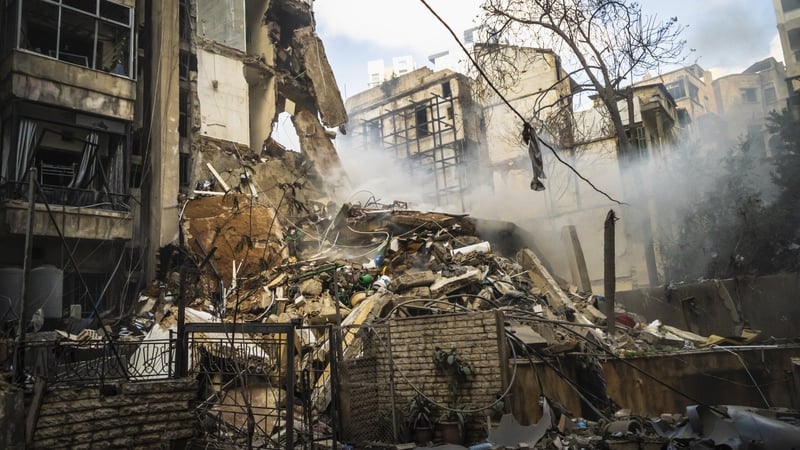
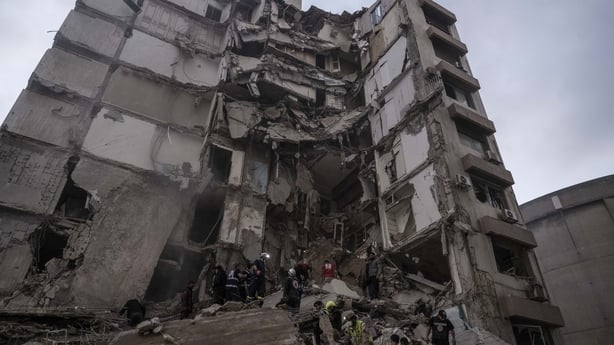
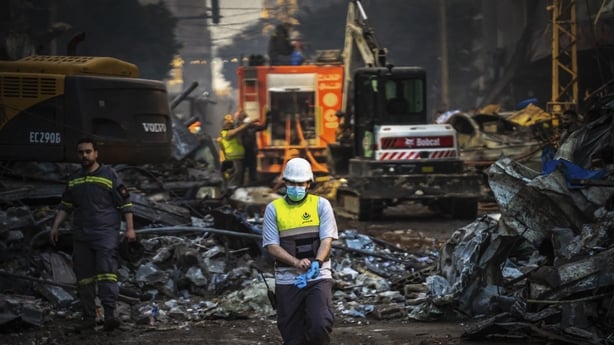
Apartment buildings in Beirut have been reduced to rubble.
The drive from the airport makes that plain to see.
Overhead, the hum of Israeli drones is unrelenting - a sound that Beirut has lived with, day and night, for six weeks.
The road into the city passes close to the southern suburbs, and it is hard to travel far in Beirut without coming upon either rubble or an ambulance.
The scale of the destruction, visible from the car window, is striking even to eyes that have followed this war from a distance.
Many of today’s strikes came without warning - hitting not just the southern suburbs but the city centre and the seafront.
Areas that had, until now, felt removed from the war.
Yet, the world has largely looked away.
When Israel made clear this morning that the ceasefire did not extend to Lebanon, nobody here was particularly surprised.
A country accustomed to being overlooked has learned not to expect otherwise.
As Washington and Tehran each claimed their own "Art of the Deal" moment, Israel issued an evacuation order for the southern Lebanese city of Tyre - one of the oldest cities in the world - and continued to strike across the country.
Pakistan, whose prime minister’s late intervention provided Donald Trump with the diplomatic cover he needed to step back from the brink, maintains that the ceasefire covers Lebanon.
Iran has consistently argued that any ceasefire must include Lebanon, that the wars in both countries are inseparable.
But Israel’s prime minister says otherwise.
While that argument plays out between capitals, Israeli forces are in the process of creating a so-called security zone stretching to the Litani River, cutting off Lebanon’s south from the rest of the country, while indefinitely displacing hundreds of thousands of residents.
It is an invasion by any other name.
Israel’s position is that it had no choice.
It says that Hezbollah drew it into this war on 2 March, firing rockets into Israel in solidarity with Iran.
Its stated goal is to ensure that tens of thousands of displaced Israelis can return to the north of the country - this time with guarantees that hold.
It is that goal - not Washington’s - that is now driving the war in Lebanon.
It is why the two allies, who went to war together six weeks ago with a shared vision, now find themselves pulling in different directions.
But the seeds of this war were sown on 11 February, when Israeli Prime Minister Benjamin Netanyahu became one of the very few foreign leaders ever to present his case in the White House Situation Room.
Flanked on the screens behind him by his military and intelligence officers, Mr Netanyahu made the hard sell for the war.
His pitch had four elements: eliminate Iran’s leadership, cripple its missile programme, trigger a popular uprising, and bring about regime change.
President Trump’s response, according to the New York Times, was brief.
"Sounds good to me," he said.
Within three weeks, bombs were falling on Tehran.
But, six weeks on, those shared objectives have come apart.
Washington wants a deal. Israel, it seems, wants Lebanon - or at least a version of it that suits its purposes.
Finance Minister Bezalel Smotrich has been explicit: "The new Israeli border must be the Litani," he said - a frontier that lies 30km north of where the border with Lebanon currently stands.
At least one Israeli settler group has circulated maps of southern Lebanon with Hebrew place names - arguing for the building of Israeli settlements there.
The Israeli government’s official position is more measured - but the pattern of the past six weeks in Lebanon suggests ambitions that go beyond a temporary buffer zone.
Israel had wanted to go further in Iran, too - to press the military campaign until more objectives were met.
That is why senior Israeli officials have described the ceasefire as the greatest political disaster in their country’s history.
It is a striking verdict - and a revealing one.
Because if Israel cannot be reined in, the fragile agreement reached last night may not survive the week.
The view from Washington is not much better.
The ceasefire will be negotiated on the basis of Iran’s own 10-point framework - a list that includes Iranian control of the Strait of Hormuz, the right to enrich uranium, the lifting of all sanctions, and the withdrawal of US forces from the region.
Washington has not signed up to all ten points.
But the fact that Iran’s wish list anchors the talks is, to put it mildly, not what was promised when the bombs started falling six weeks ago.
The Strait of Hormuz - open before this war began - will reopen imminently under arrangements that give Iran’s armed forces a formal role in managing passage.
Iran’s nuclear stockpile - 400kg of highly enriched uranium - remains intact.
Its regime remains in place.
The talks in Pakistan, when they begin on Friday, start from Tehran’s terms, not Washington’s.
While the ceasefire is, for now, a welcome step back from the abyss, the gap between what Iran is demanding and what Washington will realistically agree to makes a durable agreement hard to imagine.
Dan Shapiro, a former US Ambassador to Israel, was blunt in his assessment.
There would be no agreement on any of the ten points, he predicted.
At best, we can hope for an extension of the ceasefire. At worst, a return to war.
In between, he suggested, lay the most likely outcome: de facto Iranian control of the Strait of Hormuz, and "muddling through multiple rounds of talks that produce no agreement".
For a war that began with promises of regime change, it is a remarkably modest horizon.