


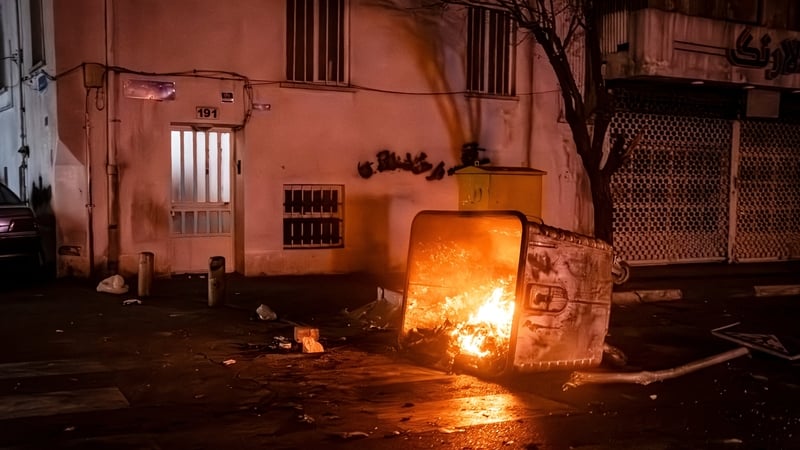
Iran has executed another man convicted in connection with nationwide protests in January, as executions of people regarded by rights groups as political prisoners mount against the backdrop of the war against Israel and the United States.
Ali Fahim, 23, was executed after being found guilty of involvement in an attack on a Tehran base of the Revolutionary Guards' Basij militia during the protests, according to rights groups who have followed the case.
The judiciary's Mizan Online website described him as "one of the enemy elements in the terrorist riots", and said he was put to death after the supreme court approved the original verdict.
Seven men, including Mr Fahim, were sentenced to death in February over the incident. Four, including two teenagers, have now been executed, leaving the three others at imminent risk of execution, according to rights groups.
After an initial pause in executions after the war broke out on 28 February, Iranian authorities have in the last eight days alone put to death ten "political prisoners", said the Norway-based group Iran Human Rights (IHR).
In this period, four people have been executed over the protests, while another six have been executed on charges of membership in the outlawed People's Mujahedin (MEK) opposition group.
IHR said Mr Fahim and his co-defendants has been "subjected to torture and denied access to legal counsel", and were sentenced to death in a "grossly unfair" fast-track trial presided over by judge Abolqasem Salavati.
Mr Salavati was sanctioned in 2019 by the United States, which said he was known as the "Judge of Death" for his frequent use of capital punishment.
"These executions are part of the Islamic republic's strategy of survival - waging war against its own people under the shadow of external conflict," said IHR director Mahmood Amiry-Moghaddam.
"The international community must respond with urgency. The situation of prisoners and the regime's systematic use of the death penalty must be made a central condition in any negotiations or engagement with the Islamic republic," he added.
Mizan said Mr Fahim was convicted of working against Iran on behalf of "the Zionist regime and the United States", as well as breaking into a classified military site to seize weapons.
The nationwide demonstrations were met with a brutal crackdown by the authorities that rights groups say left thousands of people dead.
Iran yesterday executed two men - Mohammad-Amin Biglari, 19, and Shahin Vahedparast, 30 - and on Thursday executed Amir Hossein Hatami, 18, all of whom were convicted in the same case.
Their executions were confirmed by the Iranian judiciary, and their ages given by rights groups.
Amnesty International has said that these executions have shown the judiciary is "a tool of repression sending individuals to the gallows to spread fear and exacting revenge on those demanding fundamental political change".
Iran on 19 March 19 also executed three men accused of killing police officers during the protests in January, in the first carried out related to the demonstrations.
