


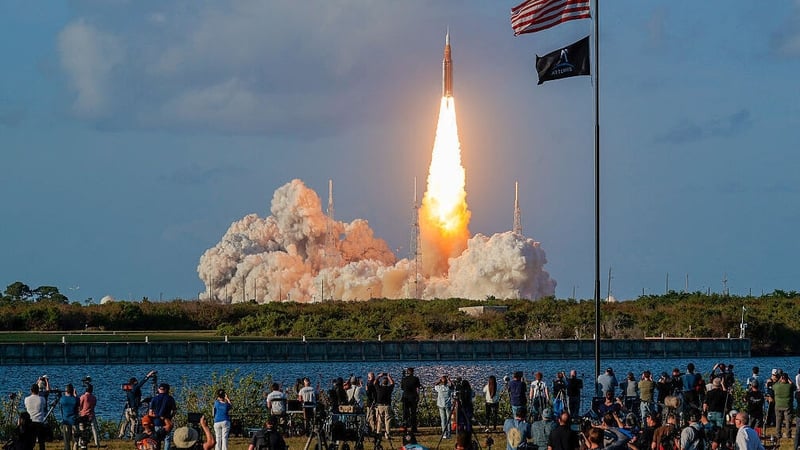
NASA has given the four Artemis astronauts circling Earth the green light to head for the Moon and carry out the first crewed lunar flyby in more than 50 years.
NASA Flight Director Jeff Radigan told the astronauts the mission management team had approved firing up the engine of their Orion capsule to send the spacecraft on a trajectory towards the Moon.
The five minute and 49 second burn is scheduled to take place at 7:49pm Eastern Time (00:49am) and send the astronauts out of Earth orbit to begin the three-day voyage toward the Moon, the first since 1972.
"Flight controllers will closely monitor engine performance, guidance and navigation data throughout the maneuver to ensure Orion remains precisely aligned for the outbound journey," NASA said.
The enormous orange-and-white Space Launch System (SLS) rocket carrying the Orion capsule blasted off from Kennedy Space Center in Florida yesterday for the long-anticipated journey around the Moon.
The astronauts - Americans Reid Wiseman, Victor Glover and Christina Koch and Canadian Jeremy Hansen - spent their first hours in space performing checks and troubleshooting minor problems, including a communications issue and a malfunctioning toilet.
Before getting a few hours of sleep, they ignited the spacecraft's main engine to place it in a high Earth orbit, the US space agency said.
"Artemis II astronauts are doing great," NASA chief Jared Isaacman said in a post on X.
"The Orion spacecraft is performing well in an impressive elliptical orbit," he added.
Orion is to loop around the Moon as part of the 10-day Artemis II mission aimed at paving the way for a Moon landing in 2028.
Read more:
Watch: NASA rocket launches from Florida for Artemis II mission
Astronauts strapped in for historic US lunar launch
Before their rest period, the astronauts performed various checks to ensure the reliability and safety of a spacecraft that has never carried humans before.
Among the problems they identified was a "controller issue with the toilet when they spun it up", said Amit Kshatriya, NASA's associate administrator.
Mr Isaacman said a communications problem had been resolved and the astronauts were "in great spirits".
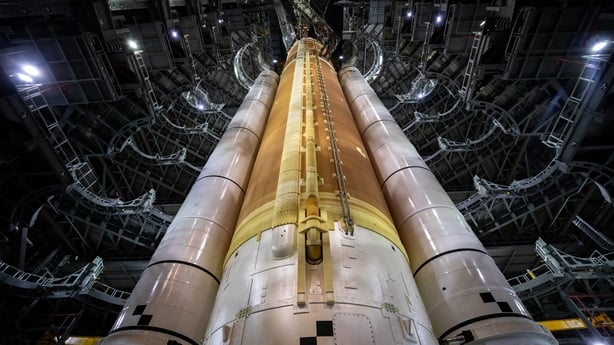
The mission marks a series of historic accomplishments: sending the first person of colour, the first woman and the first non-American on a lunar mission.
If all proceeds smoothly, the astronauts will set a record by venturing farther from Earth than any human before - more than 402,000km.
It is also the inaugural crewed flight of SLS, NASA's new lunar rocket.
SLS is designed to allow the United States to repeatedly return to the Moon with the goal of establishing a permanent base that will offer a platform for further exploration.
It was meant to take off as early as February after years of delays and massive cost overruns.
But repeated setbacks stalled it and even necessitated rolling the rocket back to its hangar for repairs.
The current era of American lunar investment has frequently been portrayed as an effort to compete with China, which aims to land humans on the Moon by 2030.
During a post-launch briefing, Mr Isaacman said competition was "a great way to mobilise the resources of a nation".
"Competition can be a good thing," he said, adding "we certainly have competition now".
The Artemis programme has come under pressure from US President Donald Trump, who has pushed its pace with the hope that boots will hit the lunar surface before his second term ends in early 2029.
Mr Trump praised "our brave astronauts" at the top of his televised address yesterday evening on the war against Iran, calling the launch "quite something".
But the projected date of 2028 for a landing has raised eyebrows among some experts, in part because Washington is relying heavily on the private sector's technological headway.
'Once in a lifetime experience'
We need your consent to load this rte-player contentWe use rte-player to manage extra content that can set cookies on your device and collect data about your activity. Please review their details and accept them to load the content.Manage Preferences
Scientist and Space Writer Dr Niamh Shaw watched last night's Moon launch from Cape Canaveral.
She said it was a once in a lifetime experience that was not like any launches she had previously seen.
Speaking on RTÉ's Six One News, she said: "The most distinctive thing was it just hits you in your chest, you could feel the vibrations in your chest, and then it went down to your feet.
"It was just incredible."
She said that Artemis II is "part of the beginning of an infrastructure where they intend to build a research station on the Moon".
"This mission is testing the living quarters, the Orion Capsule. Artemis I was about the rocket...Artemis III is about the Lander - how are we going to get people to land on the Moon. And if that all goes well, Artemis IV, as they say, footprints and flags on the Moon," she said.
It was anticipated that the two future missions would take place next year and in 2028, which she described as a "very ambitious plan".
"You never know, people who work in the space sector, they make the impossible possible," Dr Shaw said.
