


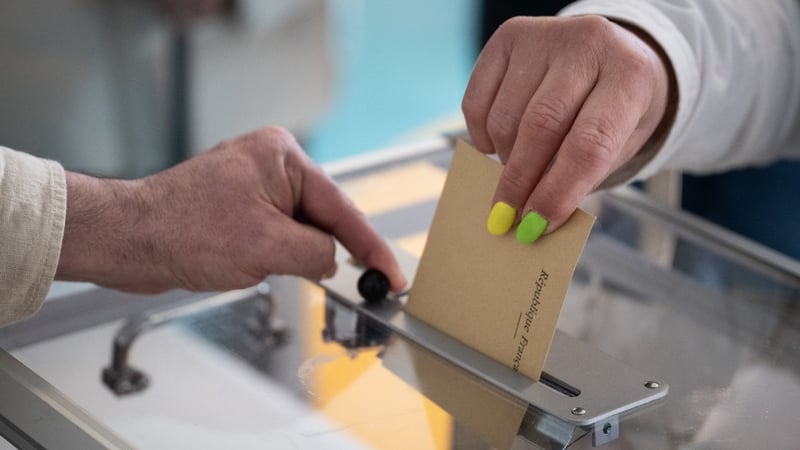
French voters are heading to the polls to vote for mayors and councillors in elections widely seen as a barometer of France's political mood ahead of the high-stakes presidential race next year.
Marine Le Pen's ascendant far-right party views next year's contest as its strongest chance yet to take power, with centrist President Emmanuel Macron constitutionally barred from running again.
The elections in 35,000 villages, towns and cities take place over two rounds held on consecutive Sundays.
While nearly 90% of the French communes are small rural constituencies where local elections are traditionally depoliticised, the races could nonetheless reveal key trends and dynamics, said political scientist Nonna Mayer.
"In large towns, national issues will matter more, and they can give some hints on the electoral dynamic of the main parties," Ms Mayer, who is affiliated with Sciences Po university and scientific research centre CNRS, told AFP.
Who will win cities like Paris, Lyon, Marseille and Nice will matter, she added.
Clarisse Bremaud, a 26-year-old exhibition producer, was among the voters trickling in and out of a polling station in central Paris.
"For me it's important to take part in every election," she told AFP.
"I feel it's even more crucial today with what's happening in France - particularly with the evolution of politics in France and the world."
Historically, France's major cities have been governed either by centre-left parties or the right-wing Republicans.
By contrast, Ms Le Pen's far-right National Rally, the hard-left party of firebrand Jean-Luc Melenchon and Mr Macron's centrists have struggled to establish a strong local footprint.
'France's recovery'
The National Rally (RN), which currently governs only one major city of more than 100,000 inhabitants, Perpignan, hopes to strengthen its local presence by capturing urban centres such as Toulon and Marseille, France's second largest city.
A strong performance would mark an important milestone in the RN's longstanding effort to gain broader acceptance in the political mainstream.
The anti-immigration party sees the elections as an opportunity to show it can govern at the local level.
In one of the highest-profile contests, former prime minister Edouard Philippe is hoping to keep his seat as mayor of the northern port city of Le Havre, a role he has held since 2014.
A loss by him, seen by some as the strongest candidate to take on Le Pen or RN chief Jordan Bardella in the 2027 polls, will deplete his political capital.
All eyes are also on the battle for Paris, where Rachida Dati, a combative former culture minister and one-time protege of now convicted ex-president Nicolas Sarkozy, hopes to wrest control of the city from the left, which has run the French capital for the last quarter-century.
Ms Dati goes neck-to-neck with left-wing candidate Emmanuel Gregoire, 48, and the loss of Paris would be a blow to the Socialist Party ahead of the presidential campaign.
'Health of democracy'
Many mayoral candidates have distanced themselves from political parties, reflecting voters' exasperation with the elites and the paralysis that has gripped the country ever since Mr Macron called snap elections in 2024.
Following a record low turnout during the last local elections, held under the shadow of the coronavirus pandemic, analysts will closely scrutinise the races for possible signs of voter fatigue.
"Turnout will tell us about the health of French democracy," said Ms Mayer, the political scientist, pointing to "political distrust and disaffection".
If no candidate wins an absolute majority in the first round, the vote will proceed to a second round on 22 March.
The week between the two rounds is expected to see political parties negotiating deals with rivals and joining forces against strong opponents.
"The pattern of tactical voting will offer a preview for next year," said Mujtaba Rahman, Europe director at risk analysis firm Eurasia Group.
He said the election results would indicate whether a strategy to contain the far right, known as the Republican Front, was "dead or might still be revived".
Results from the first round are expected this evening, but the outcome in major cities looks uncertain.
