


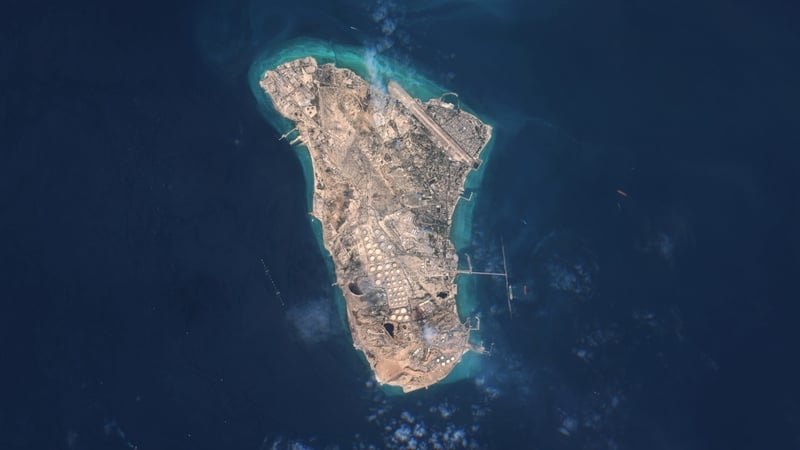
Iran's Kharg Island, targeted in US air strikes overnight, is a scrubby stretch of land in the Gulf that handles almost all of Iran's crude exports.
Announcing the strikes, US President Donald Trump described Kharg as a "crown jewel" for Iran and maintained that every military target on the island had been "totally obliterated".
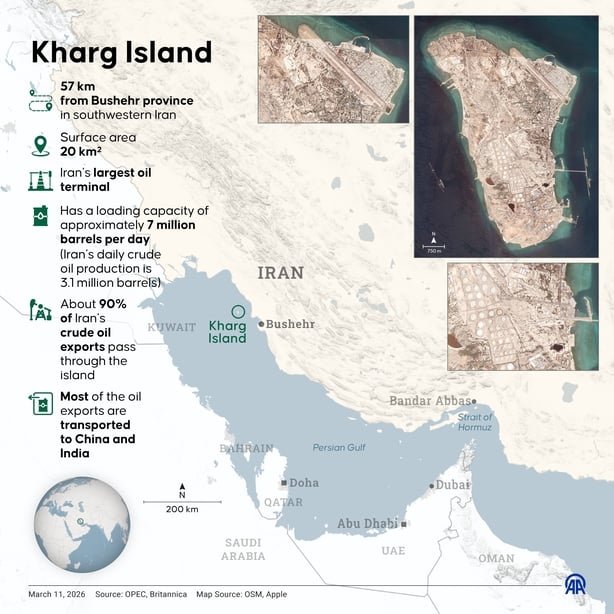
While it is only 20sq/km in size, it contains Iran's largest oil terminal.
Situated around 30km off the Iranian mainland and 500km northwest of the Strait of Hormuz, Kharg is the export terminal for 90% of Iran's oil shipments.
Much of the oil shipped from Iran via Kharg goes to China, the top global crude importer.
The terminal has a loading capacity of approximately 7 million barrels per day.
Any potential strikes on oil infrastructure on Kharg could have serious ramifications on the global oil industry.
Analysts had warned an attack could have major repercussions for the now fortnight-long conflict between the US and Israel and Iran, which began with US-Israeli air strikes that killed supreme leader Ali Khamenei on 28 February.
Iranian strikes have all but halted maritime traffic in the Strait of Hormuz, through which a fifth of global crude oil and liquefied natural gas normally pass, and have also impacted oil infrastructure in other Gulf states.
Mr Trump wrote on Truth Social that for "reasons of decency, I have chosen NOT to wipe out the Oil Infrastructure on the Island."
But he warned: "However, should Iran, or anyone else, do anything to interfere with the Free and Safe Passage of Ships through the Strait of Hormuz, I will immediately reconsider this decision."
Ehsan Jahaniyan, deputy governor of Iran's southern Bushehr province, quoted by the IRNA news agency, said oil companies "at this export terminal are continuing as normal" and there were no casualties.
Kharg underwent key developments during Iran's oil expansion in the 1960s and 1970s, with much of the country's coast too shallow for supertankers.
Iran has looked to diversify its export capabilities by opening the Jask terminal outside the Strait of Hormuz chokepoint in the Gulf of Oman in 2021, but Kharg remains "a critical vulnerability" for Iran, JP Morgan said.
Last night, U.S. forces executed a large-scale precision strike on Kharg Island, Iran. The strike destroyed naval mine storage facilities, missile storage bunkers, and multiple other military sites. U.S. forces successfully struck more than 90 Iranian military targets on Kharg… pic.twitter.com/2X1glD4Flt
— U.S. Central Command (@CENTCOM) March 14, 2026
"It is a cornerstone of Iran's economy and a major source of revenue for the Iranian Revolutionary Guards," JP Morgan added, referring to Iran's well-resourced ideological army which has major economic interests.
There had also been speculation among observers that were US ground forces to look to deploy inside Iran then Kharg would be an obvious first staging post.
Mr Trump has given no indication that such a move could be forthcoming.
Farzin Nadimi, senior fellow at the Washington Institute for Near East Policy, said the US could move to seize the island when hostilities end, but that it was "not a wise move" during combat when Kharg is "almost an entire island of oil facilities and pipelines and tank farms".
"It is very difficult to wage a military operation on that particular island," he said last week.
But other oil infrastructure could be in the crosshairs, with Mr Trump repeatedly referencing his operation to topple Venezuelan president Nicolas Maduro and gain access to the country's oil reserves in January as a blueprint.
Iran, the fourth-biggest crude producer within the Organization of the Petroleum Exporting Countries (OPEC), vowed not one litre of oil would be exported from the Gulf while the war continues.
Any attack on its infrastructure would get an "eye for an eye" response, it said.
