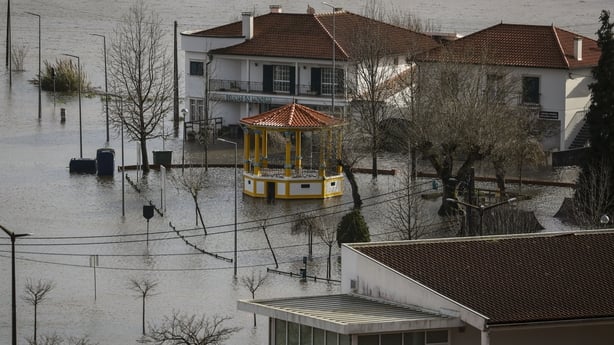
The world logged its fifth hottest February on record, with western Europe hit by extreme rainfall and widespread flooding, according to the European Union's climate monitor.
Global temperatures last month were 1.49C above pre-industrial times, defined as the 1850-1900 period before large-scale fossil fuel use drove climate change.
Temperatures and precipitation varied widely in Europe.
The average temperature in Europe was among the three coldest in the past 14 years at -0.07C.
But western, southern and southeast Europe experienced above average temperatures, according to the Copernicus Climate Change Service.
Colder conditions were experienced in northwest Russia, Baltic countries, Finland and its Scandinavian neighbours.
"Wet and dry conditions across the continent showed a pronounced contrast: much of western and southern Europe was wetter than average, whereas the rest of the continent ... was mostly drier than average," the service said in its monthly report.
The United States, northeast Canada, the Middle East, Central Asia and east Antarctica had warmer than average temperatures.
Sea surface temperatures were the second highest for the month of February.
In the Arctic, the average sea ice extent was at its third lowest level for the month at 5% below average.
In the Antarctic, the monthly sea ice extent was close to average for February - a "sharp contrast to the much below average" levels observed over the past four years, Copernicus said.
Human-driven climate change intensified torrential downpours that killed dozens and forced thousands of people from their homes across Spain, Portugal and Morocco between January and February, according to the World Weather Attribution network of climate scientists.
"The extreme events of February 2026 highlight the growing impacts of climate change and the pressing need for global action," said Dr Samantha Burgess, strategic lead for climate at the European Centre for Medium-Range Weather Forecasts, which operates Copernicus.
"Europe experienced stark temperature contrasts," Dr Burgess said.
"Exceptional atmospheric rivers - narrow bands of very moist air - brought record rainfall and widespread flooding to western and southern Europe," she added.
Storm frequency and record rainfall led to saturated ground, says Burgess
Speaking on RTÉ's Morning Ireland, Dr Burgess said that south-east Ireland was among the worst affected regions by flooding during last month’s deluge of rainfall.
Listen: France, Ireland, Spain, Portugal were Europe regions hit worst by February rainfall
We need your consent to load this rte-player contentWe use rte-player to manage extra content that can set cookies on your device and collect data about your activity. Please review their details and accept them to load the content.Manage Preferences
She said there were three main factors that caused the increased rainfall.
"In a warming climate, we know that a warmer atmosphere holds more moisture. So, in Europe in particular, when it rains, it rains more intensely.
"That has meant that throughout winter this year we've had milder but wetter conditions and that's because the polar jet has moved further south.
"Normally it's up hitting Scandinavia," Dr Burgess said.
She added: "The third one is atmospheric rivers. So, because the atmosphere can hold more moisture, and we've had really high sea surface temperatures across the Atlantic, that's driven these intense atmospheric flows of water vapour, which has been dropping out and hitting Europe with severe storms."
Dr Burgess said that all of those factors have been influenced by climate change.
"We've always had bad storms, and it's not unusual to have a bad storm at this time of year but we had seven or eight storms in a row.
"That frequency of storms, with record amounts of precipitation also, meant that the ground was super saturated," she said.
"So the ground couldn't absorb any more because of the frequency of the storms, which then meant runoff was more challenging to deal with."