


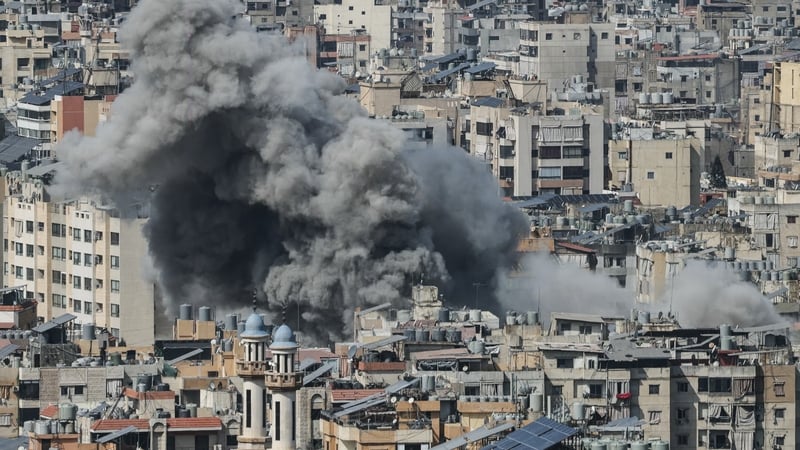
Israeli airstrikes pounded the southern suburbs of Beirut today, wrecking city streets in an escalating conflict with Iran-backed Hezbollah that has sent tens of thousands of Lebanese from their homes.
Israel ordered everyone in the densely populated suburbs, a Hezbollah stronghold, to leave before launching strikes that lit up the sky overnight.
It earlier warned civilians to quit swathes of southern and eastern Lebanon, not just areas near its borders.
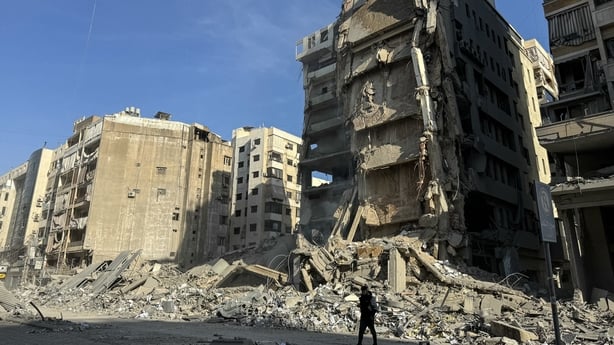
They were the widest evacuation orders ever given by Israel against Lebanon and prompted a huge exodus of people before bombardments that turned buildings into rubble and took the facades off apartment blocks.
Hezbollah said this morning it was fighting an Israeli ground incursion in the south, targeting a gathering of military vehicles near the town of Khiyam, and telling residents of Israeli communities near the border to leave.
Lebanon was pulled into the war in the Middle East on Monday, when Hezbollah fired rockets at Israel that ignited a new Israeli offensive against the Shia Muslim group - Iran's most powerful regional ally - 15 months after their 2024 war.
Israel also launched a new wave of attacks on Iran, saying 50 of its warplanes had struck a bunker still being used by Iran's leadership beneath Ayatollah Ali Khamenei destroyed Tehran compound.
Iran's president has announced that unspecified countries had begun mediation efforts, one of the first signals of any diplomatic initiative to end the conflict.
In a post on X, Masoud Pezeshkian said: "Some countries have begun mediation efforts. He did not identify the countries or provide further details.
"Let's be clear: we are committed to lasting peace in the region, but we have not the slightest hesitation in defending the dignity and authority of our country. Mediation should address those who underestimated the Iranian people and ignited this conflict," he added.
Under Iran's system, the president is subordinate to the supreme leader, but Mr Pezeshkian is now serving on a panel that has assumed Khamenei's duties.
Trump demands Iran's 'unconditional surrender'
Meanwhile, US President Donald Trump has demanded Iran's "unconditional surrender", a dramatic escalation of his demands a week into the war he launched alongside Israel.
"There will be no deal with Iran except UNCONDITIONAL SURRENDER!" Mr Trump wrote on his Truth Social platform.
"After that, and the selection of a GREAT & ACCEPTABLE Leader(s), we, and many of our wonderful and very brave allies and partners, will work tirelessly to bring Iran back from the brink of destruction, making it economically bigger, better, and stronger than ever before."
The surrender demand, and the likelihood that this would complicate any quick path to ending a conflict that has interrupted global energy supplies, caused immediate shock in financial markets.
European share markets, open at the time of Mr Trump's post, suffered a sudden swoon. Wall Street opened sharply lower soon after.
Yesterday, Mr Trump said that he was demanding the right to help select Iran's new supreme leader.
Watch: Aftermath of airstrikes on suburbs of Beirut
Israel's military says 115 targets struck in Lebanon
An Israeli military official said 26 waves of strikes were launched against Hezbollah in the southern suburbs today, striking about 115 targets including residential buildings that the official said the group used as headquarters.
Israeli airstrikes have also targeted Tripoli in the north of Lebanon, Tyre, Sidon and Nabatieh in the south, and Baalbek in the east, the official said.
Israeli military video showed what it said were strikes on command centres and weapons facilities in Lebanon. Reuters could not independently confirm that the buildings Israel hit did contain command centres or weapons facilities.
The evacuation orders issued by the Israeli military have reached an extent never seen before, an international aid official said.
"What we saw in the last couple of days is, I would say ... unprecedented in terms of the scale here in Lebanon of the warnings, the displacement orders, and the reaction, the panic also, that this has all created," said Imran Riza, UN Humanitarian Coordinator in Lebanon.
Read more: Trump urges Iranian Kurds in Iraq to attack Iran as war widens
The fighting was triggered by the Israeli and US strikes against Iran almost a week ago that killed the country's supreme leader, a figurehead for Hezbollah, and set the Middle East ablaze.
Hezbollah, a Shia Muslim group established by Iran's Revolutionary Guards in 1982, was badly weakened by Israel during the 2024 war and has been under pressure over the past year to demilitarise and give up its weapons.
The Lebanese health ministry has reported 217 people killed and another 798 wounded as a result of Israeli attacks this week. Its figures do not distinguish between civilians and combatants.
At least ten Israelis have been killed by Iranian attacks,
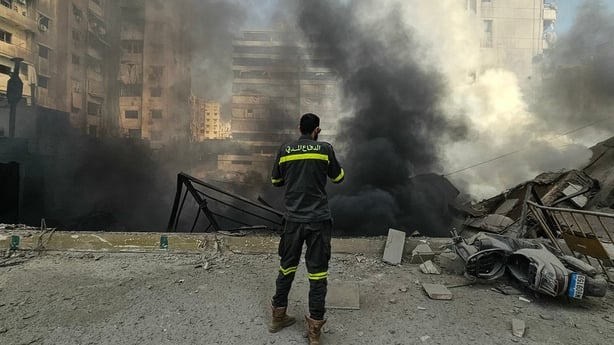
The Norwegian Refugee Council which has people on the ground in Lebanon, Iran, and elsewhere in the Middle East, has said that 300,000 people have already been displaced and that up to 1,000,000 people are at risk of being displaced under Israeli evacuation orders in Lebanon.
UN human rights chief Volker Turk has criticised Israel's evacuation orders, saying they raised serious concern under international humanitarian law.
Israel has sent tanks and troops deeper into southern Lebanon and they were visible yesterday operating in a bombed-out village near the frontier with smoke rising in the distance.
Hundreds of Israeli troops were also seen yesterday setting up fortifications on the Israeli side of the border fence.
We need your consent to load this rte-player contentWe use rte-player to manage extra content that can set cookies on your device and collect data about your activity. Please review their details and accept them to load the content.Manage Preferences
