


Spanish Prime Minister Pedro Sanchez has doubled down on his opposition to the attack on Iran by the US and Israel, warning that the conflict risked playing "Russian roulette" with the lives of millions.
Mr Sanchez was responding after US President Donald Trump threatened to cut trade with Spain over its position on the conflict.
"This is how humanity's great disasters start ... You cannot play Russian roulette with destiny of millions," Mr Sanchez said in a televised address to the nation.
Tensions between the two NATO allies increased after Mr Sanchez denounced the US and Israeli bombings of Iran, which began on Saturday, as reckless and illegal, and later banned US aircraft from using naval and airbases in southern Spain for the offensive against Tehran.
Watch: Donald Trump threatens to cut ties with Spain over its stance on conflict
Mr Sanchez said the world could not solve its problems with conflicts and bombs.
"The position of the Spanish government can be summarised in four words: 'No to the war,'" he said, adding the stance was not disingenuous but coherent.
"We're not going to be complicit in something that's bad for the world nor contrary to our values and interests simply to avoid reprisals from someone," Mr Sanchez said, appearing to reference Mr Trump's trade threats.
Mr Sanchez highlighted the negative knock-on effects of the Iraq war, from a rise in jihadist terrorism to soaring energy prices, to argue that the consequences of this attack on Iran were just as nebulous and that it would not lead to a more just international order.
The European Commission said it was "ready" to defend EU interests.
"We stand in full solidarity with all member states and all its citizens and, through our common trade policy, stand ready to act if necessary to safeguard EU interests," said commission spokesman Olof Gill in a statement issued in response to Mr Trump's threats.
Meanwhile, Canadian Prime Minister Mark Carney said the US-Israeli strikes on Iran had been "inconsistent with international law", and called for a rapid de-escalation of the conflict.
Speaking at a gathering of the Lowy Institute think tank in Sydney, Mr Carney said Canada welcomed steps to change Iran's form of government - which he said represented the "principal source of instability and terror" in the Middle East.
But, he said, the action "would appear, prima facie, not to be consistent or to be inconsistent with international law".
"It's a judgement for others to make," he added.
"I'm not a lawyer, let alone an international legal expert."
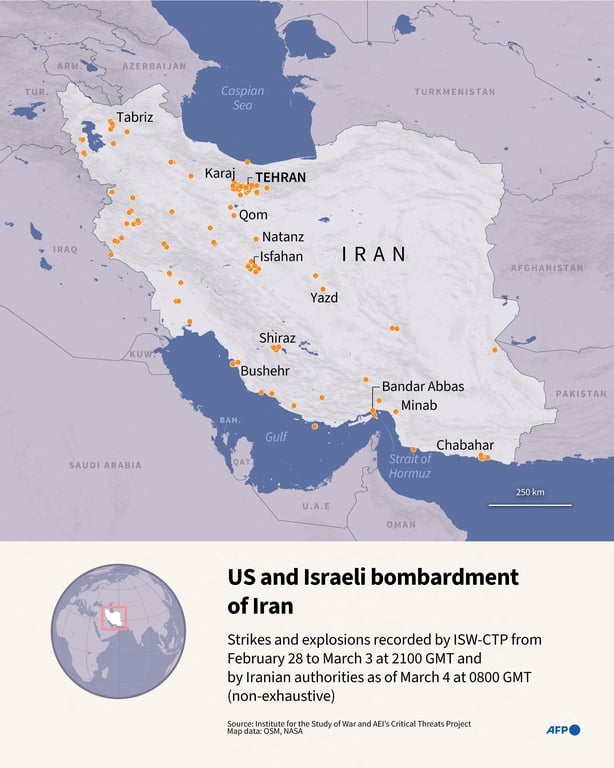
Mr Carney's comment came on the second day of an official visit to Australia, a trip aimed at bringing in investment and deepening ties with a fellow "middle power" partner.
The trip is part of a multi-country tour of the Asia-Pacific aimed at reducing reliance on the United States - a hedge against what Mr Carney has described as a fading US-led global order.
The former central banker has frequently clashed with Mr Trump, who has threatened to annex Canada and slapped stiff tariffs on the country.
In a speech to political and financial elites at the World Economic Forum in January, Mr Carney warned the US-led global system of governance was enduring "a rupture".
And today, the Canadian prime minister said the war in the Middle East represented "another example of the failure of the international order".
"Canada calls for a rapid de-escalation of hostilities and is prepared to assist in achieving this goal," he said.
"Canada reaffirms that international law binds all belligerents," he said.
Watch: Mark Carney says US-Israel actions 'inconsistent with international law'
Mr Carney has backed the Israeli-US strikes targeting Iran, saying Tehran had failed to dismantle its nuclear programme and cease support for militant groups.
But he expressed "regret" that international efforts had failed to disarm Iran.
And he noted that "the United States and Israel have acted without engaging the United Nations or consulting with allies, including Canada".
Mr Carney will meet Australian Prime Minister Anthony Albanese tomorrow and address parliament in the capital Canberra.
Albanese's office has framed Carney as a like-minded leader and said his trip will focus on economic security and critical minerals - of which Australia has vast reserves - as well as defence.
