


US President Donald Trump has warned that combat operations in Iran would continue until all objectives are achieved, as he confirmed in a video posted on Truth Social that three US service members had been killed and said there would likely be more American casualties.
He has vowed to avenge their deaths in a war he launched on Iran as he acknowledged more casualties were likely.
"Sadly, there will likely be more before it ends," Mr Trump said in a video address.
"But America will avenge their deaths and deliver the most punishing blow to the terrorists who have waged war against, basically, civilisation."
He warned Iran's security forces to surrender or be killed, after the US military said it destroyed the headquarters of the elite Revolutionary Guards.
"I once again urge the Revolutionary Guard, the Iranian military and police to lay down your arms and receive full immunity or face certain death. It will be certain death. It won't be pretty," he said.
Meanwhile, British Prime Minister Keir Starmer said he had agreed to let the United States use UK bases to fire "defensive" strikes aimed at destroying Iranian missiles and their launchers.
But in a video address posted to social media, he added: "We were not involved in the initial strikes on Iran and we will not join offensive action now."
In a statement earlier, France, Germany and the UK said they were ready to defend their interests and those of its allies in the Gulf if necessary by taking "defensive action" against Iran.

Iran's retaliatory missile and drone campaign in the Gulf has killed four people and wounded dozens more since attacks began, Emirati authorities said.
For a second day, journalists heard repeated, powerful blasts in Dubai, Doha and Manama, with explosions also in Riyadh, as Iran launched counterstrikes following US and Israeli attacks that killed its supreme leader and other top officials.
Iran's continued and unprecedented Gulf bombardment has raised fears of a wider conflict and rattled a region long seen as a haven of peace and security in the turbulent Middle East.
The death toll from an Iranian missile attack in the Israeli city of Beit Shemesh rose to at least nine people, first responders said, in the deadliest strike in the country since the war began.
Emergency services said 28 people were also injured after what police said was a direct hit on a building.
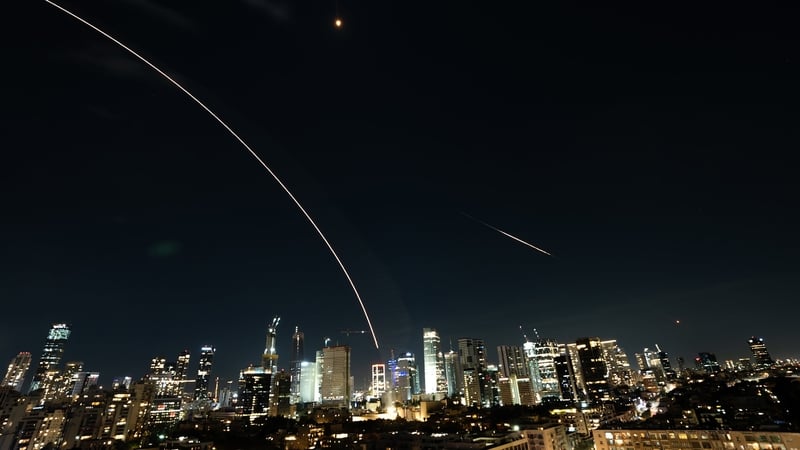
Air raid sirens repeatedly sounded across Israel, warning residents of an incoming attack, and in Tel Aviv, a series of explosions were heard as Israel's air defence system sought to intercept the latest Iranian offensive.
Tehran also appeared to target a building complex in the UAE capital Abu Dhabi housing several foreign missions, including the Israeli embassy.
Drone footage of aftermath of missile strike on Beit Shemesh
Two people were injured by debris during the incident at Etihad Towers.
Three people - Pakistani, Nepalese and Bangladeshi nationals - have been killed in the UAE since Saturday, according to Abu Dhabi's defence ministry.
Dubai's and Abu Dhabi's stock exchanges will be closed until Tuesday due to the ongoing conflict in the region, the UAE's financial regulatory authority announced.
Since Saturday the UAE detected 165 ballistic missiles, destroying 152, and intercepted two cruise missiles, the ministry said
It added that 506 of 541 Iranian drones were shot down.
In Kuwait, the health ministry said one person had been killed and 32 others injured since Saturday.
In Oman, which helped mediate US-Iran talks and was the only Gulf state spared in the first day of the Iranian campaign, the port of Duqm was targeted by two drones, the Oman News Agency said.
"One drone struck a mobile workers' accommodation, injuring one foreign worker, while debris from the other landed near fuel tanks, causing no casualties or material damage," it said.
Oman's foreign minister Badr Albusaidi has pushed for a ceasefire on a call with his Iranian counterpart Abbas Araghchi.
Mr Albusaidi "affirmed the Sultanate of Oman's continued call for a ceasefire and a return to dialogue... in a manner that achieves the legitimate demands of all parties," his ministry said.
Watch: Smoke rises in Doha, Qatar after shrapnel falls on industrial area
Hotels become targets
Earlier, Oman said an oil tanker was targeted off the coast. Its crew was evacuated and four of them were injured, the news agency reported.
The Gulf Cooperation Council was to convene via video-link later for a unified response to Iran's attacks.
Across the Gulf, civilian infrastructure has been hit: from airports and seaports to residential buildings and hotels.
UAE presidential adviser Anwar Gargash lashed out at Tehran, calling the attacks on the Gulf states a miscalculation.
"It isolated Iran at a critical juncture. Your war is not with your neighbours," said Mr Gargash.
Gulf security analyst Anna Jacobs said: "The Gulf countries right now are really on the front lines of this brutal war."
"Gulf countries, as always, want to support de-escalation and diplomacy... But this commitment and these principles are being put to the test right now," she added.
"If Iran continues to hit these countries and escalates even more, it will be very difficult for them to just sit and do nothing."
Earlier, drones struck the airport in Bahrain's capital Manama, causing minor damage, authorities said.
The US embassy in Manama urged citizens to steer clear of hotels in Manama, warning they could become potential targets after the Crowne Plaza was hit.
Palm, Burj Al Arab
In the UAE, which has borne the brunt of the attacks, two people were injured when debris from intercepted drones fell on homes in Dubai, authorities said.
On Saturday, the Iranian attacks sparked fires at landmarks such as The Palm seafront development and Burj Al Arab hotel.
At the airport in Abu Dhabi, at least one person was killed and seven wounded during what authorities called an "incident" and another died earlier in the day from falling debris.
Dubai airport, the world's busiest for international traffic, and Kuwait's airport, were also hit.
In Saudi Arabia, Iranian missiles targeting Riyadh's international airport and the Prince Sultan Airbase, which houses US military personnel, were intercepted, a Gulf source briefed on the matter said.
A witness near the airport said they "saw and heard the air defence intercept the missile in the sky".
In Qatar, host of the region's biggest US military base, officials said Iran had launched 65 missiles and 12 drones towards the Gulf state, most of which were intercepted, but eight people were injured, with one in critical condition.
The oil-and-gas-rich Arab monarchies host a clutch of US military bases.
We need your consent to load this rte-player contentWe use rte-player to manage extra content that can set cookies on your device and collect data about your activity. Please review their details and accept them to load the content.Manage Preferences
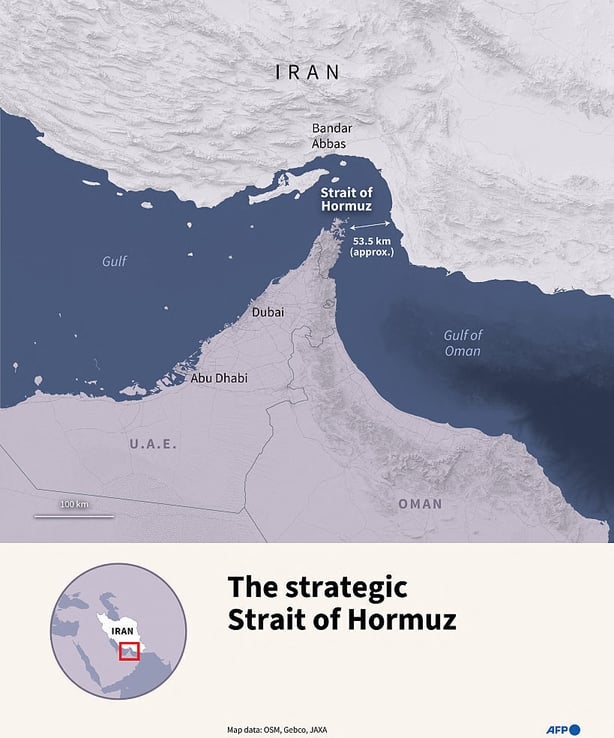
Three ships attacked in Strait of Hormuz: maritime agencies
Three ships were attacked in the Strait of Hormuz on Sunday, maritime security agencies have said.
One ship, off the coast of Oman, was "struck by an unknown projectile above the waterline.
Although the engine room was originally reported as on fire it has now been reported that the fire is under control," the British maritime security agency UKMTO said in a statement.
In a separate incident, another vessel was "struck by an unknown projectile causing a fire. The fire has been extinguished and the vessel intends to continue on its voyage," UKMTO said.
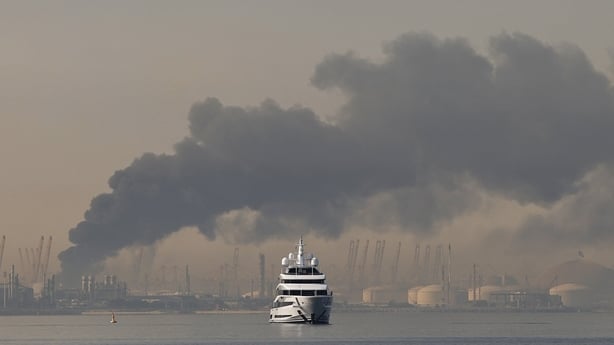
The private maritime security company Vanguard Tech indicated that the second vessel, a tanker, was located approximately 17 nautical miles northwest of Mina Saqr in the United Arab Emirates.
UKMTO later reported another projectile "exploded in very close proximity to a vessel" 35 nautical miles west of the Emirati city of Sharjah.
It said all crew were "safe and well".
Iranian state television said an oil tanker was "sinking" after being struck while transiting the Strait of Hormuz.
The strait is a key transit point for the global oil trade, through which a quarter of the world's oil and a fifth of its liquefied natural gas pass.
Nine dead in Karachi after attempt to storm US consulate
Outrage at the wave of US and Israeli strikes against Iran spilled over into neighbouring Iraq and Pakistan, where crowds attempted to storm US diplomatic missions.
In the Pakistani megacity of Karachi, at least nine people were killed by gunshot wounds during pro-Iran protests at the US consulate.
A diplomat in the compound said: "We're safe."
Large number of protesters also took to streets in other parts of Pakistan, carrying black flags and chanting "down with America" and anti-Israel slogans.
Protesters set fire to a United Nations office building in the northern city of Skardu, in the normally peaceful Shia-majority Gilgit Baltistan region popular with tourists.
Meanwhile, Iraqi police fired tear gas and stun grenades to scatter hundreds of pro-Iranian protesters also gathered outside the Green Zone in the capital Baghdad, where the US Embassy is located.
"Death to Israel, death to America," the protesters shouted.
