


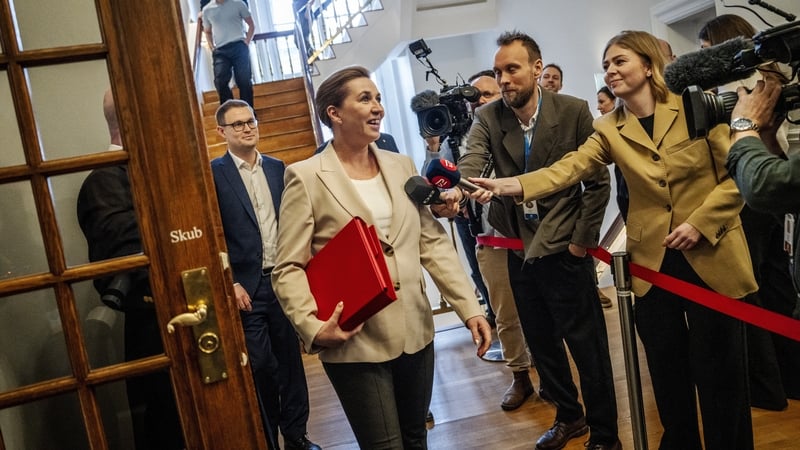
Denmark's Prime Minister Mette Frederiksen has called a general election for 24 March, against a backdrop of tensions with both the United States and Russia.
The vote comes at a time when Denmark's relationship with the US, which Copenhagen considers its closest ally, has been strained over US President Donald Trump's desire to acquire Greenland.
Under the Danish system, Ms Frederiksen had to call an election within four years of the last, which was held on 1 November 2022.
Ms Frederiksen also took the opportunity to present the outlines of her election platform, which included a reform of the retirement age and the introduction of a wealth tax.
She also stressed that Denmark must continue to rearm and help protect Europe from Russia, as Europe grapples with the new geopolitical realities in the wake of Trump's return to the White House.
"Whether I will continue to be your prime minister depends on how strong a mandate you give the Social Democrats in the parliamentary election to be held on March 24, 2026," Ms Frederiksen said.
"Security policy is and will remain the very foundation of Danish politics for many, many years to come."
Copenhagen is among Ukraine's most ardent military and civilian backers.
Over the next four years, Denmark will also have to "stand on our own feet", she declared, adding that relations with Washington would have to be redefined.
Tense US relations
Denmark and Greenland are currently holding talks with the US about the future of Greenland, an autonomous Arctic territory which Mr Trump has argued is crucial for US "national security".
Earlier threats he made to seize the island, by force, if necessary, have ebbed since he struck a "framework" deal with NATO Secretary General Mark Rutte to ensure greater US influence.
Copenhagen has nevertheless insisted that only Greenland and Denmark can make decisions on the island's fate.
In the wake of the dispute, NATO launched a mission, dubbed Arctic Sentry, to strengthen its presence in the Arctic.
Read more:
Will Denmark's hardline migration policy influence rest of EU?
'That's enough' - Greenland's PM reacts to Trump threats
Ms Frederiksen, who hails from a long-standing Social Democratic family, became Denmark's youngest-ever head of government when she was elected in 2019, aged 41.
The daughter of a typesetter and a childcare assistant won re-election in 2022 by forming a coalition government across the aisle with centre-right parties.
While Ms Frederiksen's popularity has been boosted by the recent diplomatic tensions over Greenland, her Social Democrats suffered setbacks in both the European and local elections last year.
The party lost nearly half of the municipalities under its control, including the capital, Copenhagen, ending more than a century of Social Democrat rule.
According to a poll published last week by broadcaster TV2, 21 percent of voters intended to vote for the Social Democrats.
While the party would remain Denmark's largest if true, that would represent a 6.5-percent drop on its 2022 general election haul.
Foreign Minister Lars Lokke Rasmussen, who leads government coalition partner the Moderates, told reporters that "if it were up to us, we would have waited a bit" on calling the election.
"We had not planned for there to be elections, but now there are, and of course we are ready," he said.
