


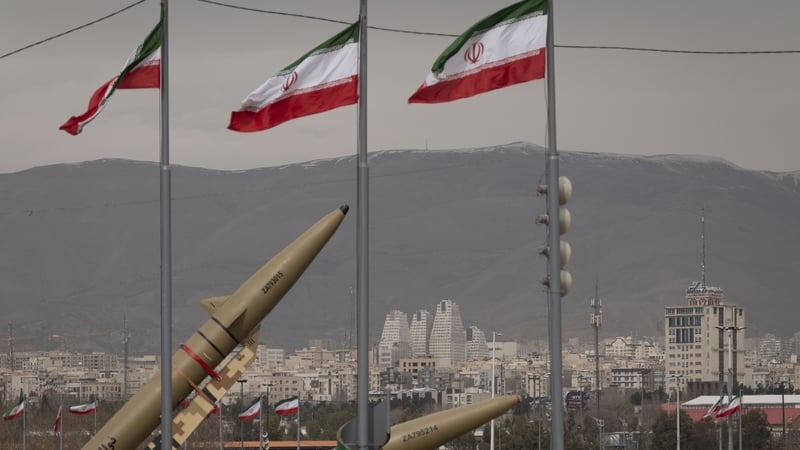
Iran's foreign ministry has dismissed US claims about its missile programme as "big lies", after President Donald Trump claimed Tehran was developing missiles that can strike the United States.
In his State of the Union address, Mr Trump accused Iran of "sinister nuclear ambitions" as the US ups the pressure with a massive military deployment around the Gulf.
The two countries are scheduled to meet for a third round of talks tomorrow in the Swiss city of Geneva in an effort to reach a diplomatic solution.
Mr Trump claimed Iran had "already developed missiles that can threaten Europe and our bases overseas, and they're working to build missiles that will soon reach the United States of America".
He said Iran wants "to start all over again" with its nuclear programme and is "at this moment again pursuing their sinister nuclear ambitions".
But Iranian foreign ministry spokesman Esmaeil Baqaei refuted those claims, without mentioning Mr Trump directly.
"Whatever they're alleging in regards to Iran's nuclear programme, Iran's ballistic missiles, and the number of casualties during January's unrest, is simply the repetition of 'big lies'," Mr Baqaei said on X.
In an interview with Al Jazeera in February, Iran's Foreign Minister Abbas Araghchi said Tehran lacked the capability to target the US but would attack American bases in the Middle East if Washington launched a strike.
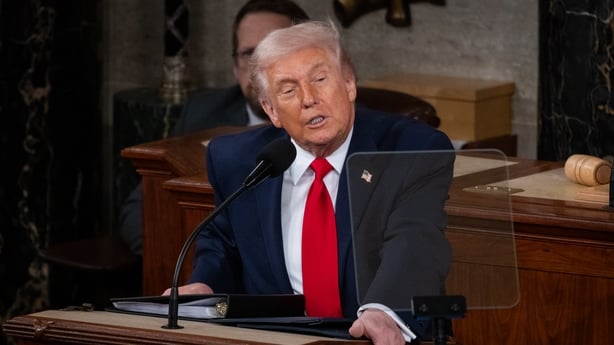
During his State of the Union speech, Mr Trump also reiterated that Iran would never be allowed to build a nuclear weapon, saying that Tehran's leaders were "at this moment again pursuing their sinister nuclear ambitions".
Iran has repeatedly denied it is seeking a nuclear weapon but insists it has the right to use nuclear technology for peaceful purposes.
The US president also claimed that Iranian authorities killed 32,000 people during a wave of protests that started in December and peaked on 8 and 9 January.
Iranian officials acknowledge more than 3,000 deaths, but say the violence was caused by "terrorist acts" fuelled by the US and Israel.
The US-based Human Rights Activists News Agency (HRANA) has recorded more than 7,000 deaths, while warning the full toll is likely far higher.
Mr Trump's claims come after Washington and Tehran concluded two rounds of Oman-mediated talks aimed at reaching a deal on the nuclear programme, with the third round set for tomorrow.
Washington has repeatedly called for zero uranium enrichment by Iran but has also sought to address its ballistic missile programme and support for militant groups in the region, demands Iran has rejected.
Mr Trump, who has ratcheted up pressure on Iran to reach an agreement, has deployed a significant naval force to the Middle East.
Japan calls for release of journalist held in Iran
A Japanese national has been detained in Iran and must be swiftly released, the Japanese government said.
The person was detained on 20 January, Deputy Chief Cabinet Secretary Masanao Ozaki told reporters.
He gave no further details.
Radio Free Europe earlier reported that Shinnosuke Kawashima, the Tehran bureau chief of Japan's public broadcaster, NHK, had been arrested by Iran and transferred to a Tehran prison.
NHK declined to confirm that an employee of theirs had been detained.
"As NHK, we always act with the safety of our staff as the top priority. There is nothing we can answer at this stage," a spokesperson said.
