


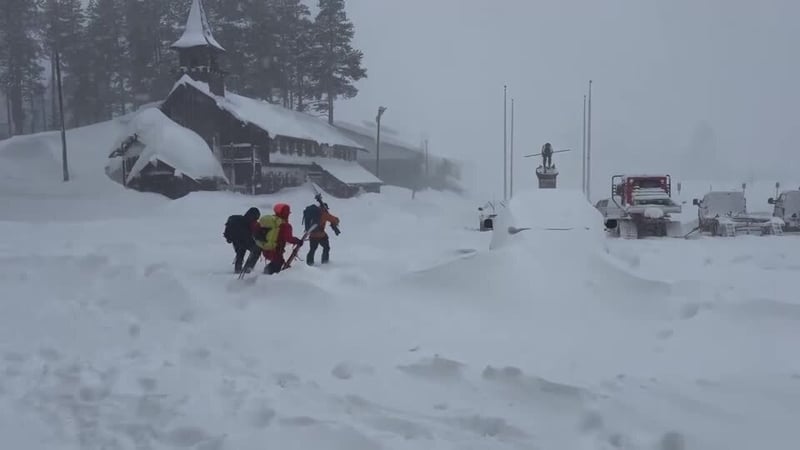
Investigators are working to determine if criminal negligence played a role in the avalanche that killed at least eight people on a guided backcountry ski trip in California, but emphasised it is too early to determine if any charges would be warranted, the Nevada County Sheriff's Office said.
The sheriff’s office, in a written statement said, "in addition to the coroner's death investigations, the Nevada County Sheriff's Office is also conducting a parallel investigation into whether criminal negligence was involved."
It cautioned the investigation was in the preliminary stages and it was too early to name a specific target of any possible charges.
The Nevada County District Attorney’s Office, which would decide on any possible charges, declined to comment.
Eight people were killed and a ninth was presumed to have died when an avalanche in California's Sierra Nevada mountains swept over a group of skiers on Tuesday during a three-day backcountry trip organised by Blackbird Mountain Guides.
It was the deadliest US avalanche in 45 years.
The group of 15 skiers, including four guides from Blackbird, was heading back to a trailhead in heavy snow after a three-day excursion when the avalanche struck. Three of the guides were among those killed.
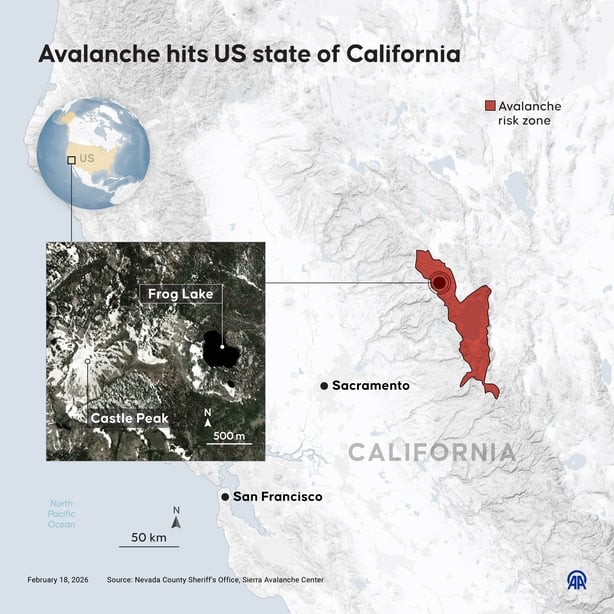
Six survivors were rescued in the rugged Castle Peak area near Truckee, California, about 16km northwest of Lake Tahoe.
Blackbird, which was founded in 2020 and provides guided ski trips, alpine climbing trips and avalanche education, did not respond to a request for comment yesterday.
In a late Wednesday written statement, Zeb Blais, the founder of Blackbird, mourned the loss of life. He said all the guides on the trip were highly trained in backcountry skiing, and each guide was also an instructor with the American Institute for Avalanche Research and Education, based in Colorado.
"There is still a lot we're learning about what happened," Mr Blais wrote. "It's too soon to draw conclusions, but investigations are under way."
He added: "We ask that people following this tragedy refrain from speculating. We don’t have all the answers yet, and it maybe some time before we do."
Ahead of the incident, avalanche centres had warned of particularly dangerous conditions following a massive winter storm that dumped huge amounts of snow on mountains that had seen scant snowpack in the months prior.
Experts warned the weak bed of old snow would be unlikely to withstand the pressure of having a heavy, dense layer of new snow suddenly on top of it, leading to high avalanche risk.
The Blackbird tour group, which included nine women and six men, had been staying at the Frog Lake Backcountry Huts near Donner Summit northwest of Truckee, at about 2,300 metres.
In addition to California, Blackbird runs backcountry tours in Washington state and British Columbia, among other ski destinations.
Frank Carus, the director of the Bridger-Teton National Forest Avalanche Center in Wyoming and a one-time backcountry ski guide, urged people to wait for the results of the investigation before drawing conclusions on who may be to blame, if anyone.
"The main thing here is not to rush to judgment," said Mr Carus, who has investigated deadly avalanches in the past and said such investigations are immensely complicated and can take several weeks to complete.
"The worst thing to do is to blame or shame before the facts are known."
Mr Carus said the training the Blackbird Mountain guides involved in the deadly avalanche had received was the gold standard for the industry.
"These were people tested on their ability to manage clients in the terrain and manage exposure risk," Mr Carus said.
The surviving skiers, who took refuge in a makeshift shelter constructed partly from tarpaulin sheets after the avalanche, used emergency beacons and text messaging to communicate their location to rescuers.
