


US Secretary of State Marco Rubio sought to reassure a nervous Europe on Saturday, saying Washington wanted to recharge the transatlantic alliance so a strong Europe could help the United States on its mission of global "renewal".
Speaking at a security conference in Munich after months of turmoil in US-European relations sparked by US President Donald Trump's vows to seize Greenland and his often derisive remarks about allies, Washington's top diplomat struck a markedly soothing tone.
"We do not seek to separate, but to revitalise an old friendship and renew the greatest civilisation in human history," Mr Rubio said, calling for "a reinvigorated alliance".
We need your consent to load this rte-player contentWe use rte-player to manage extra content that can set cookies on your device and collect data about your activity. Please review their details and accept them to load the content.Manage Preferences
"We want Europe to be strong," Mr Rubio said, adding that the continent and the United States "belong together."
He echoed the Trump administration's oft-stated assertion that immigration poses a threat, saying that "mass migration" is "a crisis which is transforming and destabilising societies all across the West".
He said Europe and the United States were "heirs to the same great and noble civilisation" and that he hoped Europe "together with us are willing and able to defend it".
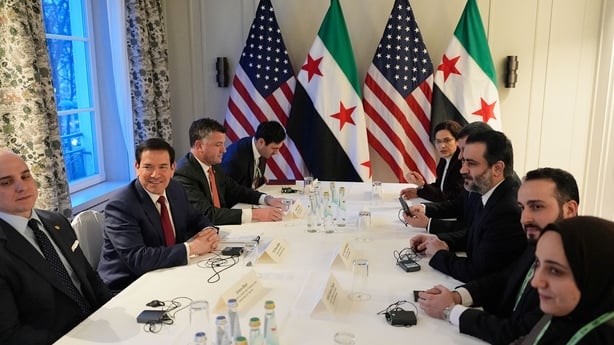
Change in tone
Aside from immigration, Mr Rubio otherwise largely avoided the MAGA flashpoint and culture-war issues that German Chancellor Friedrich Merz said yesterday had deepened a "rift" between US and Europe.
Mr Rubio's speech marked a sharp contrast to that of US Vice President JD Vance a year ago, when he used the same stage to attack European policies on a range of issues including free speech, shocking European allies.
The Trump administration has also charged that Europe faces a "civilisational decline", and has courted far-right parties on the continent.
Ties plunged last month when Mr Trump stepped up threats to annex Greenland, an autonomous territory of NATO member Denmark, forcing European nations to stand firm in protest.
Mr Rubio was tomorrow due to travel to Slovakia and Hungary, European countries run by nationalist leaders endorsed by Mr Trump.
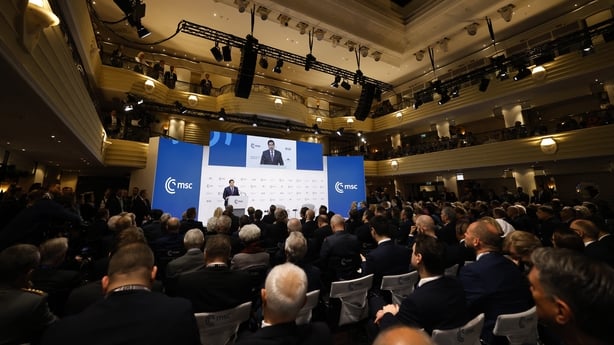
Some breathed a sigh of relief after Mr Rubio's speech, with Estonia's Defence Minister Hanno Pevkur saying: "It was needed to show that we are still allies and partners."
But others said they did not mark a shift in the US stance, with former Lithuanian foreign minister Gabrielius Landsbergis saying: "It was simply delivered in more polite terms. I am not sure the white paint will hold."
European security
European leaders at the Munich Security Conference have pledged to shoulder more of the burden of shared NATO defences, saying this was essential for Europe to counter a hostile Russia.
European Commission chief Ursula von der Leyen told the gathering that "Europe needs to step up and has to take on its responsibility" for its security, including closer ties with Britain 10 years after Brexit.
British leader Keir Starmer echoed the sentiment, saying, "We must build our hard power, because that is the currency of the age," and calling to build "a shared industrial base across Europe which can turbocharge our defence production".
NATO chief Mark Rutte told reporters that although France and Britain, Europe's only nuclear powers, have discussed greater cooperation to make their nuclear deterrence stronger, "nobody is arguing in Europe to do this as a sort of replacement of the nuclear umbrella of the United States."
Read more: Merz eyes European nuclear shield in call for reset with US
Zelensky labels Putin a 'slave to war'
Ukraine's President Volodymyr Zelensky denounced Russia's Vladimir Putin as a "slave to war" in a speech to the Munich Security Conference, adding that Russia's attacks had damaged every power plant in the country.
Mr Zelensky also drew parallels between the current talks between Russia and Ukraine over territorial concessions and the 1938 Munich Agreement, when Hitler forced territorial concessions from the European powers - a year before World War II.
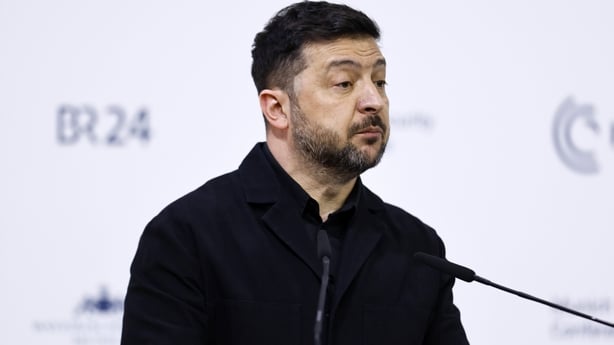
Mr Zelensky was speaking days before the fourth anniversary of Moscow's invasion, which has killed hundreds of thousands, decimated eastern Ukraine and forced millions to flee.
Moscow's attacks on the country's power infrastructure have left millions in the cold. Kyiv and its Western allies have accused Moscow of deliberately freezing Ukraine's population with the energy grid strikes.
"There is not a single power plant left in Ukraine that has not been damaged by Russian attacks," Mr Zelensky said. "Not one."
"But we still generate electricity," he added, praising the thousands of workers repairing the plants.
Once again, he appealed to the West to deliver air-defence systems to Ukraine more quickly.
Of Mr Putin, who launched the war in February 2022, Mr Zelensky said: "He may see himself as a tsar, but in reality he is a slave to war."
Russia and Ukraine will hold US-brokered talks next week, and Mr Zelensky said Kyiv was doing "everything" to end the war.
