


German Chancellor Friedrich Merz has said that Berlin had begun confidential talks with France about a European nuclear deterrent, saying the region had to become stronger in order to reset its relationship with the United States.
In a speech to open the Munich Security Conference, Mr Merz also called on Washington to "repair and revive trust" in a dangerous new era of great power politics, warning the US could not go it alone as the old global order crumbles.
The speech underscored how European leaders are increasingly looking to carve an independent path after a year of unprecedented upheaval in transatlantic ties, while also striving to maintain their alliance with Washington.
Europe faces myriad threats from Russia's war in Ukraine to massive ructions in global trade.
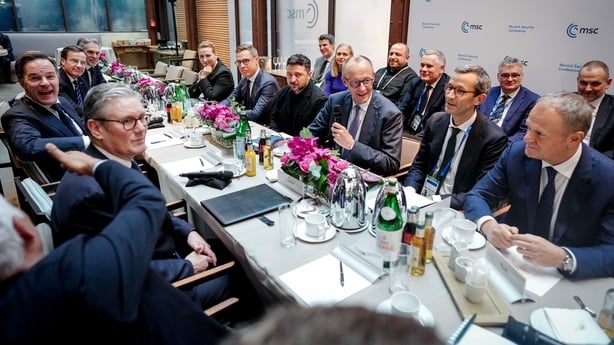
"I have begun confidential talks with the French President on European nuclear deterrence," Mr Merz said. "We Germans are adhering to our legal obligations. We see this as strictly embedded within our nuclear sharing in NATO. And we will not allow zones of differing security to emerge in Europe."
French President Emmanuel Macron is due to make a speech on the nuclear deterrent later this month. Officials have remained guarded on the issue given it is the president's prerogative.
European nations have long relied heavily on the United States, including its large nuclear arsenal, for their defence but have been increasing military spending, partly in response to sharp criticism from the Trump administration.
While Germany is currently banned from developing a nuclear weapon under international agreements, France is the European Union's only nuclear power following Britain's departure from the bloc and has the world's fourth-largest stockpile.
Taking his cue from those warning that the international rules-based order was about to be destroyed, Mr Merz said: "I fear we must put it even more bluntly: This order, however imperfect it was even at its best, no longer exists in that form."
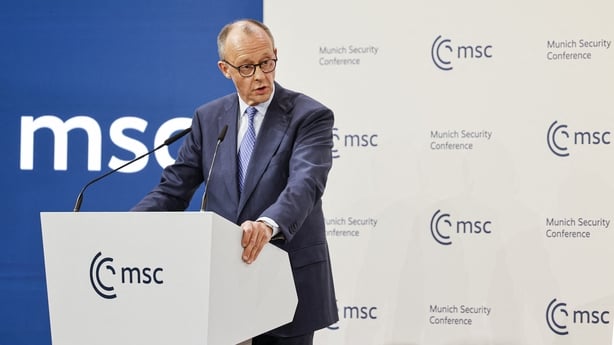
Switching to English at the end, Mr Merz said: "In the era of great power rivalry, even the United States will not be powerful enough to go it alone. Dear friends, being a part of NATO is not only Europe's competitive advantage. It is also the United States' competitive advantage."
"So let’s repair and revive transatlantic trust together," he added.
US Secretary of State Marco Rubio had also said transatlantic ties faced a "defining moment" in a rapidly changing world but struck a more conciliatory tone that contrasted with remarks by Vice President JD Vance in 2025.
At the same gathering of top security officials last year, Mr Vance had attacked European allies in a speech that marked the start of a series of confrontations.
"I think it's at a defining moment ... the world is changing very fast right in front of us," Mr Rubio said before departing for Munich.
"(The US is) deeply tied to Europe, and our futures have always been linked and will continue to be," said Mr Rubio, who is a potential rival to Vance for the 2028 US presidential race. "So we've just got to talk about what that future looks like."
Transatlantic ties have long been central to the Munich Security Conference, which began as a Cold War forum for Western defence debate. But the unquestioned assumption of cooperation that underpinned it has been upended.
Underscoring the damage, a YouGov poll of the six largest European countries showed favourability towards the US in Europe hitting its lowest since tracking began in 2016.
The latest figures are broadly comparable to – and in some cases higher than – the perceived threat from China, Iran or North Korea, although behind Russia, YouGov said.
US President Donald Trump has toppled Venezuela’s leader, threatened other Latin American countries with similar military action, imposed tariffs on friends and foes alike and talked openly about annexing Greenland from fellow NATO member Denmark - a move that could effectively end the alliance.
Last year's speech by Mr Vance accused European leaders of censoring free speech and failing to control immigration, which Mr Merz explicitly rejected.
"A rift has opened up between Europe and the United States. Vice President JD Vance said this very openly here in Munich a year ago," Mr Merz said.
"He was right. The culture war of the MAGA movement is not ours. Freedom of speech ends here with us when that speech goes against human dignity and the constitution. We do not believe in tariffs and protectionism, but in free trade," he said, drawing applause.
'Constructive’ meeting held over Greenland
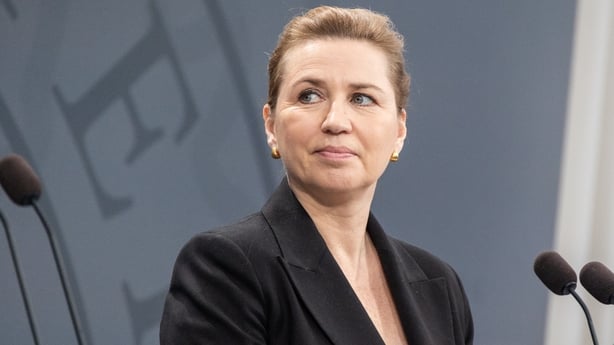
Denmark's prime minister has said she and her Greenlandic counterpart had a constructive meeting with Mr Rubio at the conference over the semi-autonomous Danish territory.
A push by Mr Trump for the US to acquire Greenland prompted severe tensions in recent months within NATO, of which Denmark and the US are both members.
On 28 January, the US, Denmark and the Arctic island nation launched talks as the parties seek to resolve the diplomatic crisis.
"Constructive talk with Secretary of State Marco Rubio together with Jens-Frederik Nielsen, Chairman of Naalakkersuisut, at the Munich Security Conference," Prime Minister Mette Frederiksen said. "Work will continue as agreed in the high-level working group.
Mr Nielsen said on Instagram Greenland's interests were "again clearly highlighted" in the meeting. "It was emphasised that the talks being held are the right way forward," he said.
He has previously stated that if Greenlanders were forced to choose between the US and Denmark, they would choose Denmark.
Mr Trump has been citing national security concerns related to Russia and China in connection with his repeated calls for US control over Greenland. NATO this week announced the launch of a mission to strengthen its presence in the Arctic as part of efforts to defuse tensions.
The president told reporters at the White House: "I think Greenland's going to want us, but we get along very well with Europe. We'll see how it all works out. We're negotiating right now for Greenland".
