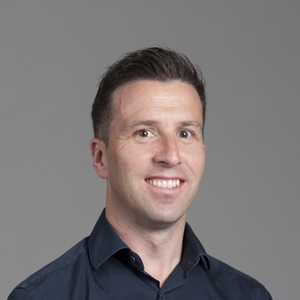
Thomas Maloney Westgard's ears must have been burning.
The Winter Olympic veteran was settling into his cosy surroundings in the athlete's village in Predazzo, in the Italian Dolomites, tucking into a delicious lunch and savouring some of the famous Italian coffee in the warm confines of his new domain.
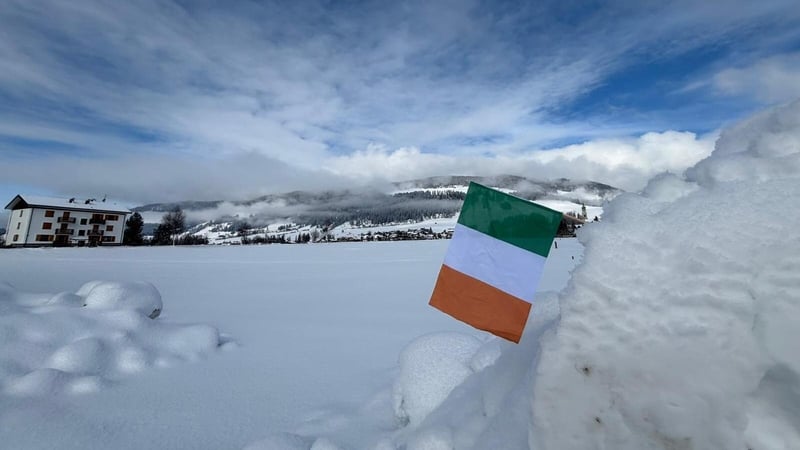
Those who were dispatched to collect his thoughts before his third appearance at a winter games, were, meanwhile, stuck on a steep mountain pass, cold, hungry, and beginning to edge towards giddy despair.
We had been warned that these Winter Olympics were amongst the most "geographically challenging" and spread out in history, with 540km between Milan and the venue in Cortina.
Watch: Tricky conditions for RTÉ's Winter Olympics crew
That it was 540km over the snowy mountain tops - but this "geographic challenge" had to be experienced to be truly appreciated as our wheels spun hopelessly in the sludge.
At one point, the idea was humorously floated that, as part of his training regime for the stamina-sapping cross-country competition he was due to compete in, Maloney Westgard could, perhaps, come to us?
The car we were travelling in showed we were 32 minutes from our destination but in the absence of proper snow tyres and chains, we had ground to a stuttering halt amid the scenic surrounds of the Italian dolomites.
Wheels whirring, snow flying and Mother Nature no doubt grinning at the naïve Irish trio making a bare-faced attempt to defy gravity, physics and the fundamental basics of mountain driving: Don't do it in the wrong car.
Eventually and trying to maintain a somewhat broad philosophical analysis of the situation, Heather Boyle, the Olympic council of Ireland’s communications chief, who was gallantly behind the wheel, had enough.
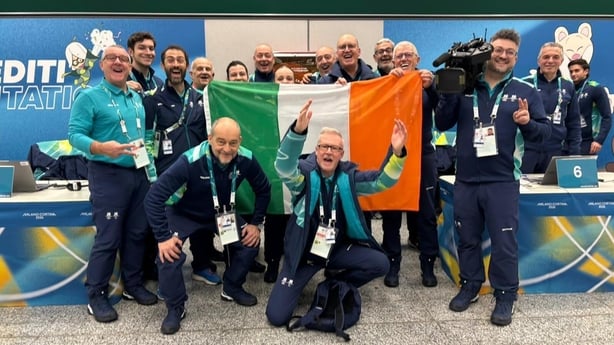
Not all heroes wear capes - on this occasion our saviour had an Irish Olympic hoodie and bobble hat.
Ms Boyle combined her inner Bear Grylls grit with a dash of daring navigation that would have put Michael Caine in 'The Italian Job' to shame in a bid to get us moving again - slowly but surely in the snow.
"Drive over and back, over and back," Stuart Halligan, RTÉ cameraman extraordinaire instructed as Galway woman Ms Boyle, successfully steered us up the snowy slopes.
Miraculously, we reached our destination and made it to Maloney Westgard (the Norwegian with his own Galwegian roots) with a tale of derring-do of our own to tell.
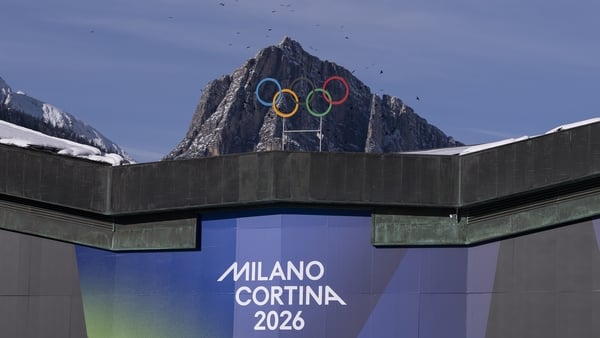
Our experience cannot be the only one: the 2026 Milano Cortina games are different and challenging – not just for the athletes.
Particularly the distance between some of the mountain venues over 12 hours, with the games held within clusters rather than a central city.
International Olympic Committee embracing sustainability
It is all part of the International Olympic Committee’s (IOC) bid to embrace sustainability and adopt a more ecological approach to the sporting spectacle.
Where possible, the IOC encourages host bids to reuse infrastructure and sporting facilities already in existence to ultimately reduce the carbon footprint and the excessive costs of staging a global sporting event.
The Milano-Cortina proudly boast that all venues use 100% renewable energy. That is certainly a plus.
Cortina has been here before though.
Of course, a lot has changed since the winter games were staged here in 1956.
Back then the scenic resort was a bolt hole for the international jet set.
Liz Taylor, Brigitte Bardot and Ernest Hemmingway were among the bright lights who holidayed in the town aptly known as the "Living Room of the Famous".
The boom is back, 70 years on, with restaurants, shops and cafés all bustling with the hoards in town for the Olympic bandwagon.
It is a scene replicated in Predazzo too.
Valentina Galvan works in a bustling café on the Main Street, having moved here from Argentina.
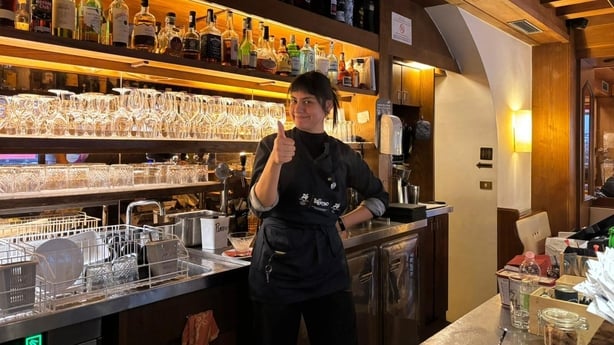
"It's a big deal. It's a big deal for me that I choose this place to be this time of the year," she said.
"And for the people, for the locals, it’s just like a party to have all these people from all around the world here," she added.
She is delighted to make hay while the sun shines, cheerfully acknowledging: "Yeah, it's busy. It's gonna be busier."
"Next week, because now it's chill as they are just arriving, but they are starting to come in," she said.
The plus side of the international influx may potentially manifest in more tips? "I hope so," Valentina laughs.
Everyone’s Olympic experience is unique - and for some, snow chains are hopefully optional.