


The United States has urged three-way talks with Russia and China to set new limits on nuclear weapons, after the last treaty between top nuclear powers Washington and Moscow expired.
Thomas DiNanno, the under secretary of state for arms control, told the UN Conference on Disarmament that the New START treaty, which was allowed to lapse yesterday, had "fundamental flaws".
Serial Russian violations, growth of more worldwide stockpiles and flaws in New START's design and implementation gives the United States a clear imperative to call for a new architecture that addresses the threats of today, not those of a bygone era," he told the conference at the United Nations' European headquarters in Geneva.
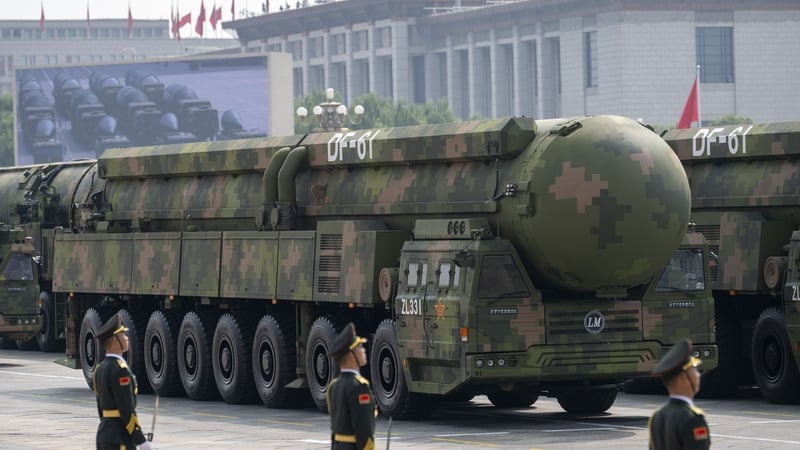
"As we sit here today, China's entire nuclear arsenal has no limits, no transparency, no declarations, had no controls," he lamented.
He added that "the next era of arms control can and should continue with clear focus, but it will require the participation of more than just Russia at the negotiating table".
The expiration of New START, which restricted the US and Russia to deploying 1,550 nuclear warheads each, marks the first time in decades that the world finds itself without a treaty to curb the positioning of the planet's most destructive weapons, sparking fears of a fresh arms race.
US President Donald Trump did not accept a proposal from Russian counterpart Vladimir Putin to keep New START's restrictions in place for another year, and yesterday called for a "new, improved and modernised treaty".
"New START does not allow the United States to credibly uphold both our strategic deterrence commitments to the American people and our extended deterrence commitments to our allies," Mr DiNanno insisted.
"We aim to improve upon New START in order to achieve a new, better strategic stability and arms control architecture that makes the world safer and more secure," he said.
China has already publicly rejected joining disarmament negotiations, noting that its arsenal is much smaller, although it is rapidly growing.
China's ambassador Shen Jian has reiterated that position, insisting to the disarmament body that "China's nuclear capabilities are nowhere near the level of those of the US or Russia".
"China would not participate in nuclear disarmament negotiations at this stage," he said.
Russia's ambassador Gennady Gatilov meanwhile insisted that any new nuclear talks should also include other nuclear-armed states such as France and Britain.
Russia "would be involved in such a process if the United Kingdom and France are also involved, who are military allies of the United States in NATO, which has declared itself a nuclear alliance," he told the conference.
'Unconstrained nuclear competition'
Campaigners have warned that the end of the New START treaty could trigger a global arms race and urged nuclear powers to enter negotiations.
A group of former senior arms control officials from around the world, in a joint statement, called on the United States and Russia to agree to keep observing New START's limits as a first step.
The end of New START "will reduce nuclear stability and predictability, threaten global security, and increase the risk of a new era of unconstrained nuclear competition," they wrote.
UN Secretary-General Antonio Guterres said the nuclear treaties between the United States and Russia after more than half a century were at a "grave moment".
"This dissolution of decades of achievement could not come at a worse time, the risk of a nuclear weapon being used is the highest in decades," Mr Guterres said, after Russian suggestions of using tactical nuclear weapons early in the Ukraine war.
A NATO official, speaking on condition of anonymity, called for "restraint and responsibility" and said that the US-led military alliance "will continue to take steps necessary" to ensure its defence.
The official condemned "Russia's irresponsible nuclear rhetoric.
