


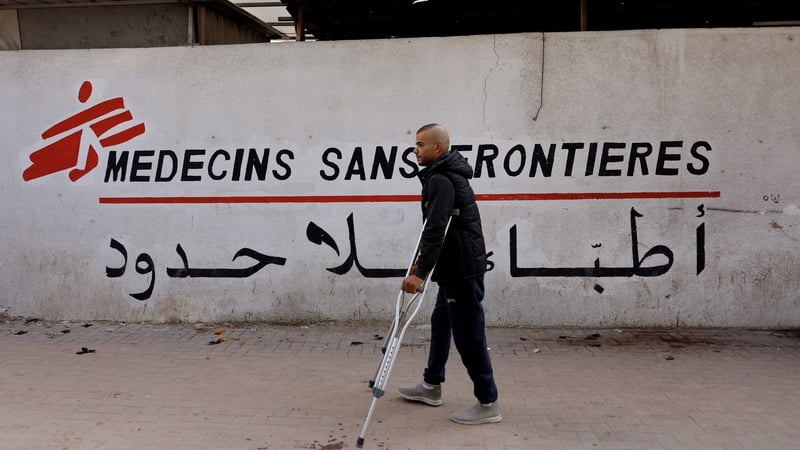
Israel has said it will terminate the humanitarian operations of the international charity Médecins Sans Frontières (Doctors Without Borders) in Gaza after the organisation failed to provide a list of its Palestinian staff.
"The Ministry of Diaspora Affairs and Combating Antisemitism is moving to terminate the activities of Médecins Sans Frontières (MSF) in the Gaza Strip," the ministry said.
The decision follows "MSF's failure to submit lists of local employees, a requirement applicable to all humanitarian organisations operating in the region", it added, stating that the group will cease its work and leave Gaza by 28 February.
MSF said Israel's decision to terminate its operations in Gaza was a "pretext" to obstruct the delivery of humanitarian aid.
"This is a pretext to obstruct humanitarian assistance. Israeli authorities are forcing humanitarian organisations into an impossible choice between exposing staff to risk or interrupting critical medical care for people in desperate need," MSF said in a statement.
"MSF did not hand over staff names because Israeli authorities failed to provide the concrete assurances required to guarantee our staff's safety, protect their personal data, and uphold the independence of our medical operation," it said.
Such demands by Israel will force aid organisations to pull out when "needs are overwhelming and health services are collapsing" in Gaza, it said.
"At a moment when more humanitarian assistance is urgently needed, it is being restricted rather than facilitated," the charity said, adding that it remained open for dialogue with Israeli authorities to maintain its services in Gaza and the occupied West Bank.
MSF said 15 of its employees have been killed over the course of the Gaza war.
We need your consent to load this rte-player contentWe use rte-player to manage extra content that can set cookies on your device and collect data about your activity. Please review their details and accept them to load the content.Manage Preferences
Rafah crossing opening
Israel partially reopened the Rafah crossing between the Gaza Strip and Egypt today, following months of appeals from aid groups, though access is limited to pedestrians.
COGAT, the Israeli defence ministry body coordinating Palestinian civilian affairs, made no mention of allowing in a long hoped-for surge of aid, and clarified that the passage of individuals through the gateway in both directions was expected to begin Monday.
Rafah is considered a key entry point for supplies into the devastated Palestinian territory.
The crossing has been closed since Israeli forces seized control of it in May 2024 during the war with Hamas, aside from a brief and limited reopening in early 2025.
COGAT said the "Rafah Crossing was opened today for the limited passage of residents only", but later added that the "movement of residents in both directions, entry and exit to and from Gaza, is expected to begin tomorrow".
An official at Gaza's health ministry, which operates under Hamas authority, said that about 200 patients were waiting to be permitted to leave the territory once the crossing opened.
AFP footage showed a queue of ambulances entering the crossing from the Egyptian side, though sources said none had been allowed into Gaza yet.
"The opening of Rafah opens a small door of hope for patients, students and people in Gaza," Amin Al-Hilu, 53, who lives in a tent in the territory's Al-Shati camp, told AFP.
"We need the crossing to fully open for travel and bringing in goods without Israeli restrictions, and this I think will require major pressure on Israel."
No displacement of Gazans
A Palestinian official told AFP on condition of anonymity that a group of "around 40 Palestinians affiliated with the Palestinian Authority has arrived on the Egyptian side of the crossing" and was also waiting to be allowed in.
Egypt's state-linked Cairo News reported that the Egyptian side of the crossing would remain open "round the clock" and that Egyptian hospitals were prepared to receive patients coming from Gaza.
The leaders of Egypt and Jordan meanwhile renewed their rejection of any attempts to displace Palestinians from Gaza.
During a meeting in Cairo, Egyptian President Abdel Fattah al-Sisi and Jordan's King Abdullah II "renewed their affirmation of Egypt and Jordan's firm stance rejecting any attempts to displace the Palestinian people from their land", according to a statement from the Egyptian presidency.
The two also called for "unrestricted humanitarian aid access to the Gaza Strip".
Israel had previously said it would not reopen the crossing until the body of Ran Gvili - the last Israeli hostage held in Gaza - was returned.
His remains were recovered days ago and he was laid to rest in Israel on Wednesday, with COGAT announcing the reopening two days later.
COGAT described the reopening as "an initial pilot phase", coordinated with the European Union, adding the parties were carrying out "preliminary preparations aimed at increasing readiness for full operation of the crossing".
Deadly violence
Located on Gaza's southern border with Egypt, Rafah is the only crossing into and out of the territory that does not pass through Israel.
It lies in an area held by Israeli forces following their withdrawal behind the so-called "Yellow Line" under the terms of the US-brokered ceasefire.
Israeli troops still control more than half of Gaza, while the rest remains under Hamas authority.
"We call on the mediators and guarantor states of the (ceasefire) agreement to monitor the occupation's behaviour at the Rafah crossing to prevent Gaza from facing a new Israeli siege," Hamas spokesman Hazem Qassem said in a statement.
The reopening is expected to facilitate the entry of a 15-member Palestinian technocratic body, the National Committee for the Administration of Gaza (NCAG), established under the ceasefire agreement to oversee the territory's day-to-day governance.
However, the NCAG, headed by former Palestinian Authority deputy minister Ali Shaath, was not expected to enter on Sunday, a member of the committee said.
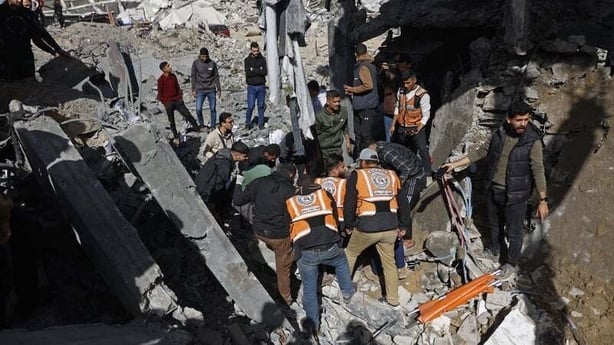
Deadly violence preceded the reopening of Rafah crossing, with the civil defence agency in Gaza reporting at least 32 people killed in Israeli attacks on Saturday.
The military said it struck in retaliation for ceasefire violations when eight militants emerged out of tunnel in Rafah on Friday.
