


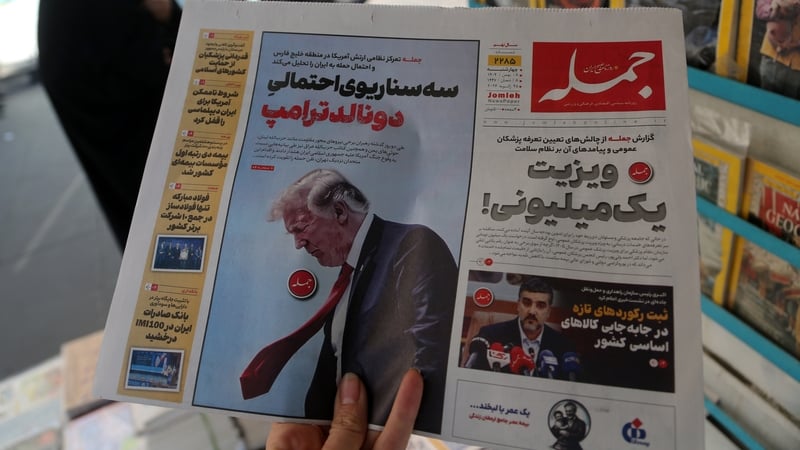
US President Donald Trump has urged Iran to come to the table and make a deal on nuclear weapons or the next attack by the United States could be far worse.
Tehran said that, if it happened, Iran would fight back as never before.
"Hopefully Iran will quickly 'Come to the Table' and negotiate a fair and equitable deal - NO NUCLEAR WEAPONS - one that is good for all parties. Time is running out, it is truly of the essence!" Mr Trump wrote in a social media post.
The Republican president, who pulled out of world powers' 2015 nuclear deal with Tehran during his first White House term, noted that his last warning to Iran was followed by a military strike in June.
"The next attack will be far worse! Don't make that happen again," he wrote.
Mr Trump also repeated that a US "armada" was heading toward the country.
Watch: Trump says another 'armada' floating towards Iran right now
Iran's mission to the United Nations responded in kind.
"Last time the US blundered into wars in Afghanistan and Iraq, it squandered over $7 trillion and lost more than 7,000 American lives," it said in a social media post quoting Mr Trump's statement.
"Iran stands ready for dialogue based on mutual respect and interests - BUT IF PUSHED, IT WILL DEFEND ITSELF AND RESPOND LIKE NEVER BEFORE!"
Iranian Foreign Minister Abbas Araqchi said he had not been in contact with US special envoy Steve Witkoff in recent days or requested negotiations, state media reported.
Mr Trump said that a US naval force - headed by the aircraft carrier USS Abraham Lincoln - was approaching Iran.
Two US officials said on Monday that the Lincoln and supporting warships had arrived in the Middle East.
The warships started moving from the Asia-Pacific region last week as US-Iranian tensions soared following a bloody crackdown on protests across Iran by its clerical authorities in recent weeks.
Mr Trump has repeatedly threatened to intervene if Iran continued to kill protesters, but the countrywide demonstrations over economic conditions and political repression have abated.
He said the US would act if Iran resumed its nuclear programme after the June airstrikes on key nuclear installations.
Iran pressuring families of killed protesters
Families of protesters killed in the protests are coming under pressure from the Iranian authorities with large fines and controlled burials, according to rights groups.
They include relatives of Hossein Mahmoudi, who was shot dead by security forces on 8 January in Falavarjan, outside the central city of Isfahan.
More than a week later, on 16 January, the 36-year-old's family were able to recover his body, according to Iran Human Rights (IHR), a Norway-based non-governmental organisation.
Authorities were initially unwilling to hand over his remains, according to IHR, and only did so after warning the family not to speak publicly about the case and forcing them to pay a fee equivalent to €2,400.
Rights groups say the family's experience is typical for many seeking to recover the bodies of loved ones from morgues which, according to videos posted on social media, have been overwhelmed by the numbers of corpses arriving.
Activists claim that relatives are pressed for large sums of money, forced to falsely claim that dead protesters were members of the security forces, and prevented from holding proper funerals.
"Authorities have relentlessly and cruelly harassed and intimidated bereaved families of killed protesters," said Amnesty International, denouncing a "systematic campaign of intimidation and coercion".
"Relatives were told that the bodies of their loved ones would be withheld unless they paid extortionate sums of money, signed pledges, or made public statements falsely declaring that their deceased relatives were members" of the Basij (youth militia group), it said.
Amnesty said it was aware of at least one case where a family "has not been able to recover their relative's body more than two weeks after his death because they are unable to afford the sum demanded by the authorities".
The United Nations special rapporteur on human rights in Iran, Mai Sato, said that she had received reports that "authorities are coercing families to falsely claim deceased relatives were Basij members allegedly killed by protesters, as well as forcing payments for body retrieval".
These are "cruel practices that compound grief with extortion" she added.
Iranian authorities acknowledge that thousands of people died during the protests, giving a toll of over 3,000, but say the majority were members of the security forces or bystanders killed by "rioters".
Rights groups dispute this, saying the toll is far higher and potentially in the tens of thousands, adding tahtt protesters were killed by security forces directly firing on them.
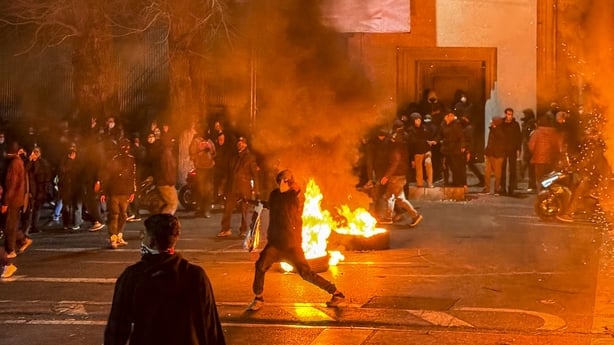
The Hengaw rights group highlighted the case of Ali Taherkhani, who it said was shot and clubbed by security forces in the town of Takestan, northwest of Tehran.
Authorities released the 31-year-old's body to his family only after they were compelled to pay the equivalent of €18,000 and remove condolence banners, the group said.
His burial was conducted under heavy security, with only four relatives allowed to attend amid a large presence of armed security forces, the group added.
"Many families were only able to identify the bodies of their loved ones after days of searching among large numbers of corpses in morgue cold-storage facilities," Hengaw said.
"In order to retrieve the bodies, most families were forced to either pay sums, sign coerced confessions stating that their child had been a member of the Basij, or falsely declare that the individual had been killed by protesters."
Authorities have been eager to ensure that funerals - which under Islam should take place as soon as possible - do not themselves turn into protests.
Footage widely shared on 11 January from Behesht-e Zahra, Tehran's main cemetery, showed angry mourners chanting slogans against supreme leader Ayatollah Ali Khamenei.
"Authorities have pressured relatives into holding burials in the middle of the night in the presence of security forces," said Amnesty International, adding it had also received reports of mass burials to prevent individual funerals from taking place.
