


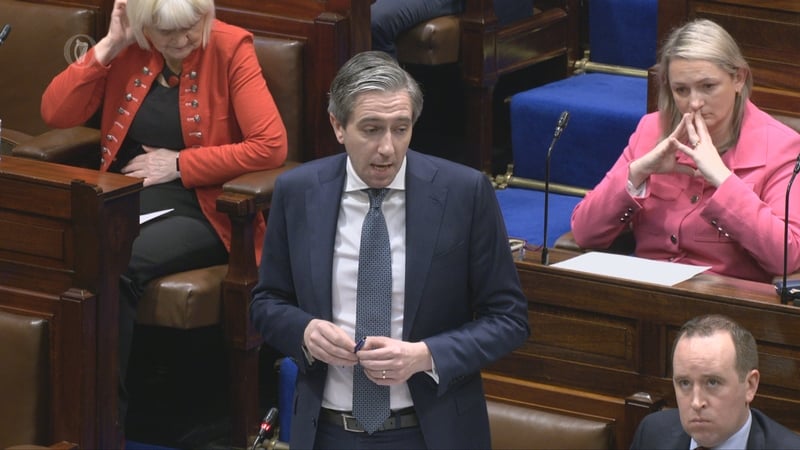
Tánaiste Simon Harris has said he cannot see a scenario where Ireland can participate in US President Donald Trump's Board of Peace.
The board is ostensibly being created to oversee the peace process in Gaza, but Mr Trump also wants to use it in a broader conflict resolution context.
Mr Trump signed the body's charter this morning at the World Economic Forum in Davos.
Speaking during Leaders' Questions, Mr Harris said that in his personal view there was no scenario in which Ireland would join the board "as currently constructed".
He was responding to Social Democrats TD Cian O'Callaghan, who asked the Tánaiste to "categorically" rule out Ireland joining the body.
Mr O'Callaghan told Mr Harris that while other countries have ruled out joining the board, "your Government is apparently still mulling over whether or not to sign up".
Mr Harris said the body raises "very serious red flags".
"We haven't joined the board. We didn't turn up at the signing ceremony," Mr Harris said.
He added: "Anything that Putin is considering joining with the word peace in it, doesn't sit well."
"The cost of $1 billion to join doesn't sit well. Also, anything that in any way seeks to undermine, replace, usurp the United Nations is not something that Government would support."
Govt 'examining' Board of Peace invitation - Taoiseach
He added the board has "very significant governance issues".
Mr O'Callaghan criticised the Government's failure to rule out joining Mr Trump's "gang of war criminals".
"It's proposed charter does not even mention Gaza," said Mr O'Callaghan.
"Given the list of people, who signalled they will join, it's clear that the outfit should be renamed the 'board of autocrats and war criminals," he said.
Mr Harris said the Taoiseach not showing up at the signing ceremony was "responsible".
He said European heads of state will discuss the issue further at a European Council dinner this evening.
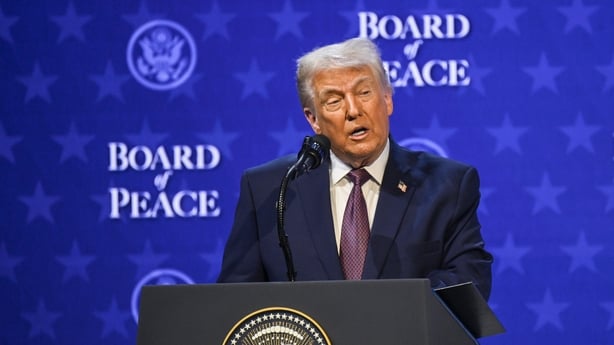
Taoiseach Micheál Martin had earlier said the Government was "examining" an invitation by Mr Trump to join the body.
Speaking in Davos, Mr Martin said: "There are issues that we will examine in respect of it."
He added that the Government welcomed the second phase of the Gaza peace process. However, he wanted to see a dramatic escalation in humanitarian aid into Gaza.
Mr Martin said the remit of the international 'Board of Peace' is "more extensive than envisaged" by the United Nations resolution that approved it for "Palestine and for the Middle East and for Gaza in particular".
Ireland was "very anxious to contribute to peace and conflict resolution in the Middle East and in Gaza", he added. Mr Martin said he met the Palestinian Authority this morning on humanitarian aid, disarmament and decommissioning.
He said there is a "role for Ireland in respect of those kind of issues" and it will be discussed at the EU Council meeting this evening.
"There is an issue about the fundamental point about the United Nations being the key arbiter for peace in the world and conflict resolution and obviously we're reliant to the UN....
"But we will seek further clarification [on the Board of Peace]", he added.
Mr Trump has described his 'Board of Peace' as the "most prestigious board ever assembled at any time, any place".
But some world leaders appear increasingly cautious about his new initiative for resolving international conflicts - which comes with a $1 billion (€855 million) fee for permanent membership.
A number of EU member states have declined an invitation to join the board, largely because of concerns over Mr Trump's prominent role, including veto powers, and its potential to pose a challenge to the primacy of the United Nations.
There have also been concerns over the invitations extended to Russian president Vladimir Putin - who has been indicted by the International Criminal Court (ICC) for war crimes - and the Belarussian dictator Alexander Lukashenko.
British Foreign Secretary Yvette Cooper said the UK would not take part in today's signing ceremony because of "concerns about President Putin being part of something which is talking about peace", according to British Foreign Secretary Yvette Cooper.
Israel's prime minister Benjamin Netanyahu has also agreed to join the board.
"We will consult with our European partners this evening and over the next while, in terms of our contribution to the peace process," Mr Martin said.
"Our principal focus at the moment is to try and contribute to the peace process in the Middle East, given our own experience in conflict resolution, and we believe that the level of humanitarian aid is not going into the degree that it should."
Read more:
Britain, Germany, Norway, Sweden, Italy and Slovenia have declined the invitation, while France is expected to decline. Mr Trump threatened tariffs of 200% on French wine and champagne after President Emmanuel Macron indicated his country would not join the board.
The Taoiseach acknowledged it had been a "very, very difficult" week for transatlantic relations, and the crisis over Greenland had spurred momentum towards greater European autonomy.
"Europe needs to develop stronger self-reliance across the board," he told reporters.
"That is clear, and already that has been happening in respect of the impact of the war in Ukraine. That has really transformed the whole psychology around European security."
Mr Martin said he would travel to Washington for St Patrick's Day to reflect the strength in the US-Irish relationship.
"Economically, [and] in terms of history, Ireland and the US have a very, very strong, robust, good relationship. Economically, [it's] very critical in terms of the number of jobs that are created both ways: Irish companies create jobs in America, multinationals from America create many thousands of jobs in Ireland."
Additional reporting by Reuters
