


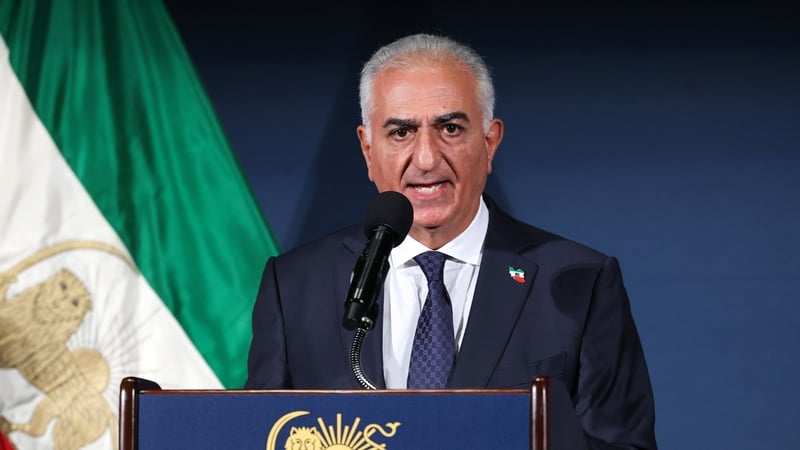
The son of Iran's late shah said Friday he was confident the Islamic republic would fall in the face of mass protests and called for intervention.
"The Islamic Republic will fall - not if, but when," Reza Pahlavi told a news conference in Washington.
"I will return to Iran."
Mr Pahlavi has lived in exile in the United States since the 1979 Islamic revolution toppled his pro-Western father.
Many protesters have chanted Mr Pahlavi's name in mass protests that have swept the country and been ruthlessly repressed.
Mr Pahlavi has said he wants to be a figurehead to lead a transition to a secular democracy, although he has plenty of detractors.
He has repeatedly called for intervention by US President Donald Trump, who has so far not acted.
"Iranian people are taking decisive actions on the ground. It is now time for the international community to join them fully," Mr Pahlavi said.
He called on the international community to "protect the Iranian people by degrading the regime's repressive capacity, including targeting the Islamic Revolutionary Guard leadership and its command and control infrastructure."
He also called on all countries to expel diplomats from the Islamic republic.
Threats to Iran spike 'volatility', says UN official
A senior UN official has warned that threats of military action against Iran, like those made by Mr Trump, increased "volatility" in the protest-torn country.
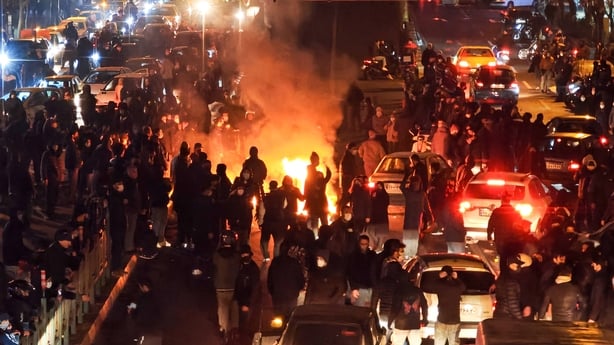
Iran was shaken over the last week by some of the biggest anti-government protests in the history of the Islamic republic, although the demonstrations appear to have diminished in the face of repression and a week-long internet blackout.
Until Wednesday, the United States was threatening military action against Iran should it carry out the death penalty against people arrested over the protests - and the US envoy to the UN said all options were still "on the table".
"We note with alarm various public statements suggesting possible military strikes on Iran. This external dimension adds volatility to an already combustible situation," UN Assistant Secretary-General Martha Pobee told the UN Security Council.
"All efforts must be undertaken to prevent any further deterioration," she added.
Watch: Iranian journalist emotionally recounts lives lost in Iran protests
Iran's representative at the meeting Gholamhossein Darzi accused Washington of "exploitation of peaceful protests for geopolitical purposes."
Mr Trump's statements were "aimed at reigniting unrest," he said.
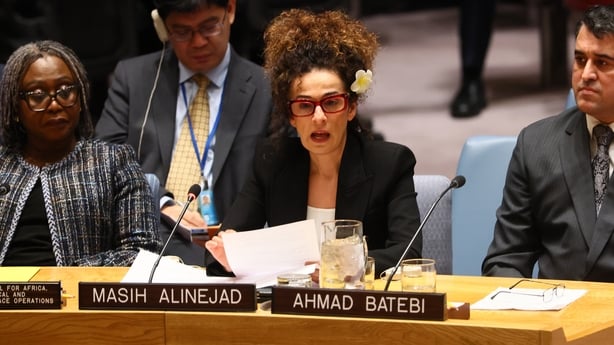
Iranian-American journalist Masih Alinejad, invited to address the council by the US, said "all Iranians are united" against the clerical system in Iran.
"Millions of Iranians flooded into the streets demanding that their money stop being stolen and sending to Hamas, to Hezbollah, to Houthi" fighters, she said referring to Iran-backed armed groups.
Iranians "welcomed when President Trump offered to rescue unarmed people being shot in their heart, in their chest by the security forces inside Iran," said Ms Alinejad who became a prominent face of criticism of the Iranian government in the United States.
US ambassador to the UN Mike Waltz said the United States "stands by the brave people of Iran period".
"The level of repression that the Iranian regime has unleashed on its own citizens, its own people, has repercussions for international peace and security," he added.
"President Trump is a man of action, not endless talk like we see at the United Nations. He has made it clear all options are on the table to stop the slaughter," he said.
New Zealand shuts embassy in Iran
New Zealand has said that it has temporarily closed its embassy in Tehran and flown out its diplomats because of worsening security in Iran.
Diplomatic staff left Iran safely on commercial flights overnight, a spokesperson for the foreign ministry said.
The Tehran embassy's operations were moved to Ankara, Turkey, because of the "deteriorating security situation" in Iran.
"We continue to advise against all travel to Iran. Any New Zealanders currently in the country should leave now," the spokesperson said.
The foreign ministry said it had an "extremely limited" ability to give consular help to New Zealanders in Iran.
Severe communication challenges were making it hard for people to get in touch with family and friends in Iran, the ministry spokesperson said, advising New Zealanders there to contact relatives when they can.
New Zealand's Foreign Minister, Winston Peters, said yesterday that his country was "appalled" by Tehran's violent reaction to huge anti-government protests.
"We condemn the brutal crackdown being carried out by Iran's security forces, including the killing of protesters," Mr Peters said in a statement.
"Iranians have the right to peaceful protest, freedom of expression, and access to information - and that right is currently being brutally repressed," he said.
New Zealand had expressed its "serious concerns" directly to the Iranian embassy in Wellington, and would continue to do so, the minister said.
