


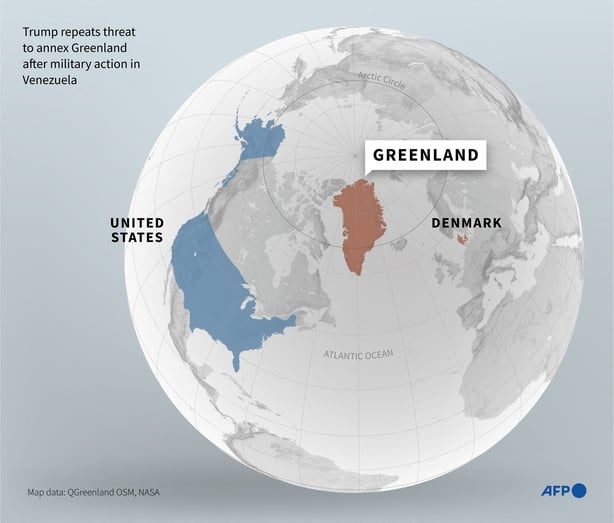
A meeting between top US officials and the foreign ministers of Denmark and Greenland has appeared to do little to quell President Donald Trump's ambition of taking over Greenland, raising the prospect of prolonged geopolitical tension between Copenhagen and Washington.
Following the White House meeting between Danish Foreign Minister Lars Lokke Rasmussen, his Greenlandic counterpart Vivian Motzfeldt, US Vice President JD Vance and Secretary of State Marco Rubio, Mr Rasmussen said the US and Denmark would form a working group to discuss a broad array of concerns regarding the Danish overseas territory.
But he also made clear that Washington had not budged on its position that it must acquire Greenland, an outcome Mr Rasmussen and Ms Motzfeldt described as an unacceptable breach of sovereignty.
"We didn't manage to change the American position," Mr Rasmussen told reporters outside the Danish embassy in Washington after the meeting concluded.
"It's clear that the president has this wish of conquering over Greenland."
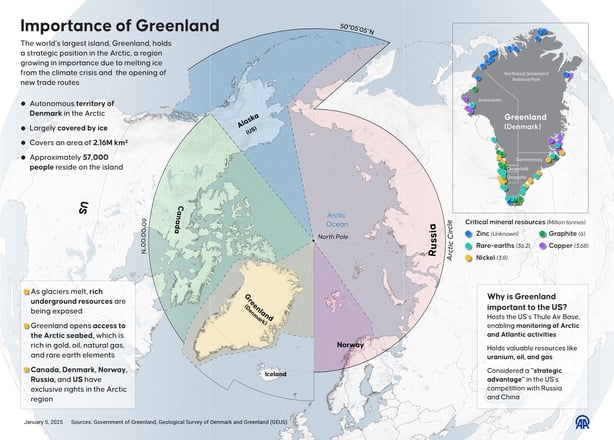
Mr Trump has repeatedly said in recent weeks that the strategically located and mineral-rich island is vital to US security, and the United States must own it to prevent Russia or China from occupying it.
He has said all options are on the table for securing the territory, rhetoric that has caused turmoil within the NATO alliance.
Before the meeting, which lasted around two hours, Mr Trump argued on social media that NATO would become far more formidable and effective with Greenland in the hands of the US. "Anything less than that is unacceptable," he wrote.
In a follow-up post citing Russia and China, Mr Trump wrote: "NATO: Tell Denmark to get them out of here, NOW! Two dogsleds won't do it! Only the USA can!!!"
Greenland and Denmark say the island is not for sale, and that threats of force are reckless and security concerns should be resolved among allies. Prominent EU countries have backed Denmark, which is a member of the NATO alliance.
Ahead of the meeting, Greenland and Denmark said they had begun to increase their military presence in and around Greenland in close cooperation with NATO allies, as part of their promise to beef up Arctic defence.
'Big problem for him', says Trump after Greenland PM prefers Denmark over US ties
The increased military presence would include a range of exercise activities throughout 2026, according to the Danish defence ministry.
During the press conference, Mr Rasmussen and Ms Motzfeldt called the meeting respectful and emphasised that Denmark shared US concerns about Arctic security. But they firmly rejected the idea of the island becoming American.
The meeting presented an opportunity for Copenhagen and Nuuk to de-escalate the crisis and find a diplomatic path to satisfy US demands for more control, analysts said.
Greenlandic leaders appear to be shifting their approach in how they are handling the diplomatic crisis.
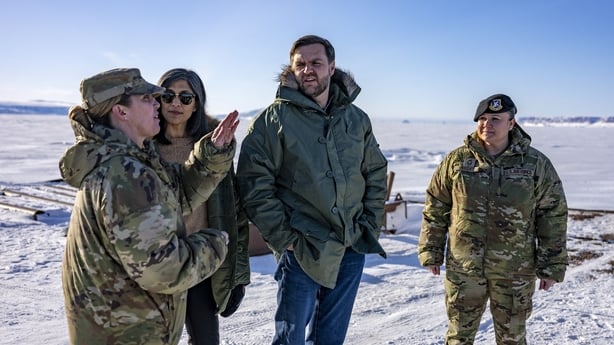
Until recently, they were stressing Greenland's path to independence. But now their public statements put more emphasis on Greenland's unity with Denmark.
"It's not the time to gamble with our right to self-determination, when another country is talking about taking us over," Greenlandic Prime Minister Jens-Frederik Nielsen told Greenland daily Sermitsiaq in an interview.
"That doesn't mean that we don't want something in the future. But here and now we are part of the kingdom, and west and with the kingdom. That's crucial in this serious situation," he said.
Ms Motzfeldt had a similar message.
"We choose the Greenland we know today – as part of the Kingdom of Denmark," she said in a statement released by the Danish ambassador to the US late on Tuesday.
Mr Trump's desire for Greenland contrasts with Americans' opposition to annexation of the Arctic island, according to a new poll.
Just 17% of Americans approved of Mr Trump's efforts to acquire Greenland, and substantial majorities of Democrats and Republicans opposed using military force to annex the island, the Reuters/Ipsos poll found.
Some 47% of respondents disapproved of US efforts to acquire Greenland, while 35% said they were unsure, in the two-day poll which concluded yesterday.
Meanwhile, European allies reiterated their backing for Denmark and Greenland ahead of the White House meeting, with European Commission President Ursula von der Leyen saying Greenlanders could "count on us".
In Paris, France's Emmanuel Macron said that, if the sovereignty of a European country and ally were to be affected, the knock-on effects would be unprecedented
France is to open a consulate in Nuuk on 6 February.
