


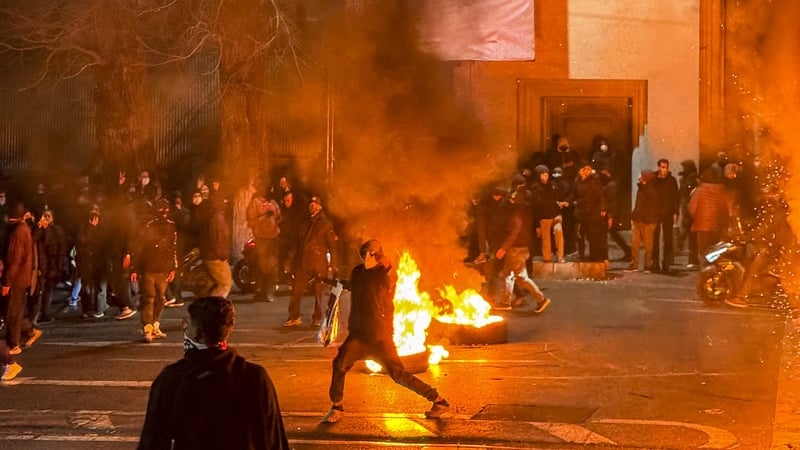
A violent crackdown on a wave of protests in Iran has killed at least 648 people, a rights group has said.
It comes as Iranian authorities seek to regain control of the streets with mass nationwide rallies.
The government's call for rallies in support of the Islamic republic drew thousands on Monday, a turnout supreme leader Ayatollah Ali Khamenei hailed as proof that the protests - which the authorities attribute to foreign interference - had been defeated.
Rights groups have warned an internet blackout, that monitor Netblocks says has lasted four days, was aimed at masking a deadly crackdown on the protests.
The Norway-based NGO Iran Human Rights (IHR) said it had confirmed 648 people killed during the protests, including nine minors, and thousands more injuries, but warned the death toll was likely much higher - "according to some estimates more than 6,000".
IHR added that the internet shutdown made it "extremely difficult to independently verify these reports", saying an estimated 10,000 people had been arrested.
"The international community has a duty to protect civilian protesters against mass killing by the Islamic republic," said IHR director Mahmood Amiry-Moghaddam.
The blackout has severely affected Iranians' ability to post videos of the protests, which have rocked big cities since last Thursday, but one video geolocated by AFP showed dozens of bodies outside a morgue south of Tehran, with what appeared to be grieving relatives searching for loved ones.
Over two weeks of demonstrations initially sparked by economic grievances have turned into one of the biggest challenges yet to the theocratic system that has ruled Iran since the 1979 Islamic revolution ousted the shah.
'Warning' to the US
Ayatollah Ali Khamenei, in power since 1989 and now 86, said in a statement that Monday's pro-government rallies were a "warning" to the United States, after President Donald Trump repeatedly threatened to intervene militarily if Tehran killed protesters.
"These massive rallies, full of determination, have thwarted the plan of foreign enemies that were supposed to be carried out by domestic mercenaries," he said, according to state TV.
In the capital Tehran, state TV showed people brandishing the national flag and prayers read for victims of what the government has termed "riots".
At Enghelab (Revolution) Square, parliament speaker Mohammad Bagher Ghalibaf told the crowd that Iran was fighting a "four-front war", listing economic war, psychological war, "military war" with the United States and Israel, and "today a war against terrorists" - a reference to the protests.
Flanked by the slogans "Death to Israel, Death to America" in Persian, he vowed the Iranian military would teach Mr Trump "an unforgettable lesson" if Iran were attacked.
But President Trump said on Sunday that Iran's leadership had called him seeking "to negotiate".
And Foreign Minister Abbas Araghchi told a conference of foreign ambassadors in Tehran that Iran was "not seeking war but is fully prepared for war", while calling for "fair" negotiations.
Foreign ministry spokesman Esmaeil Baghaei said a channel of communication was open between Araghchi and Mr Trump's special envoy for the Middle East Steve Witkoff despite the lack of diplomatic relations.
Iranian state media has said dozens of members of the security forces have been killed, with their funerals turning into large pro-government rallies. The government has declared three days of national mourning for those killed.
State outlets were at pains to present a picture of calm returning, broadcasting images of smooth-flowing traffic.
Tehran Governor Mohammad-Sadegh Motamedian insisted in televised comments that "the number of protests is decreasing".
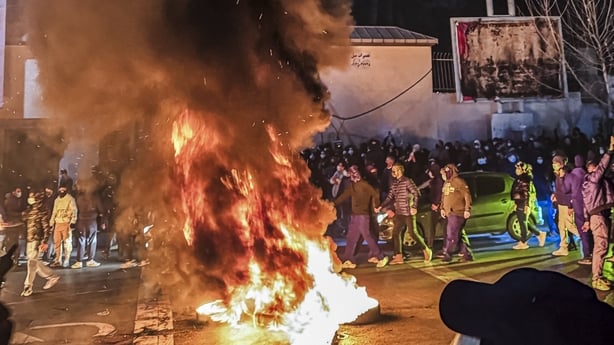
'Respect for their rights'
The European Union has voiced support for the protesters and said it was "looking into" imposing additional sanctions on Iran over the repression of demonstrations.
The European Parliament also announced it had banned all Iranian diplomats and representatives from the assembly's premises.
The Iranian foreign ministry said it had summoned diplomats in Tehran representing France, Germany, Italy and the UK, demanding they "withdraw official statements supporting the protesters".
French President Emmanuel Macron, however, issued a statement later condemning "the state violence that indiscriminately targets Iranian women and men who courageously demand respect for their rights".
Tehran-ally Russia, for its part, slammed what it called attempts by "foreign powers" to interfere in Iran, state media reported, in Moscow's first reaction to the protests.
Reza Pahlavi, the US-based son of Iran's ousted shah, urged Iran's security forces and government workers to join the protests against the authorities.
"Employees of state institutions, as well as members of the armed and security forces, have a choice: stand with the people and become allies of the nation, or choose complicity with the murderers of the people," he said in a social media post.
We need your consent to load this rte-player contentWe use rte-player to manage extra content that can set cookies on your device and collect data about your activity. Please review their details and accept them to load the content.Manage Preferences
Taoiseach would favour additional sanctions on Iran
Taoiseach Micheál Martin has said he would favour additional sanctions on Iran given the repression of protests there by the government.
Speaking in Cork he said: "I think we need an end to the repression that's going on in Iran.
"It's a very repressive regime, anti-democratic, very authoritarian, that undermined the rights of women for quite a long time."
"The sanctions have had an impact economically on Iran and continue to have an impact," Mr Martin added.
"I would prefer additional sanctions. I think the outside world needs to be very careful that we don't indirectly give sort of succour to the administration."
Mr Martin said the future of Iran is for its people to decide.
"We need to make sure that any support is mobilised behind the people, that the authorities there don't get excuses to try and rally people behind their cause because of external influences or external attacks," he said.
"So one needs to weigh up, and those contemplating that need to weigh up very carefully the import and impact of decisions of that kind.
"But on the other hand, the level of oppression is shocking."
Meanwhile, Former minister for justice Alan Shatter said Mr Martin's statement was "welcome" but "insufficient".
"The Iranian ambassador should be called in by the Government and it should be delivered directly to him," he said.
"Should the Iranian regime continue its murderous assault on, arrest and imprisonment of protesters our ambassador should be withdrawn from Tehran in protest and the Iranian ambassador to Ireland should be expelled."
Mr Shatter added: "Our government should also demand a sitting of the UN and sponsor, together with other states, a UN motion condemning Iranian atrocities and demanding the regime stop murdering, imprisoning and desist from executing protesters."
Yesterday, Minister for Foreign Affairs Helen McEntee said that she was "deeply concerned" by developments in Iran.
She said she was in contact with the Embassy of Ireland in Tehran and with EU partners.
"I call on the Iranian authorities to refrain from any further violence, to restore communications, engage with demonstrators about their grievances and to uphold the fundamental rights of all Iranians."
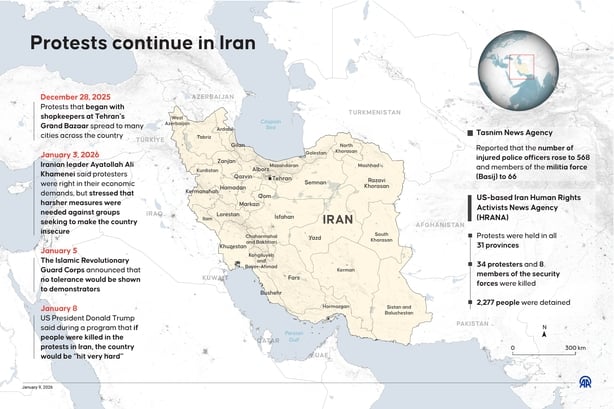
The protests in Iran began on 28 December in response to soaring prices, before turning against the clerical rulers who have governed since the Islamic Revolution.
Iranians, who are struggling to make ends meet, have grown increasing resentful of the powerful Revolutionary Guards, whose business interests including oil and gas, construction and telecommunications are worth billions of euro.
State TV aired live footage of large crowds attending a funeral procession for security forces killed in Shahrud and pro-government demonstrations in cities such as Kerman, Zahedan and Birjand, held "in condemnation of recent terrorist events".
It also relayed calls from various senior officials inviting people to take to the streets today.
Iranian authorities accused the US and Israel of fomenting trouble and called for the nationwide rally to condemn "terrorist actions led by the United States and Israel," state media reported.
The situation in Iran is "under total control" after violence linked to protests spiked over the weekend, Mr Araqchi said.
He added Mr Trump's warning against Tehran of action should protests turn bloody had motivated "terrorists" to target protesters and security forces in order to invite foreign intervention.
The flow of information from Iran has been hampered by an internet blackout since Thursday.
Mr Trump said that he would talk to businessman Elon Musk about restoring internet access in Iran through his Starlink satellite service.
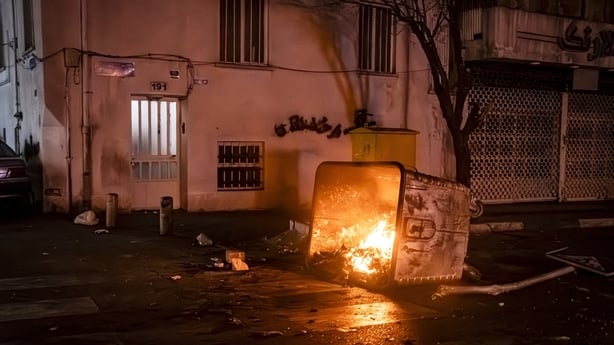
Authorities declared three days of national mourning "in honour of martyrs killed in resistance against the United States and the Zionist regime," according to state media.
Three Israeli sources, who were present for Israeli security consultations over the weekend, said Israel was on a high-alert footing for the possibility of any US intervention.
Israel and Iran fought a 12-day war in June 2025, which the US briefly joined by attacking nuclear installations.
Iran retaliated by firing missiles at Israel and an American air base in Qatar.
While Iranian authorities have weathered previous protests, the latest have unfolded with Tehran still recovering from last year's war and with its regional position weakened by blows to allies such as Lebanon's Hezbollah since the 7 October 2023 attacks against Israel.
Iran's unrest comes as Mr Trump flexes US muscles internationally, having ousted Venezuelan leader Nicolas Maduro, and discussing acquiring Greenland by purchase or force.
Alan Eyre, a former US diplomat and Iran expert, thought it was unlikely the demonstrations would topple the establishment.
"I think it is more likely that it puts these protests down eventually, but emerges from the process far weaker," he said, noting that Iran's elite still appeared cohesive and there was no organised opposition.
Mr Trump, posting on social media on Saturday, said: "Iran is looking at FREEDOM, perhaps like never before. The USA stands ready to help!!!"
Additional reporting: Colman O'Sullivan
