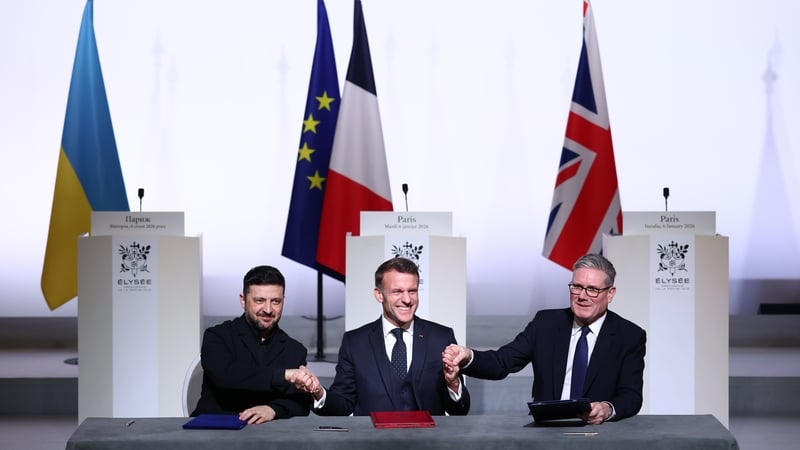

Last Tuesday's summit in Paris of the Coalition of the Willing was meant to deliver "concrete commitments to protect Ukraine", as French President Emmanuel Macron had outlined during his New Year's Eve address to the French people.
The 35-member group, set up by the British and French last March with the aim of monitoring an eventual ceasefire in Ukraine, had met on 14 previous occasions.
Those previous meetings resulted in strong words of support for Ukraine but delivered little clarity on the number of personnel and type of resources each country would commit to a multinational reassurance force after a ceasefire in Ukraine.
Ireland is a member of the Coalition and Taoiseach Micheál Martin has previously said that Irish peacekeepers could be deployed to Ukraine as part of any potential United Nations-mandated mission.
So, did the group of 35 countries deliver on those "concrete commitments" that Mr Macron had mentioned?
Not entirely.
It repeated a lot of what we already knew about the Coalition's goals. Only now it was spelt out more definitively in five points.
The declaration outlined support for a proposed US-led ceasefire monitoring mechanism, support for Ukraine's military in the short and long term and binding commitments to support Ukraine in the event of a future armed attack by Russia, and support for Ukraine's defence industry.
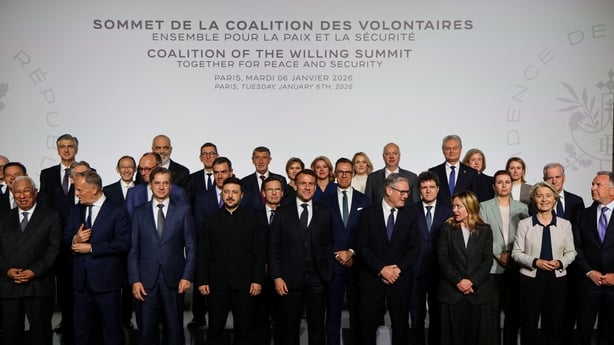
There were some "good steps forward", said Ukrainian President Volodymyr Zelensky.
However, the absence of detail on the size of troop contributions from different countries made it all seem less concrete than what had been billed by the French president (26 countries in the Coalition have previously said they would contribute personnel to land, sea or air elements of a future mission, though few will deploy troops to Ukraine itself).
That said, the very fact that the US took part was hugely positive for Ukraine's future security architecture, and Europe's.
The presence of Steve Witkoff and Jared Kushner - the two men tasked by US President Donald Trump with getting Russia to agree to a ceasefire - signalled that the US was now onboard with supporting a monitoring force.
So too did the attendance of the top US military commander in Europe, Alexus Grynkewich.
"The declaration and the summit basically demonstrated that the Europeans, but also in cooperation with the Americans, are getting closer to a really common line on Ukraine," said Piotr Buras, who heads the Warsaw office of the European Council on Foreign Relations.
"But, it doesn't mean that whatever they have agreed upon will be put in practice, because all this depends on Russia's willingness to sign up to a deal," Mr Buras told RTÉ News.
Of course, the Coalition's plan for deploying a European-led monitoring force to Ukraine is based on the need for a ceasefire being agreed first.
And, as things stand, Russia is nowhere near considering a ceasefire.
Moscow's response to the Paris summit was to warn European members of NATO this week that it would deem their troops to be legitimate targets if they were deployed to Ukraine.
Russia's decision to fire an Oreshnik missile on Friday morning at energy infrastructure in the Lviv region in western Ukraine, just 70km from the border with Poland, showed that Moscow is in the mood for escalation, rather than negotiation.
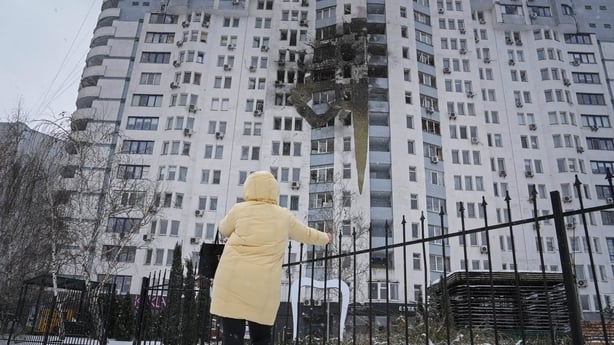
The Kremlin said the use of the hypersonic missile, capable of carrying a nuclear warhead, was in response to an alleged drone attack, which it claims targeted Russian President Vladimir Putin’s residence outside Moscow in late December.
Ukrainian officials dismissed the claim as an outright lie and demanded evidence, while US President Donald Trump has also said he does not believe Russia's account of events based on evidence collated by US intelligence services.
"Each time that Ukraine, the United States and Europe near an agreement on a preliminary plan, Russia does something to abort the whole process," said Igor Gretskiy, a Russia foreign policy analyst at Estonia's International Centre for Defence and Security.
"They're trying to raise the stakes again in order to destroy the outcome of diplomatic contacts between those three sides."
Read more: What is Russia's Oreshnik missile and why use it now?
In Paris on Tuesday, the firmest commitments made towards safeguarding Ukraine's future security came from the British and French leaders during the post-summit press conference who pledged to set up military hubs in Ukraine in the event of a ceasefire.
France and the UK also plan to also build protective facilities for Ukrainian military equipment.
The US, through its two envoys Mr Witkoff and Mr Kusher, offered its strongest commitment yet to delivering security guarantees for Ukraine if Russia attacks again.
US security guarantees, said Mr Witkoff, would be "the strongest anyone has ever seen".
He said that security protocols would "deter any attacks" in Ukraine.
"If there are any attacks, they're meant to defend, and they will do both".
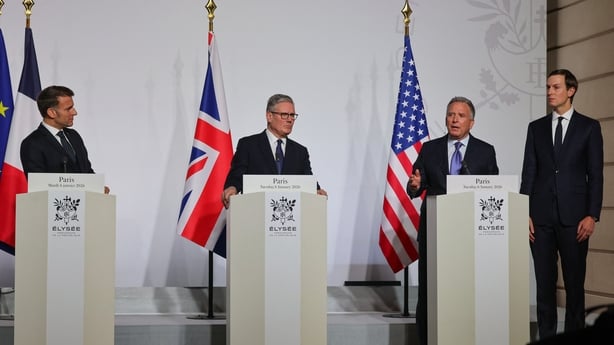
American input would involve monitoring a ceasefire through satellite technology but there was no detail on how far the US would be prepared to go to enforce a ceasefire.
Would the "defend" element of that US security guarantee mean striking Russian targets in Russian-occupied Ukraine from where attacks might be launched, or even in Russia itself?
We simply don't know, though Mr Zelensky said on Friday that the details of those US guarantees are close to being finalised.
"President Trump fully supports these security guarantees. They are designed to prevent and repel any further attacks against Ukraine," said Mr Witkoff.
"Should such attacks take place again, we are ready to defend our position," he added.
Yet, the new US National Security Strategy points out that the US has no interest in engaging in conflicts with other nuclear-armed powers. On that basis, it is hard to see US forces confronting Russian forces directly if they break a ceasefire and strike Ukraine again.
"I'm not sure that the United States is committed or more committed to invest in security guarantees for Ukraine," said Mr Gretskiy.
"The US is trying to make Ukraine accept the so-called American deal, and then Washington could think of its commitment".
During the Paris press conference with European leaders, Mr Kushner used more cautious language than Mr Witkoff, though neither referred to Russia specifically in their answers.
"We must use the right mechanism to know how we intend to proceed if such peace agreements are broken. Because we want to ensure that no one can carry out such an attack anymore," he said.
His remarks replicated what other senior officials in the Trump administration, including US Secretary of State Marco Rubio, have been saying for the past year - that the US is more of a neutral mediator in this process, backing neither Ukraine nor Russia.
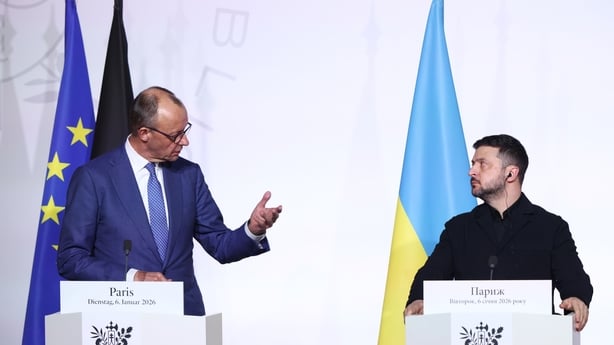
Germany moved a step closer to engaging militarily in a multinational force mission for Ukraine, if not quite in Ukraine itself.
German Chancellor Friedrich Merz said German troops would only be deployed to a neighbouring NATO country in a supporting role. This would most likely mean deploying troops to Poland.
Any deployment of German forces would need approval from the Bundestag. At the moment, that proposal would likely pass by a majority vote despite strong opposition from the far-right AfD to any mission in support of Ukraine.
Poland also stuck to the same position it has held since the Coalition was formed last year.
Warsaw will not deploy troops to Ukraine and would instead contribute to the Coalition's efforts by acting as a logistics hub for sending equipment and supplies to Ukraine, much as it has done since the start of Russia's full-scale invasion four years ago.
So does any of this future-proof Ukraine's future security?
Leaving Russia's objections to any troops from NATO countries aside and the uncertain nature around a US security guarantee (already two big elephants in the room), the other big question is whether the Coalition's members could deploy enough troops to maintain a monitoring mission across central or parts of eastern Ukraine close to the current frontline.
Defence experts estimate that the size of any monitoring force in Ukraine could range from between 50,000 to 100,000 troops.
The British army comprises just over 70,000 full-time personnel so it could realistically deploy a fraction of that number at any one time to Ukraine.
France has a much bigger army of more than 260,000 full-time personnel so it would be more capable of deploying of division of 10,000 to 20,000 troops.
With Germany, Poland and Italy - the three other European countries with large standing armies - so far ruling out the possibility of troop deployments to Ukraine, that leaves very few options to make up the numbers.
Spanish Prime Minister Pedro Sanchez said after Tuesday's summit that his country was open to contributing troops.
Turkey has also expressed an interest in contributing soldiers to a multinational mission in Ukraine and the presence of Turkish troops might be more acceptable to Russia.
Sweden and Denmark have also previously voiced support for deploying peacekeepers as part of a postwar force but both have relatively small full-time armies.
A ceasefire in Ukraine would lead to "real discussion", said Mr Buras, on how exactly European countries will contribute to security guarantees for Ukraine and, in his view, could force Coalition countries to rethink their views on troop deployments.
"If it remains the American position that they will be part of this effort, at least at the level of strategic enablers, it will be very difficult for such important European countries, like Germany and Poland, to stick to their respective positions."