


Russia has said it fired an Oreshnik missile at Ukraine. Here's what to know about this weapon.
What is the Oreshnik?
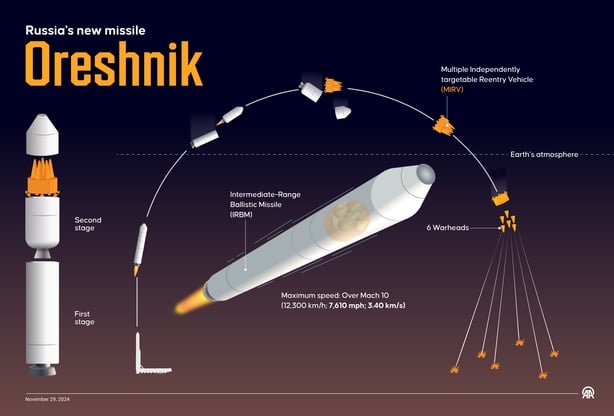
The Oreshnik, whose name means Hazel Tree, is an intermediate-range hypersonic ballistic missile that Russia has fired only once before against Ukraine, in November 2024.
On that occasion it was equipped only with dummy warheads and therefore caused limited damage, Ukrainian sources said, in what was effectively a test.
If the overnight attack carried explosive warheads, it would mark the first time that Russia has used the Oreshnik with full destructive intent.
The strike targeted what Russia called critical infrastructure in Ukraine, though the extent of the damage was not immediately clear.
What is special about the weapon?
Experts have said the novel feature of the Oreshnik is that it can carry multiple warheads capable of simultaneously striking different targets - usually associated with longer-range intercontinental ballistic missiles (ICBMs).
The missile is based on the RS-26 Rubezh, which Russia had originally developed as an intercontinental missile.
Like many Russian weapons systems, it is capable of carrying nuclear as well as conventional warheads, but there was no suggestion of any nuclear component to the overnight attack.
Ukraine said the missile fired in 2024 took about 15 minutes to reach its target after being launched from southern Russia and reached a speed of about 13,600 km/h.
Russian President Vladimir Putin has claimed that the Oreshnik is impossible to intercept and that it has destructive power comparable to that of a nuclear weapon, even when fitted with a conventional warhead.
Some Western experts have said those claims are exaggerated.
In December 2024, a US official said the weapon was not seen as a game-changer on the battlefield, calling it experimental in nature and saying Russia likely possessed only a handful.
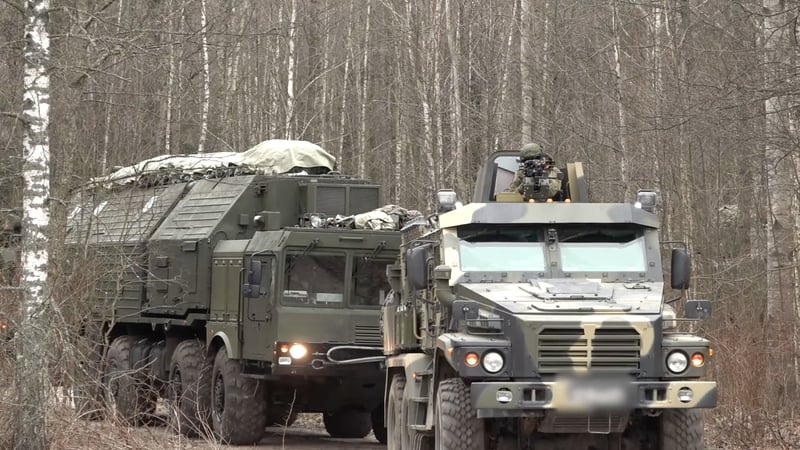
Since 2024, Russia has put the Oreshnik into serial production and also supplied it to its ally Belarus.
Why use it now?
The Russian military said it fired the Oreshnik in response to what Moscow claims was an attempted Ukrainian drone attack late last year on one of Mr Putin's residences in Novgorod, northern Russia.
Ukraine claimed Russia was lying, and that no such attack took place.
Mr Putin had previously threatened to use the Oreshnik, including against "decision-making centres" in Kyiv, if Ukraine continued to attack Russia with long-range Western weapons, but had refrained from doing so until now.
The overnight attack was directed against the Lviv region of western Ukraine, which borders NATO member Poland.
Ukraine's Minister for Foreign Affairs Andrii Sybiha claimed it was a "global threat" that demanded a global response.
The escalation comes as US President Donald Trump struggles to persuade Russia and Ukraine to agree a peace deal to end the war that began with Russia's full-scale invasion of Ukraine in February 2022.
