


Russia said that any troops sent to Ukraine by Western governments would be "legitimate combat targets", after the UK and France announced plans to deploy a multinational force there in the event of a ceasefire.
A Russian Foreign Ministry statement said "militaristic declarations" by a coalition of pro-Ukraine Western governments were becoming increasingly dangerous.
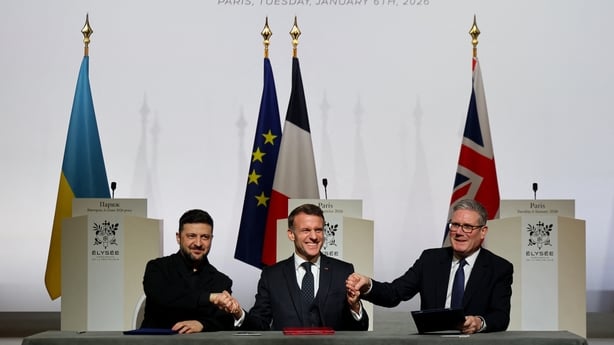
Russia was responding for the first time to a meeting of the "coalition of the willing" in Paris on Tuesday at which the UK and France signed a declaration of intent on the future deployment.
French President Emmanuel Macron said it could involve sending thousands of French troops.
UK Prime Minister Keir Starmer said it paved the way for a legal framework whereby "British, French and partner forces could operate on Ukrainian soil, securing Ukraine's skies and seas and regenerating Ukraine's armed forces for the future".
Russia "warns that the deployment of Western military units, military facilities, depots and other infrastructure on Ukrainian territory will be classified as foreign intervention, posing a direct threat to the security of not only Russia but also other European countries," the statement said.
"All such units and facilities will be considered legitimate combat targets of the Russian Armed Forces."
It added: "The fresh militaristic declarations of the so-called coalition of the willing and the Kyiv regime constitute a veritable 'axis of war'.
"The plans of these participants are becoming increasingly dangerous and destructive for the future of the European continent and its inhabitants, who are also being forced by Western politicians to finance these aspirations out of their own pockets."
Russia, which staged a full-scale invasion of Ukraine in February 2022, said it was forced to intervene in order to prevent Ukraine from being absorbed into NATO and used as a launchpad to threaten Russia.
It has consistently said it will never accept the stationing of Western forces there.
Ukraine and its allies accuse Russia of waging an imperial-style war aimed at seizing the territory of its neighbour, of which it now holds nearly 20%.
They have said Ukraine needs firm security guarantees as part of any peace settlement in order to prevent another Russian invasion in future.
The United States has ruled out sending its own troops to Ukraine, but its special envoy Steve Witkoff said at Tuesday's meeting in Paris that President Donald Trump "strongly stands behind" security protocols aimed at deterring future attacks on Ukraine.
Russian strikes plunge Ukraine's industrial southeast into blackouts
Ukrainian officials were racing to restore power after Russian drone attacks plunged two southeastern regions into near-total blackout overnight, strikes that Mr Zelensky said were aimed at "breaking" his country.
Moscow has intensified its attacks on Ukraine's energy system as Ukrainian forces fend off Russian advances on the battlefield and Kyiv faces US pressure to quickly secure a peace deal.
Nearly 500,000 households in the industrialised region of Dnipropetrovsk, one of Ukraine's largest, were still without power this afternoon, according to private energy provider DTEK.
Earlier, Deputy Prime Minister Oleksiy Kuleba had said more than one million consumers in the region had no heating or water supply.
"This is Russia's war specifically against our people, against life in Ukraine - an attempt to break Ukraine," Mr Zelensky wrote on X after a European tour aimed at rallying support for Kyiv.
"Diplomatic discussions cannot be a pretext for slowing down the supply of air defence systems and equipment that helps protect lives."
Power has been restored to the other affected region, Zaporizhzhia, after a blackout there forced critical infrastructure to rely on reserves, Ukraine's energy ministry said.
Governor Ivan Fedorov said it was the first time in "recent years" that his region had faced a total blackout.
Russia frees French researcher Vinatier in prisoner exchange
Laurent Vinatier, a French researcher serving a three-year prison sentence in Russia for violating Moscow's foreign agent laws, has been freed as part of a prisoner exchange, French and Russian officials said.
President Emmanuel Macron posted on X: "Our compatriot Laurent Vinatier is free and back in France.
"I share the relief felt by his family and loved ones."
He added that he was grateful for the work done by French diplomatic officials.
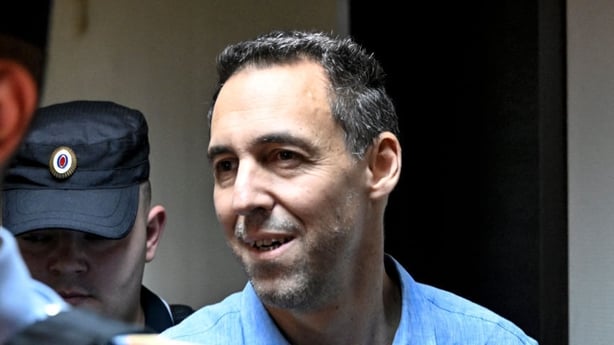
Foreign Minister Jean-Noel Barrot welcomed Mr Vinatier and his parents at the Quai d'Orsay in Paris, the ministry said.
Russia's FSB security service said Mr Vinatier, 49, had been swapped for Daniil Kasatkin, a Russian basketball player who was arrested at a Paris airport last June and who was wanted in the United States for alleged involvement in ransomware attacks.
The FSB said Mr Vinatier had been pardoned by Russian President Vladimir Putin, who promised last month to look into the case after a French journalist raised it during the Kremlin leader's annual news conference.
Mr Vinatier was arrested by the FSB at a Moscow restaurant in June 2024.
He was convicted four months later of breaking laws requiring individuals deemed to be "foreign agents" to register with the Russian authorities.
While behind bars, he was placed under additional investigation for espionage, and he had been facing a likely further trial in coming months.
The FSB statement alleged that Mr Vinatier, acting on instructions from Swiss intelligence, had collected sensitive political and military information - including on combat and training plans - that could have been used to harm Russia's security.
However, it said the case had been dismissed because of his "active repentance".
At the time of his arrest, Mr Vinatier was working for the Centre for Humanitarian Dialogue (HD), a Swiss-based conflict mediation organisation.
Fellow academics said he was a respected scholar involved in legitimate research.
At his trial, Mr Vinatier said he loved Russia, apologised for breaking the law, and even recited a verse by Russian poet Alexander Pushkin.
