


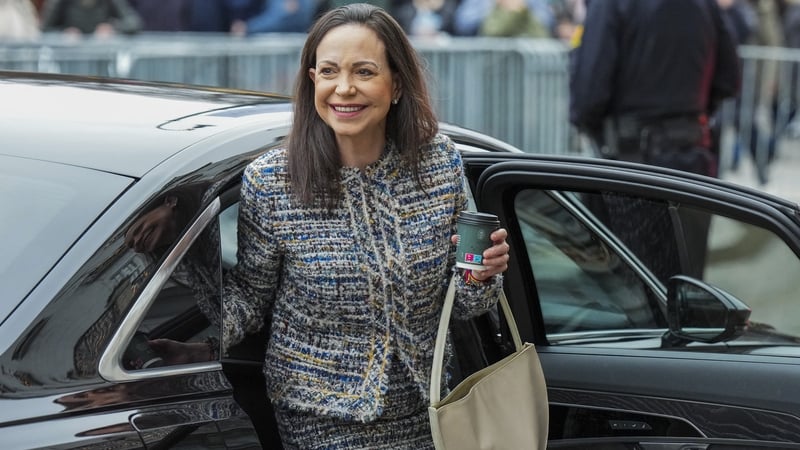
Venezuela's main opposition leader Maria Corina Machado has vowed to return home quickly, declaring her movement ready to win a free election.
US President Donald Trump appears, however, to hope for now to work with interim President Delcy Rodriguez and other senior officials from deposed president Nicolas Maduro's government, disappointing the opposition and contributing to the nervousness gripping Venezuela.
"I'm planning to go back to Venezuela as soon as possible," said Ms Machado who escaped from Venezuela in disguise in October to receive the Nobel Peace Prize, which she dedicated to Mr Trump.
"We believe that this transition should move forward," she told Fox News in an interview. "We won an election (in 2024) by a landslide under fraudulent conditions. In free and fair elections, we will win over 90% of the votes."
Ms Machado said she had not spoken to Mr Trump since 10 October, when the Nobel award was announced.
He has said the United States needs to help address Venezuela's problems before any new elections, calling a 30-day timeline for a vote unrealistic.
"We have to fix the country first. You can't have an election. There’s no way the people could even vote," Mr Trump told NBC.
Watch: Machado vows to return to Venezuela 'as soon as possible'
In the interview late yesterday, her first since Mr Maduro was seized by the US at the weekend, Ms Machado did not give her location or any more details on plans to repatriate to Venezuela, where she is wanted for arrest and Socialist Party loyalists remain in power.
To the dismay of the large diaspora - one in five Venezuelans have left during an economic implosion under Mr Maduro and his predecessor Hugo Chavez - Mr Trump has given little indication of backing Ms Machado.
The opposition, some international observers and many US allies say the opposition was cheated of victory in the 2024 election, from which Ms Machado was banned and an ally stood instead, but Mr Trump has said she lacks support in Venezuela.
Ms Rodriguez is a diehard Maduro ally who has denounced his "kidnapping" while also calling for cooperation and respectful relations with the US.
Ms Machado described Ms Rodriquez as a "one of the main architects of torture, persecution, corruption, narco-trafficking" while noting her liaison role with allies Russia, China and Iran.
The Nobel laureate, who has galvanised an often fractured and demoralised opposition in the last few years, said she would give Mr Trump the Nobel prize personally.
"He has proven to the world what he means. January 3rd will go down in history as the day justice defeated a tyranny," she said of Saturday's raid on Venezuela.
She thanked him for "his courageous vision, the historical actions he has taken against this narco-terrorist regime", and said: "It's a huge step towards a democratic transition."
We need your consent to load this rte-player contentWe use rte-player to manage extra content that can set cookies on your device and collect data about your activity. Please review their details and accept them to load the content.Manage Preferences
With the world's largest oil reserves and the US as its main ally, Venezuela would become the energy hub of the Americas, restore rule of law, open markets, bring exiles home and provide security to foreign investment, Ms Machado said.
Mr Trump has, however, been told by the CIA that Ms Rodriguez and other senior officials from Maduro's government are the best bet to maintain stability, sources said.
The authorities have ordered the arrest of anyone who collaborated with the seizure of Mr Maduro and 14 media workers were briefly detained covering events in Caracas on Monday.
With nearly 900 political prisoners still behind bars according to a leading local rights group, Ms Machado's Vente Venezuela movement has demanded that they be released immediately as a first step towards restoring democracy.
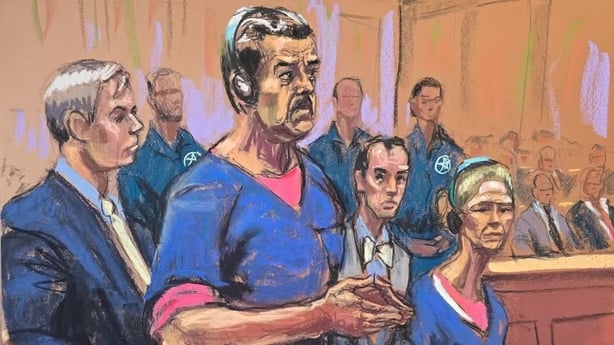
He is accused of overseeing a cocaine-trafficking network with international cartels. He has long denied the allegations, saying they were a mask for imperialist designs on oil.
"I'm president of the Republic of Venezuela and I've been kidnapped here since 3 January, Saturday," Mr Maduro told the court, speaking in Spanish through an interpreter. "I was captured at my home in Caracas, Venezuela."
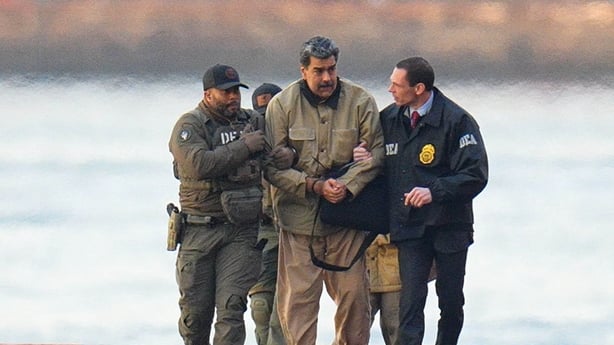
But the man who ruled his oil-rich country with an iron fist for more than 12 years got a sharp reminder of his fall when the judge told him to stick to simply stating his name.
Mr Maduro's wife Cilia Flores likewise pleaded not guilty. The judge ordered both to remain behind bars and set a new hearing date of 17 March.
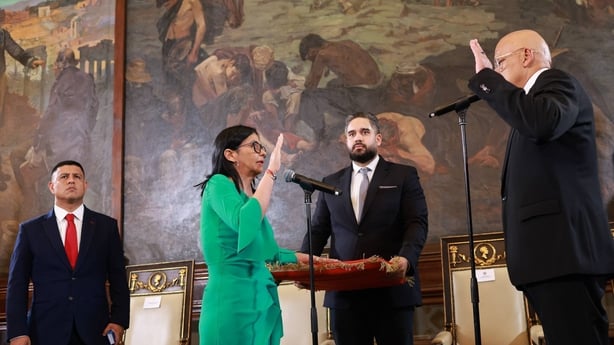
Thousands of people marched through Caracas in support of Mr Maduro as his former deputy, Ms Rodriguez, was sworn in as interim president.
Venezuela has the largest reserves - about 303 billion barrels, mostly hard-to-extract heavy oil. But the sector has long been in decline from mismanagement, underinvestment and US sanctions, averaging 1.1 million bpd output last year, a third of its output in the 1970s and much less than producers such as the United States, Saudi Arabia and Russia.
Mr Trump's actions, the biggest US intervention in Latin America since the 1989 invasion of Panama, have brought condemnation from Russia, China and Venezuela's leftist allies.
Legal experts have questioned its validity and many allies have urged adherence to international laws and dialogue.
"It sends a signal that the powerful can do whatever they like," the UN human rights office said in the latest expression of international concern.
Mr Trump has said the US is now in charge of Venezuela and will help revive its oil industry with the help of private companies. He has floated the idea of military intervention in Colombia and Mexico also.
"The history of Latin America is clear and compelling: intervention has never brought democracy, never generated well-being, nor lasting stability," said Mexican President Claudia Sheinbaum.
Brian Naranjo, a former US diplomat in Venezuela before he was expelled by Mr Maduro in 2018, said that he has "not been so worried about the future of Venezuela, ever".
"There's a very real possibility that things are going to get much, much worse in Venezuela before they get better," he said.
Details of the US operation in Venezuela were still emerging yesterday, with Cuba saying 32 Cubans were killed in the attack.
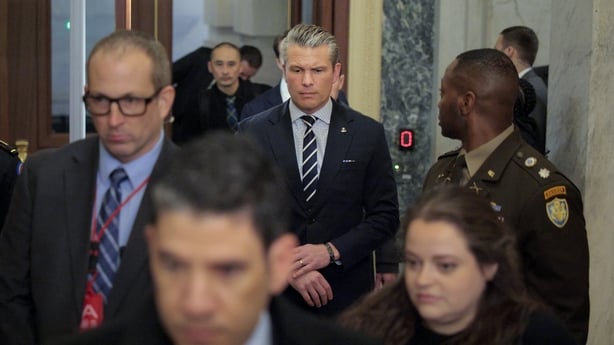
US Defense Secretary Pete Hegseth said that nearly 200 personnel went into Caracas in the surprise raid. Some injuries and no deaths were reported by US officials.
'Putting oil over democracy'
Former US ambassador to Venezuela Charles Shapiro said that it looks like the US is putting stability in oil over democracy.
Speaking on RTÉ's Morning Ireland, he said that before last Saturday, it was expected the Trump administration would want to get Mr Maduro to turn himself in by convincing him that the US would invade, without actually having to do so.
He said that this was not about changing the regime in Venezuela, as without Mr Maduro, the rest of the cabinet and the Vice President are still in place and pointed out that the US is counting on the current regime to maintain stability.
He added that it's going to be very difficult for the US to run the country and keep things together, but that everyone is waiting to see what's going to happen.
He said that Mr Trump has dismissed the popularity of Maria Machado and internationally, no NATO allies are supporting this unilateral action, so this isolates the US diplomatically.
