


After months of mounting military and economic pressure, the United States carried out airstrikes on targets across Venezuela and claimed to have deposed authoritarian left-wing President Nicolas Maduro.
Here's what we know so far:
How did it start?
The first explosions, accompanied by the sound of aircraft flying overhead, were heard in the capital Caracas and surrounding areas shortly before 2am (6am Irish time), AFP reporters said.
They continued until around 3.15 am.
Images shared on social media showed helicopters silhouetted against the night sky and missiles slamming into targets, creating fireballs and huge plumes of smoke.
Mr Trump said at 9.21am Irish time on his Truth Social platform that the United States had "successfully carried out a large scale strike against Venezuela" and that Mr Maduro and his wife had been "captured and flown out of the country".
Around five hours after the attacks began, US Senator Mike Lee cited US Secretary of State Marco Rubio as saying that the military action had ended "now that Maduro is in custody".
What did the strikes target?
Fort Tiuna, Venezuela's largest military complex, situated in southern Caracas, was among the targets.
The vast base is home to the defence ministry, a military academy and housing units for troops and their families.
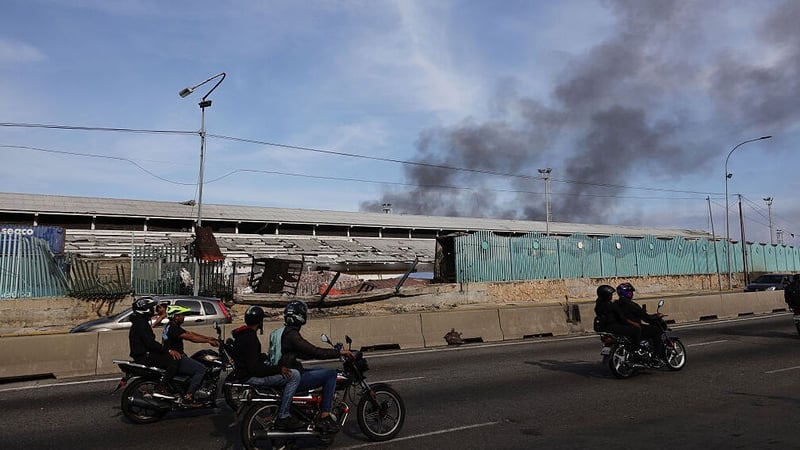
AFP reporters saw flames and huge plumes of smoke rising from the complex.
At one of the entrances, which was still guarded, AFP reporters saw an armoured vehicle and truck pocked with bullet marks.
Residents pulling suitcases and carrying bags fled the area.
One woman, who did not wish to be named, said she was leaving "because they nearly killed us".
There was no word yet on casualties.
La Carlota airbase east of Caracas was also targeted.
AFP reporters saw an armoured vehicle at the base in flames and a burnt-out bus.
Explosions were also reported in the port city of La Guaira, north of Caracas as well as in the north-central city of Maracay, Higuerote on the Caribbean coast and on the border with Colombia, a cocaine smuggling route.
Are there casualties?
Defence Minister Vladimir Padrino Lopez accused US forces of firing missiles and rockets at residential areas.
It was not possible to immediately confirm that.
There was no immediate information on casualties.
Mr Padrino said the government was gathering information "on the dead and injured."
Has Maduro been deposed?
Mr Trump said Mr Maduro and his wife Cilia Flores were captured and flown out of the country.
It was not clear how they managed to capture Mr Maduro, who was reported to regularly change residence to avoid being nabbed by US forces.
On Thursday he was filmed by television driving in Caracas.
Venezuelan Vice President Delcy Rodriguez called on the United States to issue "proof of life" of the presidential couple.
Russia, one of Venezuela's top allies, also called for "immediate" clarity about his fate.
How has the world reacted?
Russia, Iran and Cuba - longtime allies of Venezuela - all condemned the attack, as did Mexico and Brazil, both run by left-wing governments, and the left-wing president of Venezuela's neighbour Colombia.
Russia's foreign ministry said the "act of armed aggression against Venezuela" was "deeply concerning".
The EU's top diplomat Kaja Kallas, in a call with her US counterpart Marco Rubio, called on Washington to show "restraint" and respect for international law.
Argentina's right-wing President Javier Milei, an arch-Trump fan, was among the rare Latin American leaders to cheer the strikes.
Read more:
Live: Updates as they happen
Maduro faces 'wrath' of US law on drug, terrorism charges - Bondi
Bombs away for Trump, self-proclaimed peace president
