


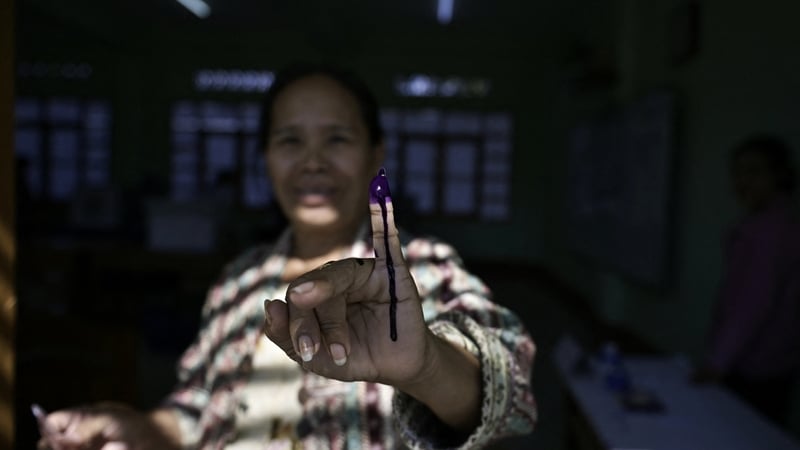
Voters in Myanmar cast their ballots in apparently low numbers in a general election, the first since a military coup toppled the last civilian government in 2021.
The junta, having crushed pro-democracy protests after the coup and sparked a nationwide rebellion, said the three-phase vote would bring political stability, despite international condemnation of the exercise.
But the United Nations, some Western countries and human rights groups have said the vote is not free, fair or credible, given that anti-junta political parties are out of the running and it is illegal to criticise the polls.
Nobel Peace Prize winner Aung San Suu Kyi, deposed by the military months after her National League for Democracy won the last general election by a landslide in 2020, remains in detention, and the party she led to power has been dissolved.
The military-aligned Union Solidarity and Development Party, led by retired generals and fielding one-fifth of all candidates against severely diminished competition, is set to return to power, said Lalita Hanwong, a lecturer and Myanmar expert at Thailand's Kasetsart University.
"The junta's election is designed to prolong the military's power of slavery over people," she said. "And USDP and other allied parties with the military will join forces to form the next government."
Initial voter turnout in today's polls was much lower than in the 2020 election, ten residents of cities spread across Myanmar said.
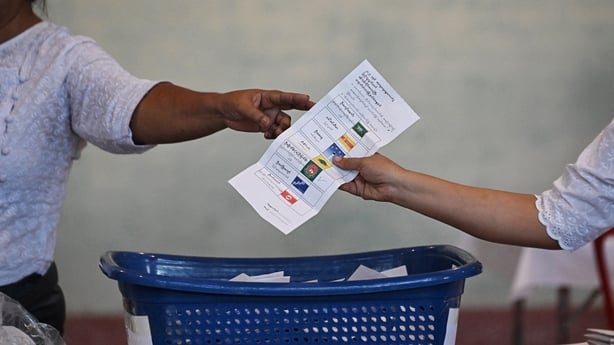
Further rounds of voting will be held on 11 January and 25 January, covering 265 of Myanmar's 330 townships, although the junta does not have complete control of all those areas.
Preliminary results of the first phase will be announced after polling booths close, junta chief Min Aung Hlaing told reporters.
A date for the final election result has not been declared.
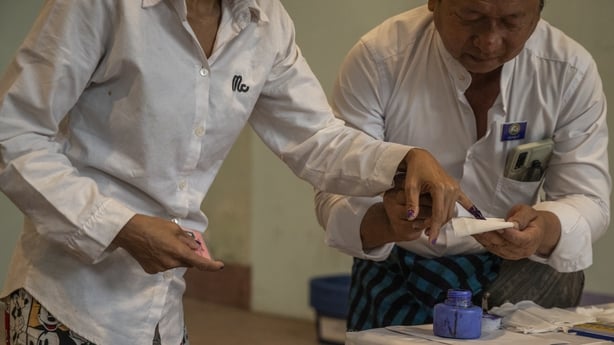
Dressed in civilian clothes, Min Aung Hlaing voted in the heavily guarded capital city of Naypyitaw, then held up an ink-soaked little finger, smiling widely, footage on state media MRTV showed. Voters must dip a finger into indelible ink after casting a ballot to ensure they do not vote more than once.
Asked by reporters if he would like to become the country's president, an office that analysts say he has ambitions for, the general said he was not the leader of any political party.
"When the parliament convenes, there is a process for electing the president," he said.
The junta's attempt to establish a stable administration in the midst of war is fraught with risk, and broad foreign recognition is unlikely for any military-controlled government with a civilian veneer, according to analysts.
Tom Andrews, the UN special envoy for human rights in Myanmar, said the election was not a pathway out of the country's crisis and must be strongly rejected.
Zaw Min Tun, a junta spokesman, acknowledged international critics who do not support the elections.
"However, from this election, there will be political stability," he told reporters after voting in Naypyitaw. "We believe there will be a better future."
Despite the junta's assurances, Myanmar's voters did not come out in numbers close to the previous election conducted under Covid-19 restrictions, including in the commercial capital of Yangon and the central city of Mandalay, residents said.
The junta's legal framework for the election has no minimum voter turnout requirement, said the Asian Network for Free Elections poll monitoring group.
Turnout was around 70% in Myanmar's 2020 and 2015 general elections, according to the US-based nonprofit International Foundation for Electoral Systems.
There has been none of the energy and excitement of previous election campaigns, although several residents in Myanmar's largest cities who spoke to Reuters did not report any coercion by the military administration to push people to vote.
Only a handful of polling booths in Yangon, some of them near areas housing military families, had dozens of voters queued up around midday local time, but others were largely sparse, according to two residents of the sprawling metropolis.
In smaller cities like Myawaddy on the border with Thailand and Mawlamyine in the southeast, people cast their ballots under heavy security, four voters said. The streets of Hakha, capital of the northern state of Chin, where fighting rages on, were empty after a local rebel group told residents to boycott the vote, two residents said.
In the lacklustre canvassing ahead of the polls, the USDP was the most visible. Founded in 2010, the year it won an election boycotted by the opposition, the party ran the country in concert with its military backers until 2015, when it was swept away by Ms Suu Kyi's NLD.
