Gratitude, fear and guilt - these are the three words Ghada Ashour chose to sum up how she felt about leaving Gaza in August this year.
The 24-year-old student was one of 52 Palestinian scholarship students successfully evacuated from Gaza that month, to study at Irish universities from September.
Just a few weeks before that, Ghada had been documenting her life in a tented displacement camp in Khan Younis for RTÉ News, while studying remotely via online courses offered by the American University in Cairo.
"When I did my report for the RTÉ it was 6 July," Ghada recalled. "I was stuck in Gaza. I was studying between either damaged houses or tents,"
Her videos showed how she had to walk long distances to charge her phone and access the internet as the war continued around her, and she spoke of "trying to cling to the smallest hope that things will get better one day".
She acknowledges that day has now come, for her at least, but not without a cost.
"My life changed dramatically when the possibility of leaving Gaza appeared, it is something I could never have imagined," she said.
That opportunity was made possible when Ghada secured a United Against Online Abuse scholarship at Dublin City University (DCU).
Sitting in her student accommodation on DCU's Glasnevin campus, having completed her first semester, Ghada spoke of the gratitude she felt towards the university and her sponsors and how "none of this would have been possible without them".
"I'm here, I'm in Ireland, I'm safe, I'm safe and sound," she said.
Nevertheless, she described her decision to leave Gaza to pursue her studies as "the toughest" she had ever made.
"Ever since I left, I have been in a constant battle of what would happen to my family, as the situation there is still very uncertain," she said.
An agreed ceasefire came into effect on 10 October, but Ghada says her family in Gaza "still struggles".
"I don't believe that this is a real ceasefire," Ghada said. "We can believe that there is a real ceasefire when houses are being rebuilt, when students and children get back to schools safely."
Ghada's family in Gaza has been able to return to the place in Khan Younis where their house once stood, but footage recorded by family members shows that it has been reduced to rubble.
In one video, a young girl is looking around the site, describing what she remembers about her home.
"This is my niece, her name is Mariam," Ghada explained. "She is the daughter of my brother who was killed back on 10 March 2024."
"It's actually heart-breaking, a child like her should be playing... but I feel like it is an impossible dream for her.
"She wants to study, she wants to be very well educated, she always tells me: 'I want to be very strong as you and I want to resume my education'.
"She doesn't have a home, she doesn't have financial stability, she doesn't have a father, yet she still thinks about education," Ghada said.
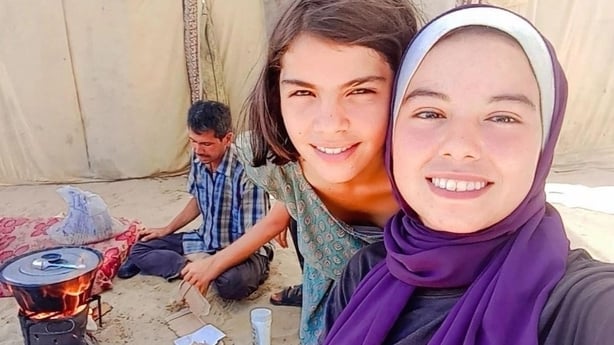
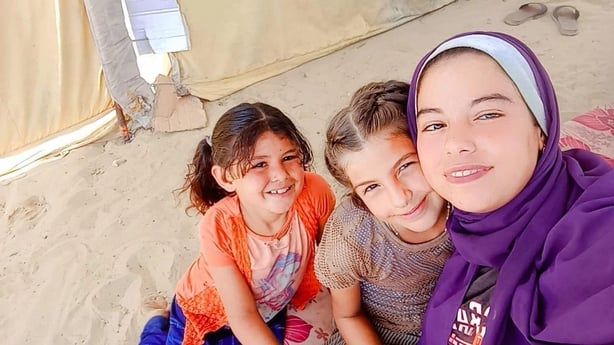
On 26 August, Ghada enjoyed her last meal with her family in Gaza before she left, and a series of photos snapped on her phone captured now treasured memories from that afternoon.
In some of the pictures, her brother Hamza can be seen cooking on an open fire.
Ghada posed for selfies alongside her nieces Reema, Habiba and Tasneem.
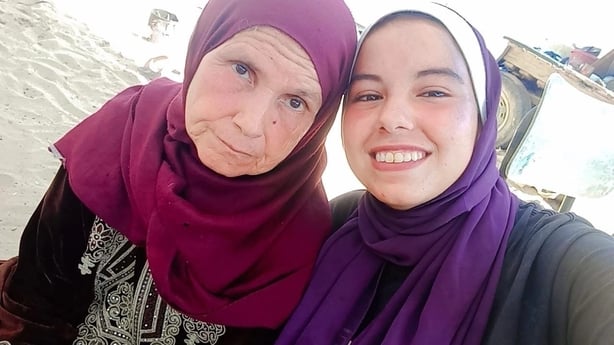
She also took a number of photos with her mother.
"It was almost 2pm," she said. "I was only thinking about leaving them, and this would be my last moment and I had to make the best out of every single moment."
"I do miss a lot my mother, especially her prayers," Ghada said. "I feel like I am here today because of her prayers."
She said that she is determined to work hard now that she has made it to DCU to complete her master's and has "high expectations" for herself.
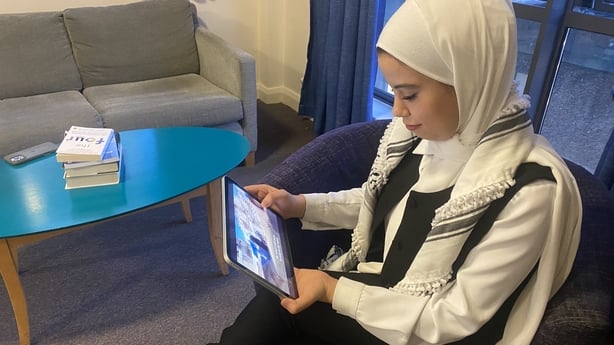
But she also described having "survivor guilt".
"I wonder, why me, sitting here, while other girls in Gaza would be at the same moment, running here and there in order to fill their water tanks?
"I try to be hopeful about the situation in Gaza, but whenever the situation relates to Gaza, hope feels very risky, hope feels very dangerous."