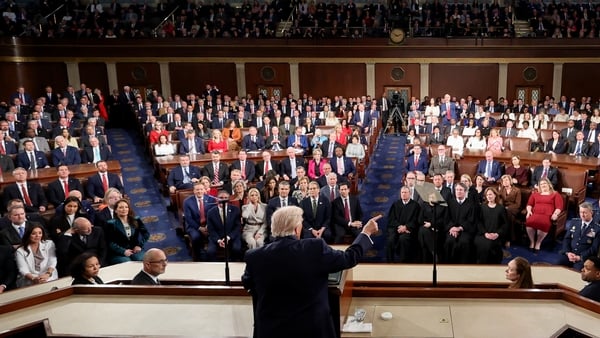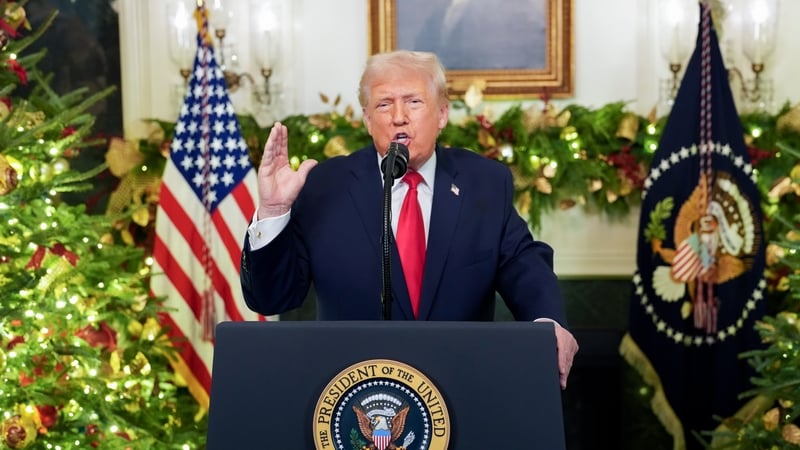

As a political figure, losing the 2020 presidential election was the best thing that happened to Donald Trump. It gave him something that most presidents never get - time.
Time to think, time to plan, time to plot, time to hire, time to decide what he wanted to do.
So he could hit the ground running on 20 January, when he was sworn in as the 47th President on a day so bitterly cold that the usual outdoor ceremony was cancelled.
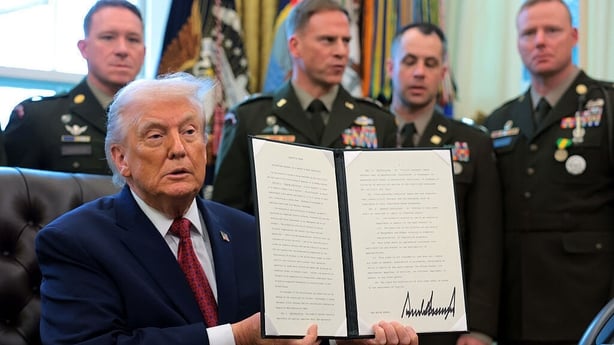
That evening he went to a basketball arena in the city centre and signed 25 executive orders - holding each up for inspection by the cheering crowd - and those watching at home on TV, the mundane business of government transformed into a spectacle for the masses.
At the end of the year, the fifth year of the Trump presidency, he is still running, turning out a phenomenal amount of initiatives, actions, deals and announcements, a veritable torrent of government communications.
That four-year hiatus between 45 and 47 enabled him and his team to learn from the errors of his first four years, reset, restock and bounce back stronger and more impactfully than he could have if he had won in 2020.
One measure, the executive orders (by my count on Christmas Eve), he has signed 223 orders in the 11 months he has been in office this year, that is more than the 220 he had signed during the entirety of his first, four-year term. And that was a record setting high for recent presidencies.
The pace of activity has been incredible: if you can't keep up, do not worry, you are not alone.
Early on, reporting the Trump presidency was likened to trying to take a drink from a fire hose. A refinement to that from a colleague at a news agency: a fire hose that has broke free from the grip of the fire crew and is spraying and thrashing around like it has a mind of its own.
But it's not crazy - it's a plan. The "Flooding the Zone" tactic helps to disrupt opposition, and camouflage both the next moves, and the bigger strategic picture of what Mr Trump is up to.
Here are a few thoughts on the latter.
Presidents have to load up the agenda at the start of their term, it's when the energy is highest, and they are often supported by their party winning in Congress, giving a two year legislative window, before midterm elections usually rein the president in, the system of checks and balances in the US Constitution reasserting themselves to keep the ship of state on an even keel.
But on this voyage, with its rare four-year preparatory time, the course is much more radical, the departure from what is normal much more severe.
So much so that it has become perfectly normal among observers of US politics to wonder if this presidency has bent the system of checks and balances beyond repair.
The US Constitution says the Congress is the first organ of government, but the Trump White House has accumulated so much power that neither Congress nor the Supreme Court have done much checking and balancing at all in 2025.
Which makes it more likely the shift in power to the White House becomes permanent.
It is not just the whims of President Trump: the power shift has been underpinned by a theory - the Unitary Executive Theory - a once fringe idea that the president actually has much more executive power than previous constitutional practice over the past almost two-and-a-half centuries would admit.
It is the alliance of this theory with a president of titanic ego and ambition, backed by a staff of true believers and a ready made programme for government, that has made such an impact now.
Make no mistake, year five of the Trump project has been far more consequential than the first four.
While they were marked by chaos and incompetence, a lack of focus and lack of execution, this past year has been almost - almost - the mirror opposite: very focused, quite disciplined, quick to fill political offices, slow to fire political officers, a coherence of plan, a cohesion in its execution.
The Administration
The writer Gore Vidal described the US as "the most Roman of Republics". But the past 11 months it has looked and felt a lot more overtly Roman Empire.
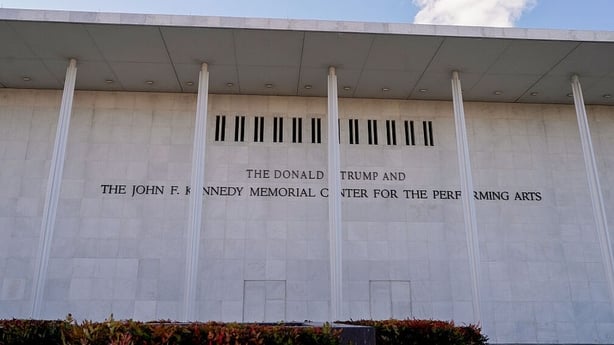
From the ever increasing gold bling in the Oval Office, to the military parades, the Triumphal Arch being built in front of Arlington Cemetery, the new "Trump Class" warships for the Navy, to renaming Washington DC's concert and theatre venue 'The Donald J Trump and John F Kennedy Memorial Center for the Performing Arts', to the incessant quest for a Nobel Peace Prize and the perpetual fawning from a whipped and beaten Republican Party in Congress, this really does look like an "Imperial Presidency" (to borrow the title of a book on the Nixon Presidency by former JFK staffer Arthur Schlesinger).
And as Emperors have left behind monumental works, so too has Trump 47.
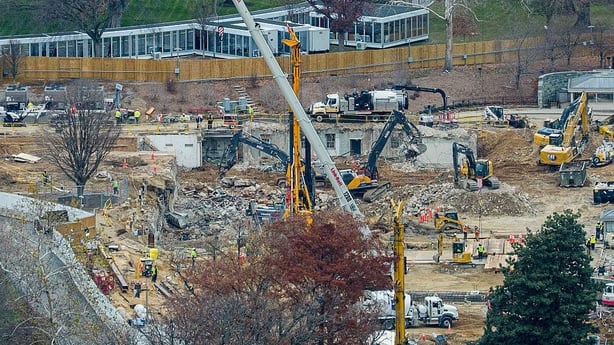
The ballroom at the White House, on the grounds of the old East wing, is proceeding apace. It is a badly needed addition to the Executive Mansion, the existing East Room is simply too small for modern needs.
The last St Patrick's Day event Joe Biden held there was dangerously overcrowded.
It's unlikely it would have been built if the president did not have the luxury of time to contemplate and plan for it in that four-year period between terms of office: incoming presidents do not know any better, second term presidents do not have the time to plan for it, and no predecessor has had the sheer neck to just press ahead and do it.
The president has placed much emphasis on gaining, using and demonstrating power.
His basic idea is that peace and prosperity are best served by a strong US with a strong leader who is not afraid to use the power at his disposal. The propaganda of the deed - and propaganda in support of the deed - are very important to him and his concept of US power.
The application of this concept of government can be seen clearly in the clampdown on migration.
The southern border has been shut, people are just not coming in anymore, and immigrants who are here are "self deporting" rather than risk the more severe treatment that awaits them at the hands of ICE - the Immigration and Customs Enforcement agency, rapidly growing, stuffed full of cash and well on its way to becoming the biggest US law enforcement agency by number of officers.
That has been augmented by the deployment of troops from the National Guard to the streets of a few cities.
Read more: Eight hundred National Guard troops mobilised for DC - Pentagon
In truth they have little to do, but the image of camouflage-clad soldiers on the streets has gone viral, signalling a new, tougher approach to law and order in general, and immigration law in particular.
But it is the speed with which people have stopped coming here that is most noticeable. Not because there has been massive sweeps, but because the sweeps that have taken place in LA, Chicago, and New Orleans have been accompanied by lots of social media video, protests and news coverage which have gone around the world, discouraging people from coming here. Which was the plan.
Yes, there have been casualties, some US citizens have been deported, others gassed, shot or beaten by ICE agents. The maximum security prison camps in El Salvador where alleged gang members have been deported to are shocking places. The administration argues it has no choice but to be rough and ready with its actions to get the results it - and the people who voted for it - want.
War and peace
The bombing of Iranian nuclear facilities may also be a case of the propaganda being more important than the deed.
It is hard to know what the military effect has really been, were the facilities really destroyed as the president claims? Does it suit the Iranians to go along with it to buy time for the regime?
Will it prove to be a positive, low death toll, turning point in the Middle East? That region was the great foreign policy success of the first Trump administration, and he is carrying on with his ambitions for regional peace and prosperity, coupled with a strategic retreat by the US, no longer needing Middle Eastern oil for itself or close allies.
Israel's military and economic strength, and better relations with key Arab neighbours provide a way out for the US. But the ghastly realities of Gaza, and recovering Iranian strength mean the US is not out of it yet, and the next three years of Middle Eastern diplomacy will test the Trump regime and its legacy.
As will Ukraine, Russia and the relationship with Europe. This is under great strain over Ukraine, Greenland and the EU’s regulatory power, especially over the Digital space and is an issue that has led the US to sanction a former EU commissioner and four other Europeans.
The seemingly incoherent approach to the EU, Russia and Ukraine, and much of the rest of the world, was crystalised in the Administration’s National Security Strategy, published in November.
It profoundly shifts US foreign policy away from decades of post war, and especially post-cold war, practice.
The document states: "Our elites badly miscalculated America’s willingness to shoulder forever global burdens to which the American people saw no connection to the national interest. They overestimated America's ability to fund, simultaneously, a massive welfare-regulatory-administrative state alongside a massive military, diplomatic, intelligence, and foreign aid complex.
"They placed hugely misguided and destructive bets on globalism and so-called 'free trade' that hollowed out the very middle class and industrial base on which American economic and military pre-eminence depend. They allowed allies and partners to offload the cost of their defence onto the American people, and sometimes to suck us into conflicts and controversies central to their interests but peripheral or irrelevant to our own.
"And they lashed American policy to a network of international institutions, some of which are driven by outright anti-Americanism and many by a transnationalism that explicitly seeks to dissolve individual state sovereignty.
"In sum, not only did our elites pursue a fundamentally undesirable and impossible goal, in doing so they undermined the very means necessary to achieve that goal: the character of our nation upon which its power, wealth, and decency were built," the document added.
Mr Trump’s stated mission now is to "correct" that course.
The EU is seen as being in the way of much of it, so it gets a four page bashing in the strategy: Russia, which launched and sustains the biggest war in Europe since World War II, is mentioned in a line, saying the US interest is strategic stability between Europe and Russia.
'Soccerisation' - the FIFA effect
Another benefit of losing in 2020 is that Mr Trump gets to be the president when the US (along with Canada and Mexico) hosts the World Cup this coming summer.
He is smart enough to recognise the potent global force that soccer is, and harness himself to it for domestic and global effect (much like Silvio Berlusconi, another billionaire turned politician did in Italy decades ago).
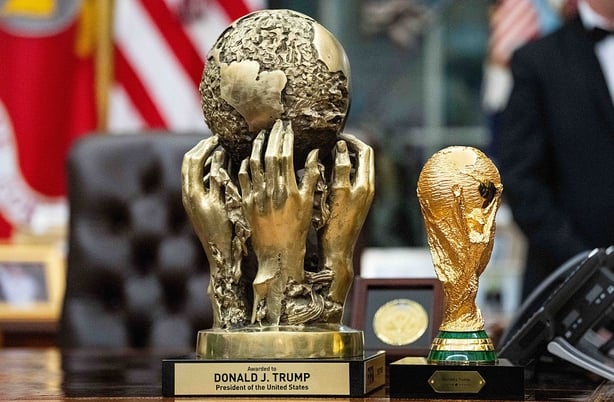
FIFA boss Gianni Infantino has encouraged Mr Trump's desire for attention, letting him keep the World Club trophy in the Oval Office, awarding the president a newly minted FIFA peace prize at the World Cup draw in the Kennedy Center (before the name change) and turning up at the signing of the Gaza peace deal in Cairo, along with 20 heads of state and government.
Soccer is now well established in the US, and being so closely associated with the sport in the coming year will do Mr Trump no harm.
It will be worth watching how that relationship evolves (especially as Mr Infantino has engineered Saudi Arabia's hosting of the event in 2032).
The 'soccerisaton' of Trump is another sign that his is a far from normal US Presidency, but it chimes with British radio Host James O’Brien's idea of the "footballification" of politics, where rival supporters stick with their team right or wrong, good or bad: objective performance matters less than identifying as part of the club, and therefore different from the other lot.
Politicians who pull off the same feat can count on a loyal base who will often vote for them regardless of the personal cost in money or lifestyle.
Tariffs
Take the domestic reaction to the imposition of tariffs on imports from around the world.
The president tells the people tariffs are good for them, as they bring large sums of money into the Treasury. Economists believe tariffs drive inflation up, raising prices for consumers, who ultimately bear the cost of the tariffs, which are a tax on consumption.
Sometimes businesses absorb some of the cost in order to preserve or create market share.
But over time, the end consumer usually pays the cost. The Federal Government needs extra tax revenues to reduce the 6.5% budget deficit that has seen the US national debt surge above 100% of GDP.
How it is sold is the issue. Mr Trump keeps telling the public foreign countries are paying the tariff, and will do so to keep doing business in the US.
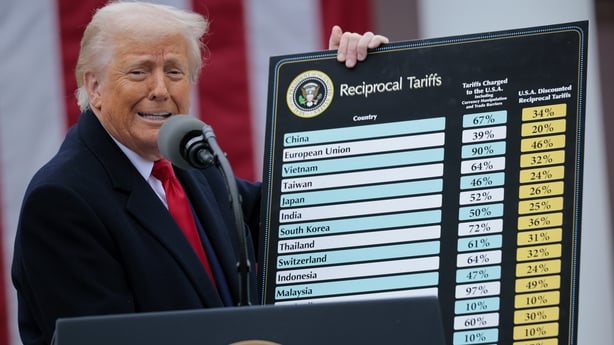
It is true that foreign companies (who actually trade with the US) will pay for market access, up to a point.
What that point is has yet to play out, but prices are certainly not falling for consumers. It is easier to sell when your political base acts like football fans - and your opponents can be cast as fans of a rival club.
The tariffs were the most visible sign of the president's economic policy - again all part of a plan for radical change - that has seen cuts to spending as well as a revenue raise from taxing foreign imports.
The most politically sensitive cut - which came in the so-called 'One Big Beautiful Bill', which turned the president’s programme for government into federal law - was to health insurance premium subsidies from the Affordable Care Act, or Obamacare (for the president who introduced them to try and make health insurance affordable for more ordinary Americans).
The Democrats picked the scrapping of the health insurance subsidies as the hill to fight on in the autumn, forcing a government shutdown for more than a month in order to make a point about the impact of the cuts, which will be felt from 1 January, the day the new insurance premiums kick in.
Read more: Trump signs bill to end record US government shutdown
The US healthcare system is a disaster, the highest amount of health spending in the world resulting in lower than average health outcomes compared to other rich countries.
It is impervious to reform. The president has wrung concessions on pricing out of the big pharmaceutical companies, which will be of some help. But the overall structure is out of control and is not delivering good healthcare for those in the US.
The president starts this new year with the albatross of the Obamacare cuts hanging around his neck, with the Democrats having put it there during the shutdown.
The stupid economy
For all the upheaval of the tariffs, the economy has ended the year strongly, with annualised growth in third quarter GDP coming in at 4.3% in figures released just before Christmas.
Employment is holding up well also, but inflation remains stubbornly high.
The surge in prices are the main political issue for the main street United States. More granular numbers, well below the headline levels, are suggesting a lot of belt tightening among ordinary US citizens, with less shopping, less dining out, even McDonald's is seeing less spending per head among customers.
And the car industry is really hurting. The car, that symbol of US freedom and socio-economic necessity is speeding out of reach of many people.
Again, figures released just before Christmas show that the average new car price in the US has gone over $50,000 (€42,455) - a 33% rise over the past five years.
This has led to consumers taking out longer borrowing terms to try and make the costs bearable , 100 month loans are now being written by dealers to finance car sales. One of them admitted to the Wall Street Journal that the $300 monthly car loan is no longer available, it's more like $700 now.
The affordability crisis in automobiles, essential for getting around in a country built on personal transport, is part of the reason the president scrapped the electric vehicle mandates that had seen the auto industry invest billions in EV production, but still fall further behind China.
It is just cheaper to build petrol driven cars in the US and Europe, which followed suit at the last EU council in December, abolishing the 2035 deadline for ending sales of internal combustion powered cars.
Ford Motor Company wrote off $19.5 billion in investments in electric vehicles, but said it was delighted the president has scrapped supports for the Electric Vehicle industry: it sees its future in producing hybrid vehicles.
The vast size of the US militates against the rapid rollout of EV infrastructure, data centres want the electricity, and the oil industry, newly liberated by the president’s mantra of "drill baby drill", is moving to establish US energy dominance based around fossil fuels.
And that is also shaping the strategic outlook of US diplomacy - from the Middle East and Europe, where it is getting out, to China - a rival that has achieved dominance in EV’s and their supply chain, to Latin America, and the "Trump Corollary" to the "Munroe Doctrine", as set out in the National Security Strategy.
Narco-diplomacy
The National Security Strategy (NSS) revives the early 19th century concept of the Munroe doctrine, keeping European powers from meddling in Latin America, with a new take - keeping China out too, by stopping it getting military bases or control of strategic assets and minerals in South America.
In short, it is going to be a much more assertive White House when it comes to Latin America.
The immediate consequences of that plan can be seen in the growing confrontation with Venezuela, ostensibly over drugs, but actually seeking regime change.
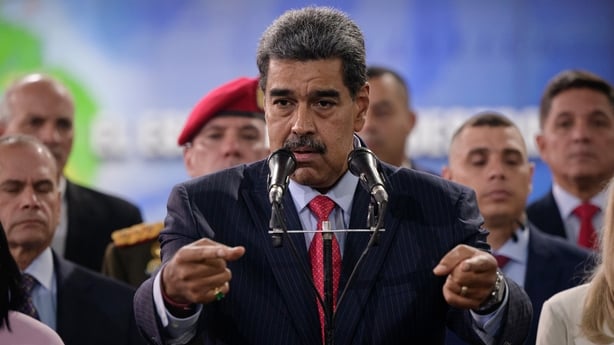
But it is also the guiding light for policy towards Mexico on migration, the drug fentanyl and the growth of Mexican industry as a tariff-free way into the US for Chinese car companies in particular, but a lot of other medium value Chinese goods, such as steel.
Mr Trump calls it 'America First', a policy aim of strengthening the US domestic economy and society, by shoving other countries around if necessary, with tariffs the preferred method, but cutting off military aid (such as the case with Europe and Ukraine), if needed, and bombing if absolutely necessary (such as Iran and Venezuela).
The money
Forbes Magazine has been tracking Mr Trump's wealth for decades. It estimated his wealth in September at $7.3 billion. It was just over $4 billion before he won the election. The three billion surge in his wealth is mostly down to cryptocurrency, with the Trump Family launching and partnering with several crypto ventures, having been heavily backed by crypto firms during the election campaign.
Since election day, the value of the Trump's wealth has increased by 70%. Stock in Nvidia, the manufacturer of the most advanced microchips for the AI industry and the world's most valuable company, has gone up by 35% in the same period.
Mr Trump's sons have done even better, again from Cryptocurrency ventures. Forbes estimated Eric Trump's wealth had increased from $40 million last year to $750 million in 2025.
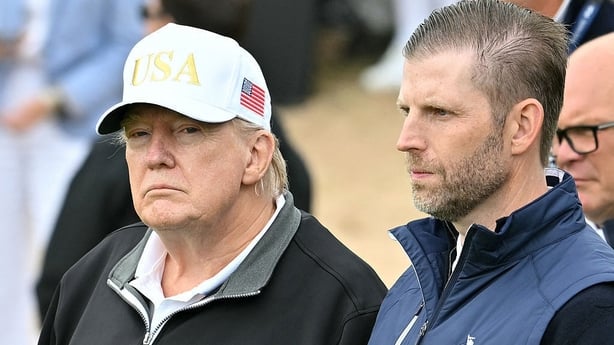
Don Junior went from $50 million in 2025 to $500 million in 2025, while 19-year-old Barron Trump pocketed $80 million, and still holds other crypto assets that give him a net worth of $150 million.
The media and the message
The media landscape - so vital to communicating the president's agenda - has shifted very significantly, and looks set to shift more profoundly.
With a Trump loyalist installed in the Federal Communications Commission, the agency has extended its reach into editorial decision making in ways not seen before, and which could have a long lasting legacy as far as communicating a Conservative worldview is concerned.
Strategic libel actions have helped raise not just $30 million (so far) for Mr Trump and $2 million for his beleaguered lawyers, but they have also given the president big whips to flog major media companies with.
It is not the money that arose from these settlements , the cases do not go to court - the Wall Street Journal and the New York Times are counting on it, probably the BBC as well.
The eye-watering sums sought - $10 billion (€8.5bn) in the case of the BBC for a show not seen in the US, and hardly viewed in Britain, is not the point. It's the control he has gained over the major media outlets.
Take the $15 billion CBS settlement. There was no substance to the claim by Mr Trump of being defamed, but the owner of CBS and its parent company were right in the middle of trying to sell the network and TV studio and associated streaming services to Skydance, a company controlled by the son of tech billionaire Larry Ellison, the founder of Oracle.
That deal needed FCC approval, which put the Trump administration into the equation.
Cash for Mr Trump, and the problem went away.
Ellison’s Skydance now owns CBS and Paramount. It is currently mounting a hostile takeover for Warner Discovery, the combine of a major Hollywood studio with the cable TV and streaming services of Discovery, including news Channel CNN and Home Box Office (HBO), the number three streaming service in the US.
Mr Trump has said he wants to see CNN sold and its current management removed as part of any deal. Watch this space.
Meanwhile, Ellison senior is involved in the consortium bidding to take over TikTok’s US business, and host the social media app on Oracle servers.
Larry Ellison is a firm supporter of President Trump. He is sitting on the verge of owning a massively powerful media combine.
Right now it looks like Mr Trump’s biggest media opponent is Rupert Murdoch, owner of the Wall Street Journal and Fox News, which is an indication of just how much he has come to dominate the media distribution, and through that control content.
It seems a mere afterthought that his own, loss making, social media company, Truth Social, is now valued at about $6 billion (from Crypto and Nuclear Fusion energy tie ups) and is a principle source of administration news distribution.
Happy New Year
But at what point does Mr Trump become a lame duck?
It is the fate of all second term presidents.
At what point does he lose the ability to ram legislation through congress, or bypass the first branch of government altogether by using executive orders? At what point do the legal blank cheques get refused by the Supreme Court, and the president runs out of constitutional road?
Some think he has already entered the domain of the lame duck. The issue they point to is healthcare, and the inability of the Republicans to agree on a reform that they can then take to the Democrats to see if both parties can actually agree to a sensible reform that benefits the vast majority of ordinary US citizens.
The US president appears unable to bully his party into adopting a healthcare reform.
The Democrat's autumn trap is about to be sprung. Everybody knows it.
But still we await the "concepts of a plan" then candidate Mr Trump promised us in the Presidential Debate with Kamala Harris way back in 2024.
Ever since then there has been no agreement in the party about what to do, and so nothing gets done.
The government shutdown of the autumn - the longest in US history - was about getting changes to the consequences of the 'One Big Beautiful Bill', which in crude terms gave tax breaks to billionaires and cut health insurance subsidies for everyone else.
The consequences of that will manifest in the next few days, with a new insurance year starting on 1 January.
The price increase letters have already gone out. The cost always goes up, but the Affordable Care Act subsidies were supposed to make Medical Insurance affordable for ordinary people.
But the subsidy cost is vast, as the constraints on medical inflation are few, and there is no agreement on what to do about them.
It will become a big political issue as the year ahead unfolds, as it could well be the issue that sinks the Republicans in the House of Representatives mid-term election in early November.
Even the Senate majority is being questioned in some quarters, such is the potential threat from the healthcare issue.
That likely loss of control of the House (at the least) will throw a wrench in the president's plans, stalling legislative change (though this president seems to prefer bypassing Congress and using executive orders: they get things done quickly, but can be easily overturned once a new administration gets into the White House, as legislation is more enduring).
It would also shut down various investigations into the president's enemies, that are now being done by various House Committees.
And new investigations into the president and his associates could be launched as a result. It is election time in the US once again, and that argues for a quickening of the pace (if that were possible) of the president's programme, to try and nail down as many points as possible.
Amidst the patriotic celebrations that will mark 2026 - the 250th year since the Declaration of Independence - domestic politics will be roiled by rows over health care costs, affordability of cars, houses and food, and a likely slowdown in the jobs market as AI bites lumps out of the white collar workforce, and there are not enough blue collar skills to met the demand from the data centre boom, which many believe is a bubble which will burst soon.
But Mr Trump is a lucky general - he has seen off challenges that would individually have floored any other opponent - but cumulatively seem to have forged a politician of remarkable strength and endurance.
In June he turns 80, weeks before a massive Fourth of July celebration and a World Cup Final.
Given all that has happened in Trumpland in the past year, anything could happen between now and then.
Literally anything.