
One step forward and two steps back.
For most of this year, that has been the rhythm of the US-led initiative to end the war in Ukraine.
It has been a delicate, frustrating 10-month process for the Ukrainians and Europeans, the latter trying to recalibrate the focus of US proposals, often playing catch-up with the Trump administration's plans.
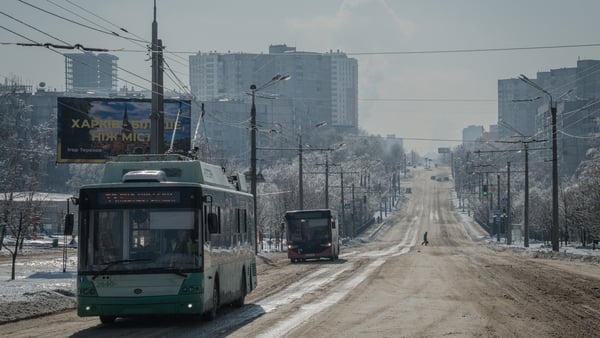
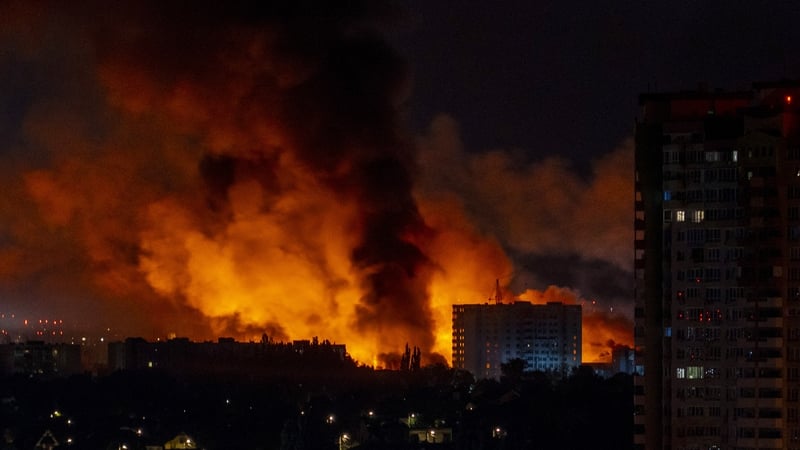
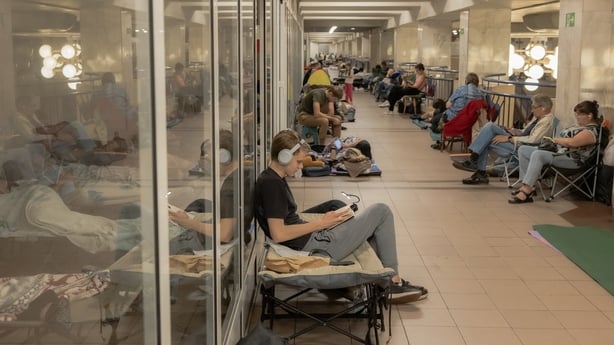
Throughout that time, Russia expanded the scale of its drone and missile attacks on Ukrainian cities and the country's energy grid, meaning many Ukrainians have lived through 2025 on a diet of little sleep.
The country's electricity grid struggles to deliver 50% capacity at times of peak demand and more than six million Ukrainians live without power for 8 to 16 hours each day.
"We don't have electricity, but we don't care. It has the opposite impact," Mykhailo Samus, a Ukrainian defence analyst, told RTÉ News.
Despite "psychological pressures" at night, as Mr Samus described drone attacks, people have adapted, using generators for their heating and lighting needs.
During drone and missile attacks, he descends to a basement car park and tries to get a few hours' sleep in his car.
"A lot of people have explained to [US President Donald] Trump that he should push and press on [Russian President Vladimir] Putin, instead of trying to find weak points in Ukraine's position, but at least Trump tried to do it," said Mr Samus, director of Kyiv's New Geopolitics Research Network, a think tank.
"My forecast is that Putin will continue this war, at least till the end of the winter."
No doubt the stop-start nature of negotiations has been frustrating for American officials too.
They have pushed this process along, sometimes undiplomatically, sometimes unconventionally and often with far too much deference for Russian demands.
Communication between US and Russian officials has been too cosy at times, as evidenced by the leaked transcripts of phone conversations between US Special Envoy Steve Witkoff and Yuri Ushakov, a senior Russian foreign policy advisor.
And throughout the 10-month process, the direction of American pressure has been decidedly placed on Ukrainian President Volodymyr Zelensky and his officials to sign a peace deal, and not Russia.
Nonetheless, the US has developed a process with Russia that did not exist a year ago, though it is difficult to strictly label it as a peace process yet.
US officials, namely US Secretary of State Marco Rubio, showed more flexibility towards Ukraine's concerns as the year progressed. That is due to European lobbying and more nuanced diplomacy from Ukraine after the disastrous meeting between Mr Trump and Mr Zelensky at the Oval Office last February.
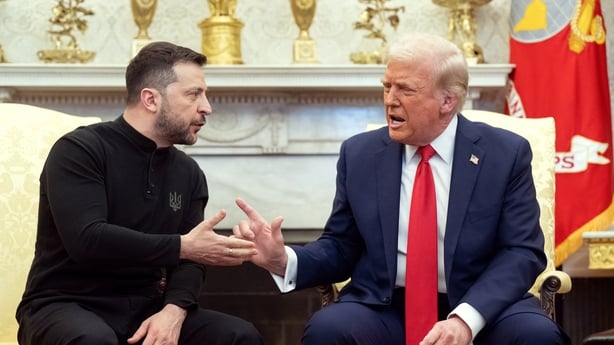
Since then, Ukrainian officials have never missed an opportunity to thank Mr Trump and his administration for all their work to bring about an end to the war.
Ten months after the US president picked up the phone and called Mr Putin, it appears that US, Ukrainian and European officials are getting close to a draft peace proposal that could be acceptable to Kyiv.
The key issue remains territory and Russia's demand for Ukraine to withdraw from unoccupied Donbas.
But giving up territory is a red line for Ukraine and one that Mr Zelensky cannot sign off on himself.
Any such change to Ukraine's 1991 internationally recognised borders would require a vote in parliament and a change to the country's constitution. It would be a divisive and lengthy process with no guarantee of majority support.
Mr Trump's push to end the war has also galvanised European countries to work together and ensure that Ukraine is not sold an unfavourable peace.
They know that a bad peace for Ukraine could also put European security at risk in the years ahead.
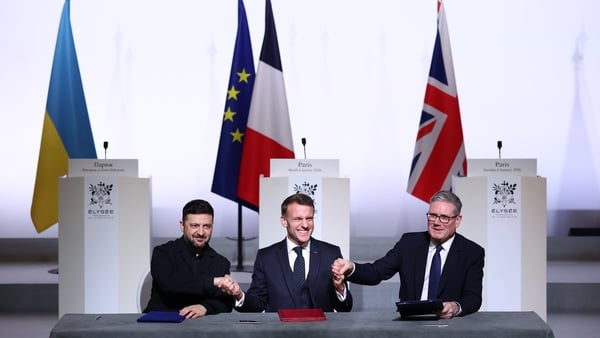
Europe's response has included the formation of the Coalition of the Willing, a British and French-led initiative of more than 30 countries set up to monitor an eventual ceasefire in Ukraine – a proposal that Russia opposes.
Getting the Kremlin to compromise on its demands remains key to resolving the impasse, as it has been all year.
Between March and August, Russia repeatedly declined a US proposal for a ceasefire whereas Ukraine was quick to give its support to the idea of starting a ceasefire first, followed only then by negotiations on the major issues of territory, NATO membership and security guarantees.
Mr Putin's key demands for ending the war remain the same as when he first outlined them in June 2024: Ukraine to cede the rest of Donbas, official recognition of Russia's annexed territory, no NATO membership for Ukraine and limits to be imposed on the size of Ukraine's armed forces.
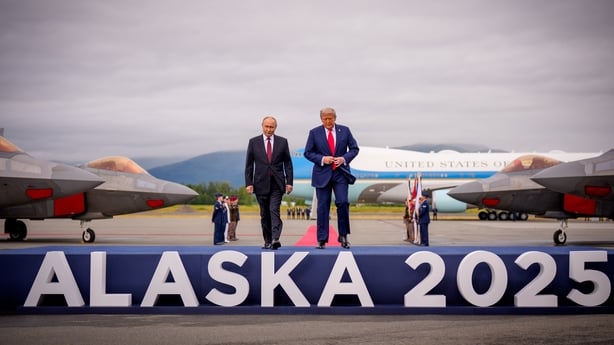
Yet, the Kremlin maintains that European governments are to blame for the impasse, for derailing whatever was agreed by Mr Putin and Mr Trump when they met in Alaska for a brief and inconclusive summit in August.
As the year progressed, Mr Putin's ire towards European leaders increased too. Earlier this month, he referred to them as "swine" in a speech.
He has always seen Ukraine within Russia's sphere of interest and views the resolution of the conflict as something Europe should not have a hand in. His meeting in Alaska with Mr Trump was evidence that he is only prepared to discuss the resolution of the war with the leader of another big power.
Another notable development in recent weeks has been Mr Putin's increased obsession with propagating a fake, counter-narrative that Russia did not start the war, and that its full-scale invasion of Ukraine in 2022 was a response to, what he perceives as, the West's threat towards Russia – by this, he means NATO's expansion eastwards from the late 1990s onwards. This piece of propaganda is now becoming the Kremlin's official history of the war in Ukraine.
It is telling that while Mr Zelensky spent the last few weeks of this year on a whistle-top tour of European capitals, including Dublin, to shore up diplomatic support for Ukraine, Mr Putin held more meetings with his senior military commanders than usual, donning military fatigues.
It shows that the Russian leader still prioritises waging war, or, at least, wants to project an image to the outside world that Russia's invasion is unstoppable.
"The goals of the special military operation will be achieved unconditionally," Mr Putin told a meeting of senior Russian military commanders in Moscow on 17 December.
"If [Ukraine] does not want to have a substantive discussion, then Russia will liberate its historical lands on the battlefield."

Such statements gave the clearest indication since the publication of a leaked US-proposed 28-point peace plan that Russia's leader will not concede on any of his demands and that he intends to pursue his war goals until the end.
That end goal could mean occupying all of Donbas, or going further, dismembering the Ukrainian state entirely, which was the original goal of Mr Putin's 'special military operation'.
Even the 28-point peace plan, a Russia-friendly document drummed up by Mr Witkoff and Russia's investment envoy Kirill Dmitriev, does not go far enough to satisfy the Russian president.
The plan "could form the basis for a final peace settlement," said Mr Putin. It was hardly a ringing endorsement.
Such remarks make the odds of Europe and Ukraine's revised 20-point plan, worked out in conjunction with Mr Rubio, Mr Witkoff and Mr Trump's son-in-law Jared Kushner, even less likely to be considered by the Kremlin.
Many analysts have concluded at various points in the process that the Russian leader has been playing for time, to keep the war going while his forces make more incremental gains, which plays into the Kremlin's narrative of a Ukrainian frontline defences that is on the verge of cracking.
Take the three rounds of mid-level talks in Istanbul between Russian and Ukrainian officials, brokered by the US and Turkey during the summer.
Those talks were the result of an offer in May from Mr Putin for direct negotiations with Ukrainian officials, which torpedoed another US ultimatum for a ceasefire and a European threat to impose new sanctions on senior Russian officials.
The world's press awaited to see if the Russian and Ukrainian leaders might meet in Istanbul. Mr Zelenksy flew to Ankara for meetings with Turkish officials and said he was ready to meet the Russian leader in Istanbul. Instead, Mr Putin sent a B-team of diplomats, led by a Russian historian whose writing has questioned the existence of the Ukrainian state.
It was a classic case of subterfuge from Mr Putin. Despite the threat of US and European sanctions, nothing came to pass and Russia continued its war.
Three large-scale prisoner-of-war swaps emerged from those talks in Istanbul, just enough to keep the US engaged at the time.
"I think the very fact that the main Russian negotiator is now Kirill Dmitriev is a tactical move, a very smart one from Putin," Pavel K Baev, a political scientist and expert on Russian foreign and security policy, told RTÉ News.
Mr Dimitriev, a graduate of Stanford University who built a successful private equity career in Russia until he became head of Russia's direct investment fund in 2011, would appear to be a natural match for Mr Witkoff, a former real estate developer.
"Witkoff, Trump generally, and Dmitriev, all three, see the war as nonsense, as an anomaly that stands in the way of doing business, as something irrational, something destructive but meaningless," said Prof Baev, a senior professor at Oslo Research Peace Institute.
"For Putin, war is the thing and that is probably the main division in these channels of negotiation, where the tactics suddenly hit the wall of Putin's philosophy, his worldview," said Prof Baev.
Mr Putin met Mr Witkoff six times this year.
Each meeting set off a flurry of diplomatic activity with US officials decamping with Ukrainian and European officials to assess the latest Russian signals.
Yet, Mr Putin has never conceded any ground and so the process continues in a loop.
Throughout the 10-month process, Ukraine has not received clarity on the kind of security guarantee it could expect from the US and its European allies if Russia attacks again.
The security guarantees will be NATO-like, we have heard. But that is still vague.
Mr Zelensky still seemed to think the issue of security guarantees was up in the air when he spoke to reporters in Brussels on the margins of an EU Council summit on 18 December.
"There's a question I still can't get an answer to. Not because someone refuses. We just haven't gotten there yet. The question of security guarantees," said the Ukrainian president.
"I'll only evaluate one thing: what will the United States do if Russia comes with aggression again? What will these security guarantees do? How will it work? How will all partners work together? How exactly will they stop Moscow?"
Those remarks summed up what Ukraine needs in order to sign a peace deal: a solid and clearly written security guarantee from its Western partners that will deter Russia from restarting the war.
Mr Putin's hardline position relies heavily on promoting the message that Russian forces are advancing aggressively on all fronts.
Yet, Russian progress has been modest throughout 2025 and the overall picture of the frontline remains largely unchanged from this time last year.
The Institute for the Study of War, a Washington-based research group, estimates that Russian forces gained 0.77% of Ukrainian territory since the start of 2025 while suffering disproportionately high personnel losses.
A conservative estimate by Mediazona, an independent Russia media outlet, and the BBC's Russian-language service puts the number of Russian servicemen killed this year at 19,000, and 156,000 since the start of the full-scale invasion.
Others like the US-based Center for Strategic and International Studies estimate that close to one million Russian servicemen have been killed or wounded in the war.
Ukrainian drone defences, said Mr Samus, have created a "kill zone" for 20 kilometres.
"Any mechanised units, any tank armour or vehicles will be killed immediately."
This "kill zone", he explained, has reduced Russian forces to sending small groups of soldiers across the frontline on foot, which is an incredibly slow way to conduct modern military operations.
A British ministry of defence report from last August estimated that at the rate of incremental gains made by Russian forces since the start of this year, it would take Moscow more than four years to occupy the territory of all four eastern Ukrainian regions, at the expense of almost two million casualties.
Russia's economic growth slowed this year but its oil exports remain steady so Mr Putin could be banking on continuing a war of attrition for some years to come.
Ukraine is not in that position as 2025 draws to a close. It does not have an unlimited supply of soldiers that it can pay through contracts.
A peace deal still seems far off given that Russia and has hardened its stance and Ukraine is unlikely to yield to Moscow's demand to hand over unoccupied Donbas.
Only the offer of a real US security guarantee is likely to sway Ukraine to make a big concession on territory.
"There might be an opportunity for a pause which Ukraine badly needs, and which Putin might also feel it's about time to take," said Prof Baev.
"In any case, it will certainly not be a beautiful deal, as Trump is certain to call it, but rather ugly and dirty".