Few countries in the world are more vulnerable to the impact of climate change than Bangladesh in south Asia.
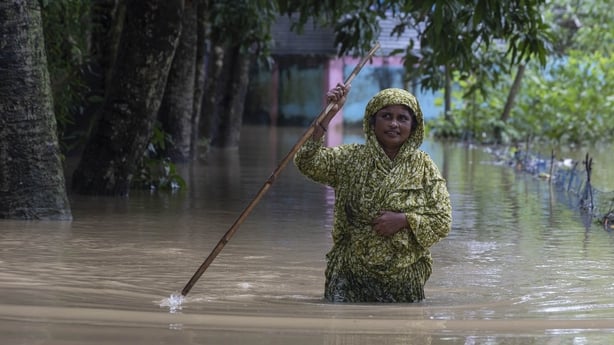
Intensified monsoon floods, riverbank erosion and rising sea levels displace 700,000 Bangladeshis each year.
In the final of our special reports from Bangladesh, reporter Kate Varley and cameraman Bram Verbeke visited Dhaka to hear how the climate migration crisis is shaping the country's capital.
The first time Bizly Begum’s home was swept away by the river, her husband Khairul rebuilt it higher up the bank.
But not high enough.
Twice more the rising waters claimed their modest shelter, as the scale of river erosion in their home region of Bhola accelerated.
Eventually, Bizly and Khairul came to accept that this way of living was no longer sustainable.
And so, they reluctantly packed their bags and moved to Dhaka, the megacity capital of Bangladesh.
2,000 climate migrants each day arrive in Dhaka
They followed a well-trodden path - each day, around 2,000 people make the move to Dhaka to escape the effects of climate change.
They find themselves in a vast, congested landscape of 36 million people, which is constantly expanding upwards and outwards.
Many migrants hope for jobs in the textile industry or other secure employment.
But the reality is often quite different, according to Manish Kumar Agrawal, the Country Director for Irish NGO, Concern Worldwide.
"Many of them have been climate victims…. And they come here in search of a better life and better livelihood," he said.
"However, Dhaka is a highly densely-populated city, so the majority of them end up spending (living) in the slums, which are very, very poor living conditions.
"There is no public supplies in terms of water or education facilities for the children. The housing is very, very cramped."
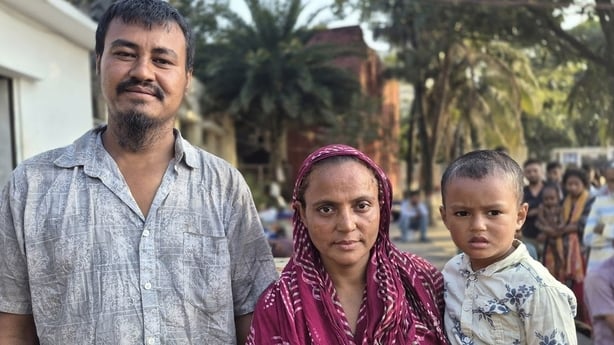
For Bizly, Khairul and their four-year-old son Yeasin, life has been exceedingly difficult in the capital.
They are currently sleeping rough, barely surviving on the margins of a city already over-populated and over-stretched.
Read more:
Trapped and traumatised: Inside the world's largest refugee camp
'Ground zero': Impact of aid cuts on world's largest refugee camp
'Everything in my home is totally gone'
The largest slum area in Dhaka is Korail, a densely-packed maze of tin structures and narrow alleys.
According to the UN Migration Agency, 70% of residents in Korail have fled some sort of environmental shock.
And now they face another.
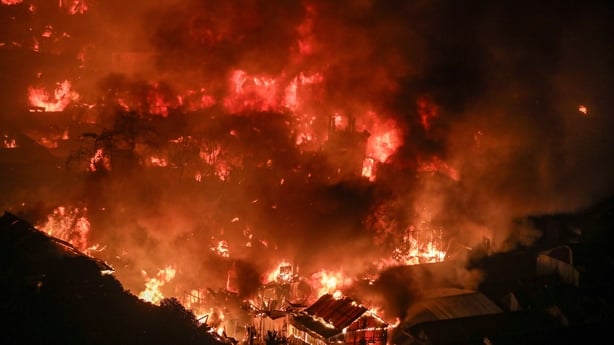
RTÉ News visited Korail the day after a major fire sweeps through the area. No one was injured but thousands have lost their homes. Many were inspecting the charred remains in despair.
Among them is Minu Begum, a mother-of-two, whose one-room home was reduced to ruin.
"When I saw the fire, everything is burning and I ran out with the newborn with me," she tells us.
"Everything in my home is totally gone - all the furniture, all the stuff. I couldn’t even save one dress for my kid."
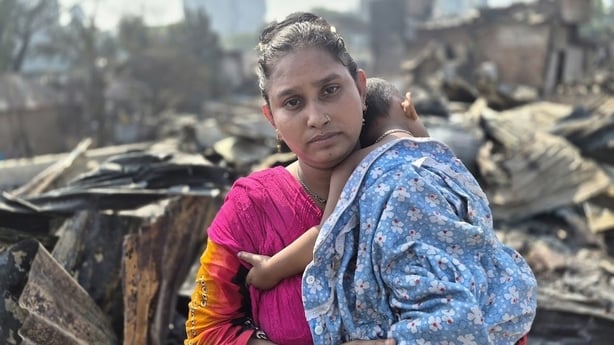
Minu and her family are now receiving emergency support from Concern Worldwide, but it highlights once again the many challenges facing people on the frontline of the climate migration crisis.
And that challenge is only expected to grow.
The government predicts that by 2050, one in every seven Bangladeshi citizens will be displaced by climate change.
For a nation of 170 million people, squeezed into an area only twice the size of Ireland, it raises profound questions about space and resources.