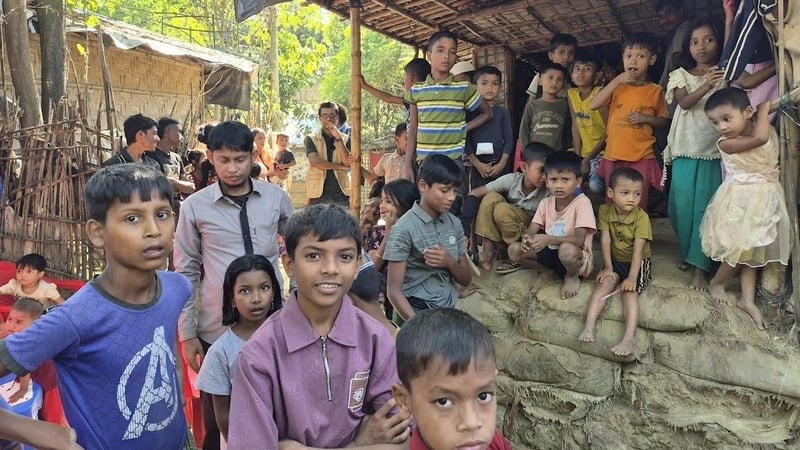
With a population of around 1.3 million people, Cox's Bazar in southern Bangladesh is the largest refugee camp in the word.
For the Rohingya people sheltering there, it is a life suspended between a violent past and an uncertain future - as aid organisations warn that their humanitarian situation is reaching a critical point.
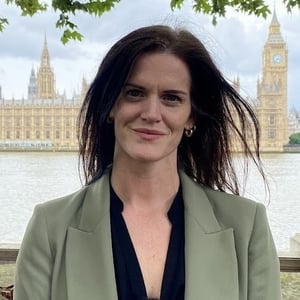
Reporter Kate Varley and cameraman Bram Verbeke visited Cox's Bazar to hear from some of those affected.
In a makeshift bamboo shelter in the hills of Cox's Bazar, Nur Haba carefully unwraps a small bundle of keepsakes.
She wants to show us a photograph of her mother Mariam, who was just 44 years old when her life came to a sudden and violent end in Myanmar in 2017.
"She was shot dead in front of me," Nur tells us.
The faded photo of Mariam is one of the few belongings Nur managed to salvage from her home in Rakhine State before it was set on fire by the military, forcing the surviving family members to flee in terror.
In the chaos that followed, further tragedy struck. Nur’s two-year-old son Mohammed became separated from the family as they attempted to escape across a river.
"He was swept away and drowned," Nur recounts with tears in her eyes.
'The most persecuted minority in the world'
As a member of the Rohingya community - a group described by the United Nations as the "most persecuted minority in the world" - Nur's story is not unique. It is a collective trauma that shapes generations; a shared history of suffering.
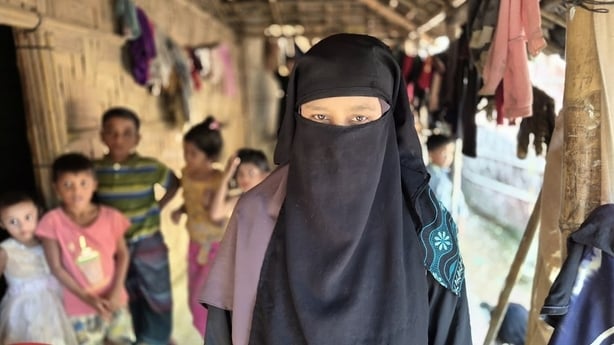
Denied citizenship in their homeland of Myanmar since 1982, the Rohingya have endured decades of discrimination and repression under successive authorities.
The latest wave of violence erupted in 2017 when the military in Myanmar, backed by local Buddhist mobs, attacked the predominantly Muslim Rohingya in Rakhine State.
It was a campaign of killing, arson, torture and rape that was later labelled as a "textbook case of ethnic cleansing" by UN human rights experts.
The violence forced more than a million people, like Nur, to escape into neighbouring Bangladesh.
Now they remain trapped in Cox’s Bazar - the world's largest refugee camp, hosting the world's largest stateless community.
Watch: Life inside world's largest refugee camp
Cramped and crowded conditions
One of the major challenges facing the Rohingya in Cox's Bazar is overcrowding, with 1.3 million people living in cramped, often unsanitary, conditions.
"It's unimaginable in such a small area," says Manish Kumar Agrawal, the Bangladesh Country Director of Irish humanitarian organisation, Concern Worldwide.
"The population density in the refugee camp is 45,000 people per square kilometre, and if I can put that into the perspective, Ireland has 73 people per square kilometre. So we're talking about people living in such a congested environment, and 75% of them are women and children."
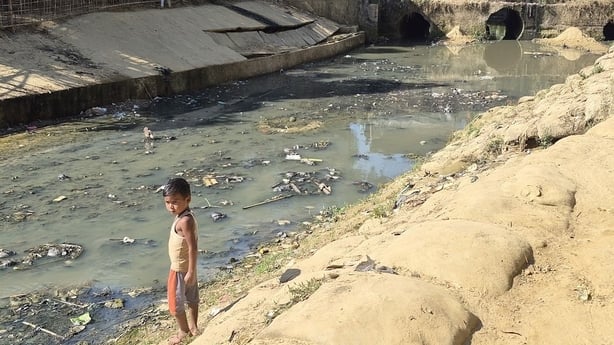
Because of the overcrowded and unhygienic conditions, disease and infections spread quickly through the camp.
Over the past year there have been multiple outbreaks of cholera and dengue fever, plus spikes of severe diarrhoea.
The Rohingya are also at the mercy of extreme weather events, as described by UN Secretary-General António Guterres, who visited the camp earlier this year.
"These camps - and the communities that host them - are on the frontlines of the climate crisis," he said.
"Summers are scorching, and the chance of fires skyrocket. In the cyclone and monsoon seasons, floods and dangerous landslides destroy homes and lives."
It is now the dry season in Bangladesh, but evidence of those extreme weather events are still visible across the camp.
Several hills remain scarred by mud and debris, where shelters were flattened and their inhabitants displaced once again.
For 23-year old refugee Aziz Ullah, who also fled Myanmar in 2017, the camp presents a range of challenges.
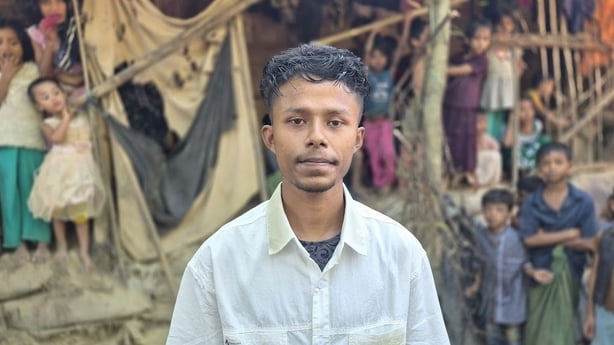
"(In the) hot seasons, we have difficulty to drink fresh water. We are also facing the (lack of) warm clothes in the winter season, and in the rainy season the landslide and the flooding.
"I’m thinking of the people of my community, the young generation - the future is absolutely dark," he said.
Kidnappings, gang violence and armed clashes
The Rohingya do not have the right to work outside the camp, or move freely. Most are entirely dependent on humanitarian aid.
That includes "food, water, shelter, health, everything", according to Manish Kumar Agrawal.
"It means they are not constructively engaged in anything. They are just sitting idle. And that creates huge potential for protection risk."
In recent years, there have been multiple reports of kidnappings, gang violence and armed clashes inside the camp, while sexual exploitation is also a concern.
Exodus continues
As fighting continues across the border in Myanmar, so too the exodus.
Humanitarian agencies estimate that around 150,000 Rohingya have arrived in the past year alone, putting further pressure on aid and resources in the crowded labyrinth of Cox’s Bazar.
Bangladesh has also warned that its capacity to support the Rohingya is reaching its limits.
"Bangladesh is a small country, it is also a land-hungry country.
"So our main target or task is to send (them) back to their country," said Shamsud Douza, a Bangladesh government official overseeing refugee affairs.
He did however acknowledge that mass repatriation is currently unlikely due to the security situation in Myanmar.
For the Rohingya, it means life will remain on hold for now.
Trapped in the world's largest refugee camp, where they are increasingly invisible to the world.