


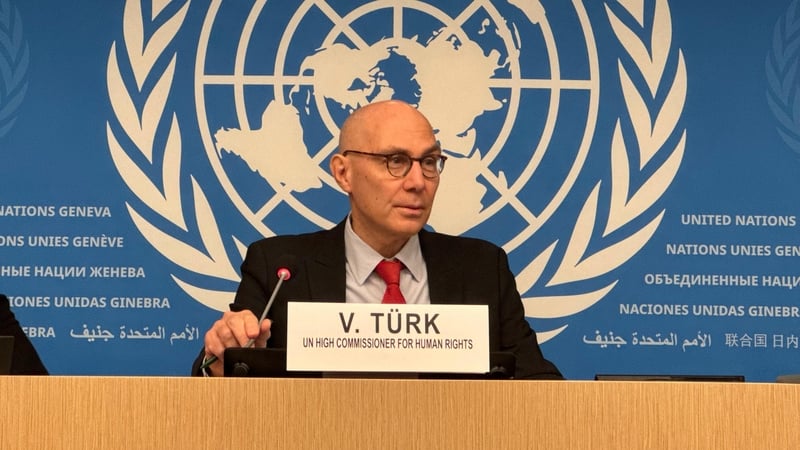
United Nations High Commissioner for Human Rights Volker Turk has said that his office is in "survival mode" due to major funding cuts from global donors, while rights violations and needs in conflict-affected areas increase.
"Our resources have been slashed, along with funding for human rights organisations - including at the grassroots level - around the world.
"We are in survival mode," Mr Turk told reporters.
The Office of the United Nations High Commissioner for Human Rights (OHCHR) has around €77m less in funding than it needed this year, which resulted in 300 job cuts, directly impacting the office's work, he said.
"Essential work has had to be cut, including on Colombia, the Democratic Republic of the Congo, Myanmar, Tunisia and other countries at a time when the needs are rising."
Mr Turk said that country visits by United Nations' special rapporteurs, who are independent experts, as well as investigative missions by fact-finding bodies have been reduced, while dialogues with states on their compliance with human rights treaties have had to be postponed.
"All this has extensive ripple effects on international andnational efforts to protect human rights," Mr Turk said, pointing to grave human rights concerns in Sudan, Gaza and Ukraine.
"I am extremely worried that we might see in Kordofan a repeat of the atrocities that have been committed in Al-Fashir," he said, referring to the conflict in Sudan.
Sudan's paramilitary Rapid Support Forces took over the city of Al-Fashir in late October in one of its biggest gains of the two-and-a-half-year war with Sudan's army.
This month, advances have continued eastward into the Kordofan region, and they seized the country's biggest oil field.
Russia's increased use of powerful long-range weapons had driven a sharp rise in civilian casualties in Ukraine - with these rising 24% from the same period last year, he said.
