


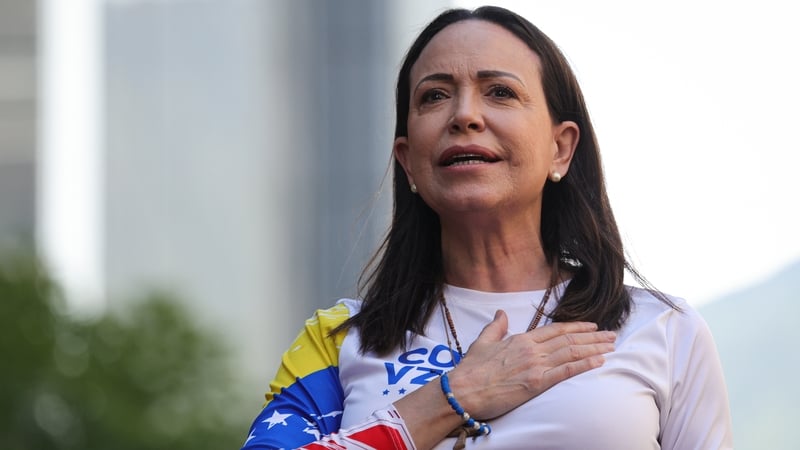
The daughter of Venezuelan opposition leader Maria Corina Machado, who lives in hiding, has accepted the 2025 Nobel Peace Prize on her behalf at a ceremony in Oslo.
In a call with the chair of the Nobel Committee published just before the ceremony, Ms Machado said she was "very sad and very sorry" that she would not make it in time, while stressing that she was on her way and that there were "so many people that risked their lives in order for me to arrive in Oslo".
She is "safe" and is expected to arrive in Oslo by tomorrow at the latest, the Nobel Institute said shortly before the ceremony was to begin.
Ms Machado won the Nobel for challenging Venezuelan leader Nicolas Maduro's grip on power.
In her speech, delivered by her daughter, Ms Machado condemned the "state terrorism" of the Venezuelan government.
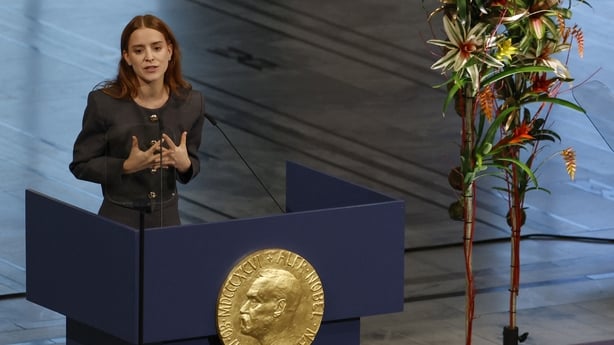
She noted that 2,500 people had been "kidnapped, disappeared, tortured" under the rule of President Maduro.
"These are crimes against humanity, documented by the United Nations. State terrorism, deployed to bury the will of the people," he daughter, Ana Corina Sosa Machado, said.
Ms Machado's presence in the Norwegian capital could put her at risk of arrest if she tries to re-enter Venezuela, which has said it will declare her a fugitive if she leaves the country.
Ms Machado's mother and three daughters, and some Latin American heads of state, including Argentine President Javier Milei, are in Norway for the prize-giving at Oslo's City Hall.
While organisers said Ms Machado had previously indicated she would attend, doubts had already been raised when a traditional press conference with the award winner yesterday was first postponed and then cancelled.
Ms Machado has accused Maduro of stealing Venezuela's July 2024 election which she was banned from.
Her claim is backed by much of the international community.
Ms Machado has been hailed for her efforts in favour of democracy, but she has also been criticised for aligning herself with US President Donald Trump, to whom she has dedicated her Nobel.
The Oslo ceremony coincides with a large US military build-up in the Caribbean in recent weeks and deadly strikes on what the US says are drug smuggling boats.
Mr Maduro insists that the goal of the US operations - which Ms Machado has said are justified - is to topple the government and seize Venezuela's oil reserves.
Since going into hiding, Ms Machado's only public appearance was on 9 January in Caracas where she protested against Mr Maduro's inauguration for his third term.
The opposition claimed its candidate, Edmundo Gonzalez Urrutia, won the election. He now lives in exile, and was also in Oslo today.
Multiple other Nobel Peace Prize winners have been unable to collect their prizes in person. Family members usually do so on their behalf, Mr Harpviken explained this week.
Doubts had been raised about how Mr Machado would return to Venezuela if she made the trip. Her refusal to leave the country has helped boost her political power there.
"She risks being arrested if she returns even if the authorities have shown more restraint with her than with many others, because arresting her would have a very strong symbolic value," said Benedicte Bull, a professor specialised in Latin America at the University of Oslo.
On the other hand, "she is the undisputed leader of the opposition, but if she were to stay away in exile for a long time, I think that would change and she would gradually lose political influence," she added.
Both pro- and anti-Machado protests are expected in Oslo.
The Nobel laureates in medicine, physics, chemistry, literature and economics will receive their prizes at a separate ceremony in Stockholm.
