
'Japa' means to split, or to leave in Yoruba, an ethnic group in West Africa, prominent in Nigeria.
While emigration has long been a factor of modern Nigerian life, Japa has become a cultural phenomenon.
Despite a growing economy, more than half of Nigeria's population lives in poverty so emigrating is not an option for everyone, and those that do leave, often risk their lives doing so.
Juliette Gash and cameraman Mark Ronaghan travelled to Lagos with the assistance of the Simon Cumbers Media Fund to report on Japa syndrome.
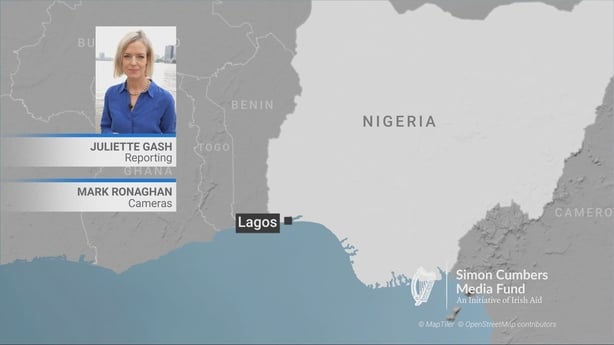
Nigeria is booming, its economy predicted to grow this year and next, and it has a vast and young population.
In stark contrast to European demographics, Nigerians are overwhelmingly young.
With a population of over 230 million people, the median age is 18, and more than two thirds are under 30 years of age.
But Nigeria is also suffering from mass emigration, with millions leaving every year.
Dr Tunde Alabi from the Department of Sociology at the University of Lagos, or UniLag, says that it is hard to find accurate statistics on migration, as there is a lot of irregular migration through north Africa, via the Sahara, which is not easy to measure.
But he says that "definitely, the emigration rate in Nigeria is increasing".
He gives the health sector and academia as areas where many professionals are leaving.
It has become such a cultural phenomenon, that it has even got its own nickname - 'Japa'.
Dr Alabi, who did his PhD on the Japa phenomenon, says the name comes from Yoruba slang for leaving, Yoruba being one of the main ethnic groups in West Africa.
He says the term originally meant to quit, to leave and never return, but it is not always that simple.
'I thank God I'm still alive'
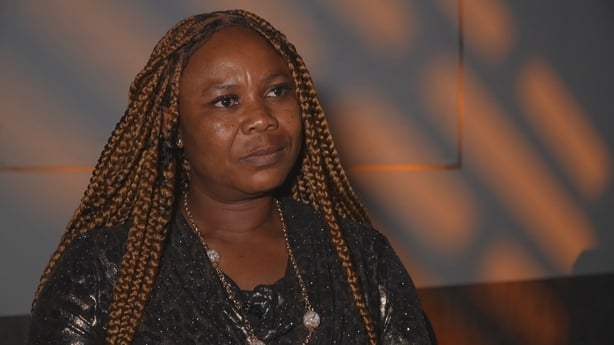
"There were a lot of dead people in the Sahara Desert," Sylvia says, recounting the second time she tried to get to Europe.
"We lost a lot of people.
"Some were dead, when we were in the Hilux driving, even if someone fell, they would not wait for them."
In 2007, Sylvia decided to leave Nigeria, after her parents died.
She had a friend who told her about Norway, so she tried her luck and made it to Madrid using someone else's passport.
She went north on various buses, eventually arriving in Oslo.
She was brought to a refugee camp, but she absconded, eventually striking up a friendship with a Norwegian man.
She moved in with him and after about a year, they decided to get married.
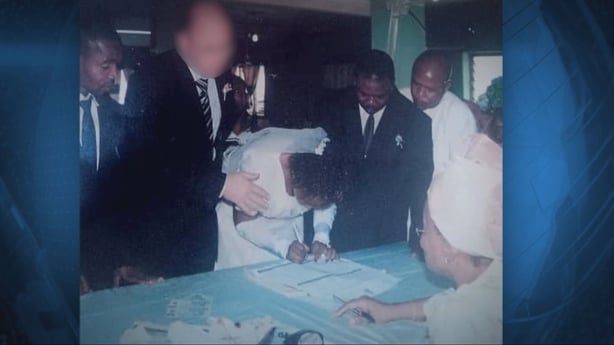
The couple got married in Lagos, where Sylvia then applied for a visa, but officials said they thought it was, in her words, "a contract marriage".
Her husband eventually went back to Norway, and the pair stayed in regular contact.
But after a year without any progress in getting papers, Sylvia decided to take the treacherous route north, paying traffickers to bring her to Libya.
It is over 4,000km from Lagos to Sabha, a common destination for migrants using that route to get to the Mediterranean Sea.
First, Sylvia got to Agadez in Niger, before beginning the perilous journey across the Sahara.
"They said we would leave in the morning, but later they said police people came and that there were a lot of dead people in the Sahara Desert.
"That two, three days, we walked [in] the desert, until they came to take us in the Hilux."
At one point, the traffickers left the group, who were spread out across five or six trucks, for several days to scope out the road ahead, to see if it was clear.
As well as police, the traffickers are wary of kidnappers, known as Asma Boys, who look for ransoms for kidnapped migrants.
"They left us in that hot sun, no tree, no water, and everywhere was really hot. There's no place to get water, our water was finished, so people were just fainting."
She falters while telling the story, the recollection clearly affecting her, and says that the group had to resort to drinking their own urine.
The traffickers eventually returned, and the group, minus the people who died en route, made their way to Sabha.
After several months there, Sylvia says they got to the Mediterranean Sea, near Sabratah, where violence broke out.
After a week of gunfire, Sylvia says they got help from the UN, and she was eventually repatriated by the International Organisation for Migration.
She had to start all over again and is finding life difficult in Lagos.
She thanks God that she is alive but will not risk the journey again.
"It's only God that spared my life. I just prayed that if God can bring me back, I can never go on that journey again. The prayer worked for me then."
Asked if she is happy in Nigeria, she takes a breath and says, "I thank God I'm still alive, because some of my friends, we lost them ... but I'm not really happy."
'Please can you help me, don't let them deport me'
Chiutu left Nigeria in 2014, spending five years in Germany.
He flew to Frankfurt on a tourist visa, and applied for asylum there. He says he pleaded with immigration officers not to send him back.
He says he borrowed so much money to get to Germany, that he feared the consequences if he was sent home.
He spent time learning the language, and took classes to become a carer.
This was around the time that Angela Merkel opened up Germany's borders, eventually allowing one million people into the country under the slogan of 'Wir schaffen Das' - loosely translated as 'Yes we can' or 'We can do this'.
Chiutu says he qualified and got a job, but says "I was so unlucky" because he was just one week away from getting residency, when an incident occurred at the nursing home.
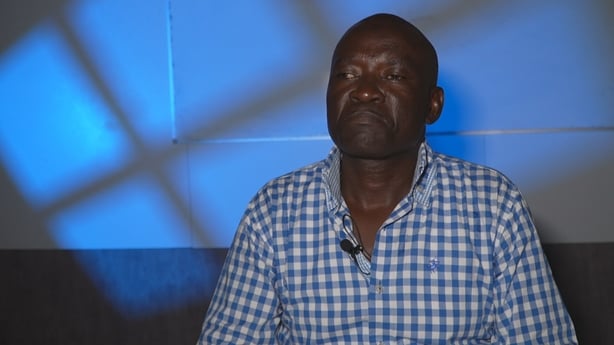
He was working there for 11 months and three weeks, when he swapped shifts with another man.
A patient on his ward had soiled bedsheets and he went to clean them up, but there was a disagreement as to whether the patient was left in the dirty bedclothes.
He was let go from the nursing home and had to get by on casual labour, which he said was exhausting, as it involved so much travel.
After a year of this, he called his wife and said he had to go home.
"I'm coming back, then my wife, she told me I should not come back. I said, 'Don't let me die in this country.' I was so depressed.
"I left my children, over five years of not seeing them. I can't continue life in this country."
He eventually agreed to be voluntarily repatriated to Nigeria, and while he was thrilled to see his family again, he regrets leaving Germany.
Back at the University of Lagos, some of Dr Alabi's sociology students give their thoughts on Japa.
Florence says: "Some just Japa for some safety reasons actually. There's so much insecurity in the country, so some people are scared for their lives."
"I think I would like to Japa at a point but mainly for educational purposes or to pursue work over there, but at a point, I would like to come back to my country," Jaqueline said.
Benjamin would like to visit the UK, where his sister lives, but said he wants to bring that experience of living abroad back home.
It is a sentiment echoed by his classmate Wuraola who said: "I feel like if you want to go there, experience new things, you should come back and improve, like this is your country, there's no place like home."
Favour sees Japa as both positive and negative. "In the sense that due to the fact of the economy in Nigeria now, a lot of people actually want to leave for greener pastures."
Just like Sylvia, the desire to get to greener pastures is strong for many people.
But Japa is prohibitively expensive and it is a big decision to make.
With 130 million Nigerians living in poverty, it is too much for many, but the lure of Japa can be hard to resist.
Supported by the Simon Cumbers Media Fund